Cat Scratching Post Placement 2026
Why your cat ignores the scratching post - the placement psychology most owners miss, plus material and height rules that actually work.
You bought a cat scratching post. The cat ignored it and went straight back to the sofa. You bought a different post. Same result. After three failures, you concluded your cat just doesn’t use scratching posts - and you started looking at couch protectors, claw caps, or the dreaded option of declaw surgery.
The cat isn’t broken. The post is in the wrong place. Cats don’t choose scratching surfaces based on what humans think is convenient - they scratch where territorial and behavioral psychology tells them to scratch, and some cat breeds are far more enthusiastic scratchers than others. Get the placement right, and almost any cat starts using the post within days.
This guide explains the actual psychology of cat scratching, where posts must be placed to be used, the material and height rules that matter, and what to do if your cat is already attached to your couch as their scratching surface. For more on redirecting unwanted feline habits, see our cat behavior problem-solver.
Why Cats Scratch (And Why You Need to Cooperate)
Scratching isn’t just a claw-trimming behavior. It serves four functions:
- Visual marking - leaves visible signs of territory
- Scent marking - paw pads have scent glands; scratching deposits scent
- Claw maintenance - strips off old claw sheaths
- Stretching - full-body stretch that cats need multiple times a day
These functions explain almost everything about scratching placement:
- Cats want to mark territory in socially significant locations - entrances, sleeping areas, places they use frequently
- They want to stretch after waking up - meaning posts near sleeping spots get used
- They want visibility - a post hidden in a corner doesn’t satisfy the visual marking function
The Three Placement Rules That Change Everything
Rule 1: Place near sleeping spots
The most common time a cat scratches is immediately after waking from a nap. Place posts within 5 feet of the cat’s favorite sleep spots. A post in a different room misses the post-nap scratch opportunity.
Rule 2: Place at room entrances and high-traffic zones
Cats mark territory at boundaries. Doorways, near the front door, at the entrance to rooms where they spend time - these locations satisfy the marking function. A scratching post tucked behind a couch fails the visibility test.
Rule 3: Place near furniture the cat is already scratching
If your cat is scratching the corner of your sofa, place a tall post right next to that corner. The cat is telling you where they want to scratch. Cooperate with that information instead of fighting it.
Why Your Cat Ignores Their Current Post
Walk to your current scratching post. Now answer:
- Is it within 5 feet of where your cat naps?
- Is it in a room your cat actually uses?
- Is it tall enough that an adult cat can fully stretch upward while scratching?
- Is the post stable enough that it doesn’t wobble when bumped?
- Is the material real sisal rope (not carpet, not flat fabric)?
- Can you see your cat clearly when you’re in the main living area?
If you answered “no” to any of these, you’ve identified the problem.
The Height Rule
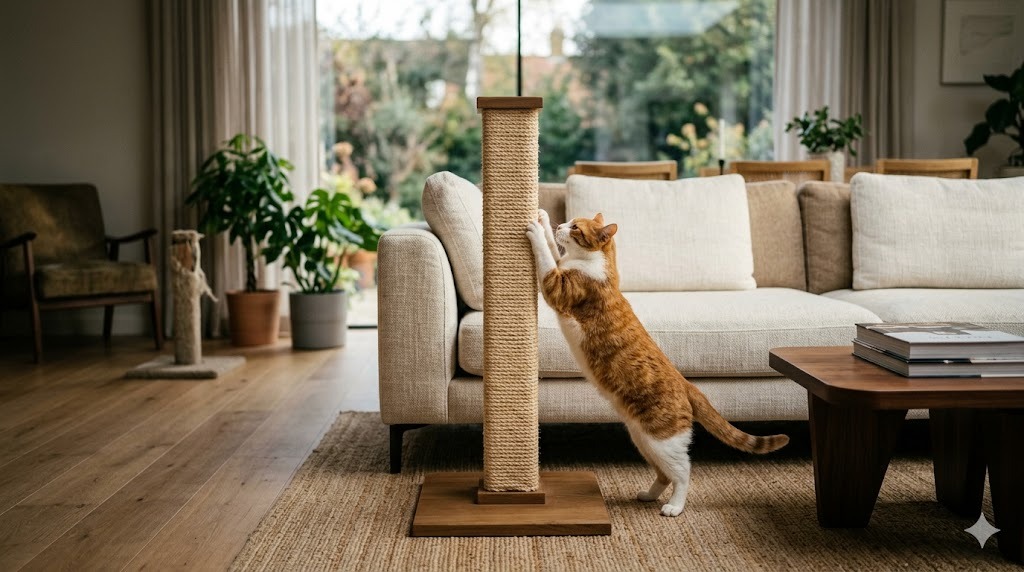
A scratching post must be tall enough for an adult cat to stretch their entire body vertically while scratching. For a typical adult cat, this means:
- Minimum: 32 inches (most cheap posts fail this)
- Better: 36-40 inches
- For Maine Coons and large breeds: 40+ inches
A short post forces the cat to stretch partially, which is unsatisfying and leads to seeking taller surfaces - typically your couch or door frame.
The Material Rule
Cats prefer specific scratching textures:
- Real sisal rope (gold standard) - the natural rope material is what cats prefer above all others
- Sisal fabric - different from sisal rope; less preferred but acceptable
- Cardboard - many cats love horizontal cardboard scratchers as a supplement
- Carpeting - the worst choice for posts, because it teaches cats to scratch carpeted surfaces (like your floor)
- Wood with bark - natural and effective but messy
The Stability Rule
A wobbling post deters scratching. Cats want resistance - that’s how they get the deep stretch and the satisfying scratching action. A flimsy post that tips when leaned against teaches cats to avoid it.
For tall posts (3+ feet), the base should be at least 16 inches wide and weighted (concrete, weighted plastic, heavy wood). Cheap posts with narrow bases fail this test consistently.
Horizontal vs Vertical Scratchers
Many owners assume cats want vertical posts. Most cats want both:
- Vertical posts for the stretch-and-mark function (typically used immediately after waking)
- Horizontal scratchers for casual claw maintenance and stretching the back
Both should be available. A cat with only vertical options often scratches your floor or rugs for the horizontal version.
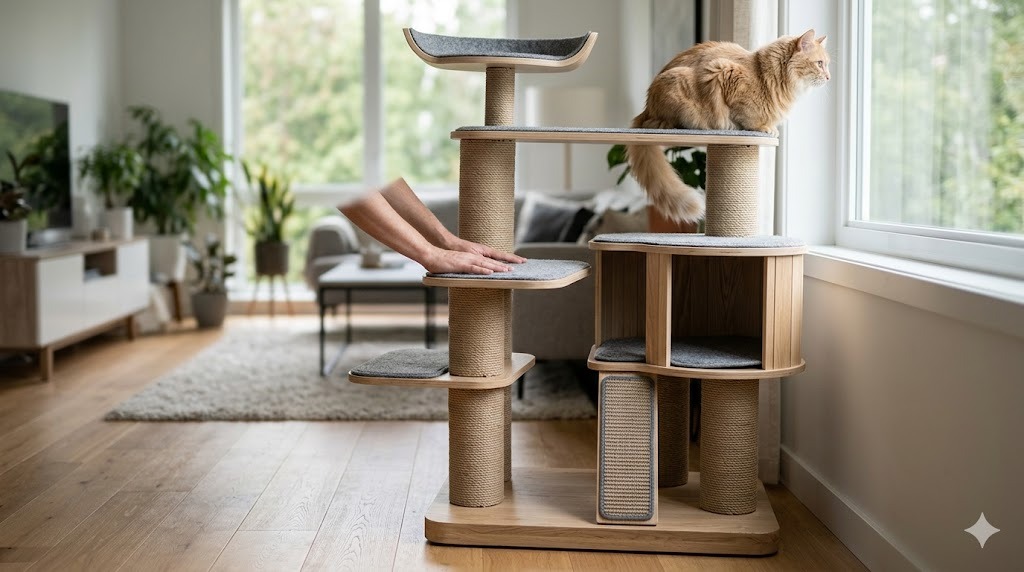
The Vertical Post Worth Buying
For most households, a tall sisal-wrapped vertical post placed correctly solves 80% of inappropriate scratching.
How Many Posts Does a Household Need?
The rough rule is one scratching surface per cat plus one extra. For a single-cat household, two surfaces (one vertical post + one horizontal scratcher) in different locations work well. For a multi-cat household, add posts proportionally.
Spread the posts across the home - don’t cluster them. Cats want options in different territorial zones.
Stopping Couch and Furniture Scratching
If your cat is currently scratching the couch, the fix has two parts:
Part 1: Make the desired post irresistible
- Place a tall sisal post directly next to the scratched corner of the couch
- Sprinkle catnip on the post (or use catnip spray)
- Praise lavishly when the cat scratches the post
Part 2: Make the couch unattractive
- Cover the scratched corner with double-sided sticky tape (cats hate sticky surfaces)
- Apply citrus-scented spray (cats dislike citrus)
- Drape a thin sheet over the corner if necessary
- Use furniture protectors specifically designed for cat-scratching prevention
Within 2-4 weeks of consistent application, most cats redirect to the post.
What Not to Do
Don’t punish scratching
Cats don’t connect punishment with the scratching action - they connect it with you. Punishment makes them scratch when you’re not looking and damages your relationship.
Don’t pick up the cat and force their paws against the post
This is uncomfortable, scary, and counterproductive. Cats don’t learn to use posts by being forced to “demonstrate.”
Don’t declaw
Declawing is amputation of the last bone of each toe. It’s illegal in much of Europe, increasingly illegal in U.S. states and cities, and is associated with chronic pain, behavioral changes, and litter box avoidance. There is no medical justification for elective declaw.
Don’t use squirt bottles
Modern animal behavior science consistently shows that punishment-based training damages trust without producing reliable behavior change. Redirect, don’t punish.
Claw Caps as an Alternative
For households where scratching damage absolutely cannot be tolerated, soft vinyl claw caps (Soft Paws and similar brands) glue onto the claws and prevent damage. They’re temporary, falling off naturally as the cat grows out the claw layer. Some cats tolerate them; others remove them quickly.
Caps are a stopgap, not a substitute for proper scratching post placement. The cat still wants and needs to scratch - caps just prevent the damage during the behavior.
Frequently Asked Questions
Why does my cat ignore the new scratching post?
Most often: placement is wrong (post is in a low-traffic area, far from sleeping spots, or visually hidden), or the post is too short or wobbly. Move it next to the cat’s nap spot or near the furniture they’re already scratching.
How tall should a scratching post be?
Minimum 32 inches for an adult cat - tall enough to allow a full vertical stretch. Maine Coons and large breeds need 40+ inches.
What material is best?
Real sisal rope wins. Sisal fabric is second. Cardboard is excellent for horizontal scratchers. Carpet is the worst - it teaches cats to scratch carpeted surfaces in your home.
My cat only scratches horizontal surfaces. Should I bother with a vertical post?
Yes - most cats need both. The vertical post serves the stretch-and-mark function; the horizontal scratcher serves the casual maintenance function.
How many scratching posts do I need?
One per cat plus one extra, placed in different rooms or zones.
Does catnip help?
For most cats, yes. Catnip on the post (sprinkled, sprayed, or rubbed) makes it more attractive during the introduction phase. Not all cats respond to catnip - about 30% don’t.
What about scratching pads on doors?
Door-mounted scratchers work well for cats who scratch door frames. Place at full stretching height for the cat (typically 24-30 inches from floor for adult cats).
Why does my cat scratch right after waking?
Stretching post-nap is a primary scratching trigger. This is why placing posts near sleep spots is so effective - you’re putting the post where the cat already wants to be scratching.
Final Word
A scratching post that’s tall enough, stable enough, made of sisal, and placed within 5 feet of where your cat naps will be used by almost any cat. A post that violates any of these rules will be ignored, and the cat will redirect to your furniture.
The cost of getting this right is $30-60 for a quality post plus some attention to placement. The cost of getting it wrong is years of damaged furniture, escalating tension between you and your cat, and possibly the temptation to consider invasive solutions like declawing.
Cooperate with the cat’s psychology instead of fighting it. Almost every cat will use a properly placed, properly sized, sisal scratching post within days.
Related Reading
Last updated: May 2026.