Dog Treadmill Guide 2026
Honest guide to dog treadmills in 2026 - when they're worth it, the safety rules most owners ignore, and which models are actually built for dogs (not converted human ones).
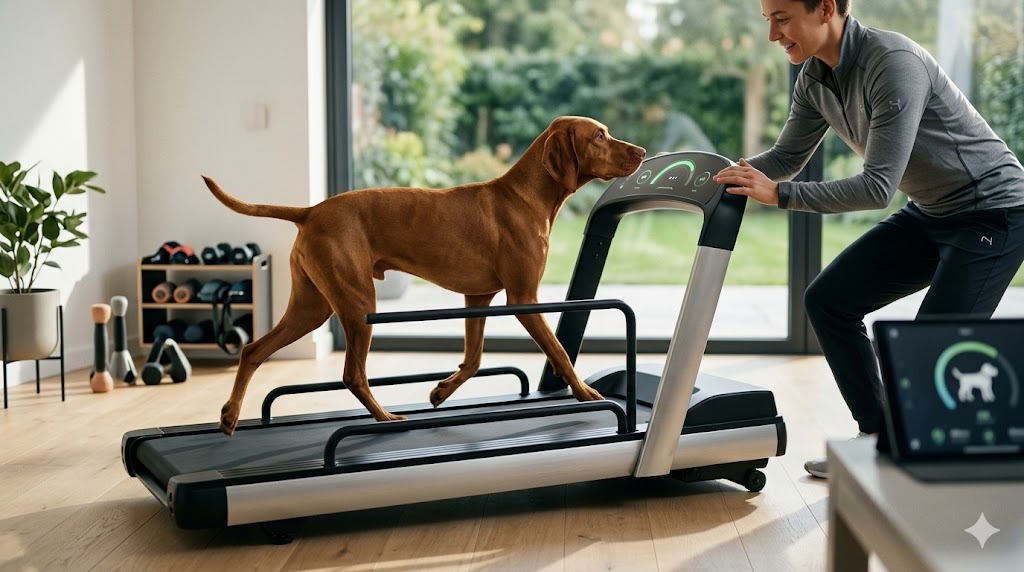
A dog treadmill is worth it only for high-energy dogs whose owners will actually train and use it - and only on a model built for dogs (a flat, long belt with side rails), never a converted human treadmill. Used right it rescues dogs trapped by climate or city life; bought on impulse it becomes a $1,500 clothes rack.
A dog treadmill sits in a strange spot in the pet product world. It’s either life-changing - for owners of high-energy dogs trapped by climate, schedule, or city life - or a $1,500 clothes rack collecting dust in a basement. The difference between the two outcomes isn’t the treadmill. It’s whether the owner actually trains the dog to use it, uses it consistently, and chose a model designed for dogs rather than a converted human treadmill that’s dangerous for canine biomechanics.
This guide covers when a dog treadmill makes sense, why human treadmills are not suitable substitutes, how to choose a model, and how to introduce one to your dog. It’s specific about which breeds and lifestyles benefit, and honest about the alternatives that might serve you better and cheaper.
When a Dog Treadmill Is Actually Worth It
The right use cases are narrower than the marketing suggests:
Strong fit
- Working breeds in apartments (Border Collies, Australian Shepherds, Belgian Malinois - these dogs need more exercise than most owners can provide on foot)
- Climates with brutal extremes (Phoenix in summer, Minnesota in winter)
- Owners with disability or mobility limitations who can’t walk a high-energy dog adequately
- Rehabilitation and conditioning (under-water treadmills are vet-prescribed; land treadmills can supplement under guidance)
- Travel professionals (truck drivers, traveling sales) who can’t always walk dogs
Poor fit
- Average household with moderately energetic dog - daily walks plus play work fine
- Owners who hate maintenance (treadmills require space, training, and supervision)
- Substitute for socialization - a treadmill doesn’t replace stimulation, smells, and social exposure
A dog who needs 90 minutes of vigorous exercise daily but lives where you can only manage 30 minutes is a strong candidate. A dog who’d be satisfied with two 20-minute walks is not.
Why Human Treadmills Are Wrong for Dogs
Owners often consider their existing human treadmill as a “free” dog option. It almost never works safely:
- Belt length is too short for a four-legged gait (dogs need 1.5-2x the length of a human-comfortable belt)
- Belt width is too narrow for dogs to walk straight (they crab-walk and risk falling off)
- Motor is loud - most human treadmills startle dogs
- Speed increments are wrong for canine walking speeds (often jumps too aggressively at low end)
- Side rails are at the wrong height - actively dangerous for dogs
For occasional very low-speed walks with a small dog, a human treadmill at the slowest setting can work. For serious dog exercise, get the right tool.
Dog Treadmill Categories
Slat-mill (manual)
The dog provides the power; treadmill responds to dog’s pace. Used heavily in professional dog sports (sled racing, weight pull). No motor, no electricity. Excellent biomechanically. Expensive ($1,500-3,000).
Powered dog treadmill
Motorized like human treadmills but built for canine proportions. Easier to use; less expensive ($600-1,500). Most common choice for home use.
Underwater treadmill
Veterinary rehabilitation tool. Cost is typically $200-300 per session at a rehab facility. Not for home purchase except by professionals.
What to Look For in a Powered Model
Belt size
- Small dogs (under 25 lbs): 32-40 inch belt
- Medium dogs (25-60 lbs): 50-60 inch belt
- Large dogs (60-90 lbs): 60-72 inch belt
- Giant dogs (90+ lbs): 72+ inch belt with reinforced motor
A belt too short forces the dog to crowd the front or back; too long is fine but pricey.
Motor power
1.5-3 HP for most home models. Higher horsepower handles larger dogs at faster speeds. Avoid no-name motors with unspecified ratings.
Speed range
Should start very slow (0.5 mph) and go up to at least 7-8 mph for active dogs. A range that starts at 2 mph is too aggressive for training and slow walks.
Incline
Optional but useful. Incline turns a flat walk into a much more vigorous workout in the same time.
Side rails or hood
Most dog-specific treadmills include side panels that prevent the dog from stepping off mid-stride. Some include a fully enclosed hood - useful for training but not strictly necessary.
Noise
Quieter motors reduce training time. Aim for under 75 dB at top speed.
Top Brands in 2026
dogPACER
The mainstream dog treadmill brand. Multiple models from compact (small dog) to professional (large dog). Reasonable prices ($500-1,200) and decent customer service.
GoPet / PetRun
Manual slat-mills and powered models from a long-time dog treadmill maker. Generally higher-quality construction than dogPACER, also higher price.
Hands-down avoid
Generic “pet” or “training” treadmills under $300 with no manufacturer accountability. Belt failures and motor burnouts are common in cheap models - at best, you’re stuck with a useless purchase; at worst, your dog gets hurt.
Training Your Dog to Use a Treadmill (4-Week Plan)
This is where most owners fail. They buy the treadmill, turn it on, and try to make the dog use it. The dog freaks out, refuses, and the treadmill becomes furniture.
Week 1: Familiarization (treadmill off)
- Place treats on the belt; let the dog explore and step on at their pace
- Have the dog walk across the belt repeatedly with treats
- Practice “place” command - getting on and off on cue
- Sessions: 5 minutes, 2x/day
Week 2: First low-speed runs
- Start the treadmill at minimum speed (0.5 mph) with the dog on it
- Use a leash held loosely (not as restraint, as guidance)
- Treat constantly for 30-60 seconds at a time
- Build to 2-3 minutes of continuous slow walking
- Sessions: 5-10 minutes, 1-2x/day
Week 3: Building tolerance
- Increase speed slowly (each session, go up 0.5 mph)
- Reduce treat frequency as the dog focuses on walking
- Build to 10-15 minutes at a comfortable walking pace
- Add slight incline once walking is comfortable
Week 4 and beyond: Real workouts
- Build to your target exercise duration (typically 20-45 minutes for high-energy dogs)
- Vary speed and incline for interval-style workouts
- Monitor recovery - dog should be tired-not-exhausted post-session
- Never leave the dog unsupervised on the treadmill
Critical Safety Rules
- Never tie the dog to the treadmill. A fall while restrained causes severe injury. Use the leash for guidance only, hand-held.
- Always supervise. Hands-off treadmill use with a dog is unsafe.
- Use the safety key. All quality dog treadmills have a magnetic safety cord that stops the belt immediately if pulled.
- Warm up and cool down. Start at minimum speed for 2-3 minutes, ramp up, ramp down at end.
- Check paws frequently. Pad wear from belt friction is real. If pads look red or worn, reduce duration.
- Provide water afterward, not during. Drinking water while exercising risks vomiting.
- Don’t use on a dog under 1 year. Growth plates aren’t closed; treadmill running can cause joint issues.
- Don’t use immediately after eating. Wait 1-2 hours.
What Else You Need
A flat-buckle collar or harness for guidance
Not for restraint. The leash should be held lightly to guide direction, not to keep the dog on the belt.
High-value treats
For training phase. Small, soft, easy to deliver at speed.
A puzzle feeder for cooldown
A lick mat or food puzzle after exercise extends the mental engagement.
Floor protection
Treadmills are heavy. Place on a mat to protect floors and reduce sound transmission.
Alternatives That Might Serve You Better
Before spending $800-1,500, consider:
Backyard or driveway running
With a tennis-ball-launcher or flirt pole, a dog can get vigorous exercise in 15 minutes outside.
Hire a professional dog walker
$15-25 per 30-minute walk, no equipment to maintain, also provides socialization. For many city dwellers, this is the better answer.
Indoor agility setup
Tunnels, jumps, and weave poles in a basement give exercise and mental stimulation. Much cheaper than a treadmill.
Cervical training and trick work
Mental exercise tires dogs as much as physical. A few 10-minute training sessions per day can substantially reduce restless behavior.
Frequently Asked Questions
Can I use my human treadmill for my dog?
Generally not safely. Belt size, speed range, and noise are all wrong for canine use. Possible for very brief, slow walks with small dogs - not safe for actual exercise.
How long should my dog use a treadmill?
Start with 5-minute sessions. Build to 20-45 minutes once trained, depending on breed and fitness. Most dogs don’t benefit from more than 45 minutes of treadmill at a stretch.
What age can a dog start treadmill training?
Wait until growth plates close. For most breeds, 12-18 months. Giant breeds, 18-24 months. Always check with your vet for young dog exercise plans.
Is treadmill exercise as good as outside walking?
Cardiovascularly, yes. Behaviorally and mentally, no. Treadmill exercise lacks the smells, social exposure, and environmental stimulation of outside walking. Use both.
How much do good dog treadmills cost?
$600-1,500 for quality powered models. Manual slat-mills $1,500-3,000. Avoid models under $300.
Does my dog need a hood/cover on the treadmill?
Useful during training for distractible dogs; not strictly necessary once trained. Most home users don’t need it.
Can old dogs use treadmills?
Yes, under low-intensity protocols. Senior treadmill exercise (slow walking, brief sessions) can maintain mobility for arthritic dogs. Consult your vet first.
What’s the difference between underwater and land treadmills?
Underwater treadmills are veterinary rehabilitation equipment that reduces joint load with water buoyancy. Land treadmills are exercise equipment. Different purposes.
Final Word
A dog treadmill is a tool, not a solution. The right owner - typically someone with a high-energy working breed in a limiting environment - gets enormous value from one. The wrong owner ends up with an expensive piece of basement furniture.
If you fit the profile (apartment with Border Collie, climate-trapped owner of a Siberian Husky, mobility-limited owner of a working breed), invest in a dog-specific model from dogPACER or GoPet, commit to a 4-week training plan, and use it consistently. If you don’t fit the profile, skip the treadmill and invest in a flirt pole, professional dog walker, or indoor agility setup instead.
Related Reading
Last updated: May 2026.