Pet Stairs vs Ramps 2026
Pet stairs vs ramps for dogs and cats - which is safer for joints and spine, when each works better, and how to introduce them so pets actually use them.
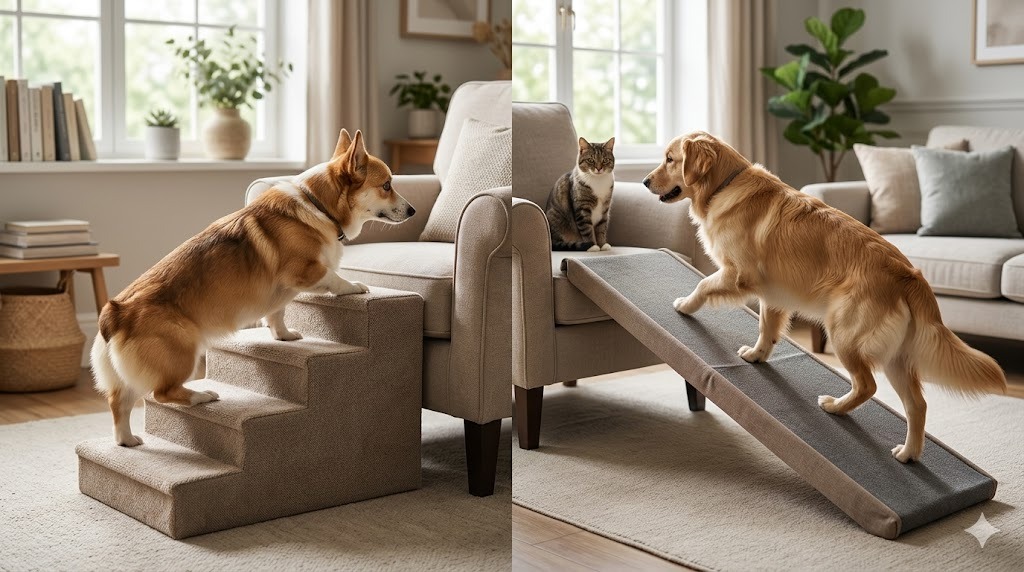
For most dogs, a ramp is the safer choice - it keeps the spine level and avoids the hard impact of stepping down, which matters most for long-backed breeds like Dachshunds and Corgis and for arthritic seniors. Stairs are fine for small, agile dogs and tight spaces; whichever you pick, train the pet onto it gradually with treats.
The decision between pet stairs and a pet ramp seems aesthetic - until your dog jumps off a couch and yelps, and you realize you should have addressed this six months ago. Long-bodied breeds (Dachshunds, Corgis, Bassets), aging dogs of any breed, and cats with arthritis are at significant risk of spinal and joint injuries from jumping down from beds and couches. The right access tool isn’t optional; it’s preventive medicine.
This guide covers when stairs win, when ramps win, how to size for your specific pet, and how to introduce these tools so your pet actually uses them. The most expensive ramp does nothing if your dog ignores it and keeps jumping.
The Short Answer
- Ramps win for: long-bodied breeds (Dachshunds, Corgis), dogs with disc disease, severely arthritic dogs, dogs over 50 lbs, and cars
- Stairs win for: cats, small breeds with shorter bodies, dogs with vision issues, and households tight on space
- Either works for: most healthy small-to-medium dogs accessing a bed or couch
Why This Matters
The physics aren’t subtle. A dog jumping down from a 30-inch couch lands with roughly 7-10x its body weight on impact, concentrated on front legs. Over years, that impact contributes to:
- Disc disease (especially in long-bodied breeds)
- Cruciate ligament tears
- Shoulder and elbow arthritis
- Wrist and pastern injuries
- Spinal injuries
A single bad jump can cause an acute injury requiring surgery. Repeated impacts cause cumulative damage that shows up later as chronic pain.
The Long-Body Problem
The Dachshund, Pembroke Welsh Corgi, Basset Hound, and similar chondrodystrophic breeds (those with disproportionately short legs and long backs) face dramatically higher disc disease risk. For these breeds:
- No jumping down should be permitted from any height
- A ramp is mandatory, not optional
- Stairs are inferior to ramps because the up-and-down step still creates spinal impact
- Some owners restrict access to elevated furniture entirely
This isn’t overprotective. Disc disease in long-bodied breeds frequently requires $3,000-8,000 emergency surgery and may leave permanent paralysis even with treatment.
Ramps: Pros and Cons
Pros
- Gentlest on joints and spine
- Best choice for long-bodied breeds and disc disease
- Smoother gait pattern
- Works for medium to large dogs (where stairs are impractical)
- Often works well for cars (folding car ramps)
Cons
- Takes more floor space
- Some dogs find them slippery
- Steep ramps cause hesitation
- Less compact for small spaces
- Most foldable ramps are clearly visible as a pet item
Sizing rules for ramps
- Slope under 25 degrees - gentle enough that dogs walk comfortably
- Width: at least 1.5x the dog’s shoulder width
- Non-slip surface: carpet or grippy texture, not bare plastic
- Side rails or raised edges: for nervous dogs
Stairs: Pros and Cons
Pros
- More compact footprint
- Easier for some dogs to learn
- Better for cats (cats are climbers)
- Lower visual impact in furniture-conscious rooms
- Useful for short bursts of height (not gradual access)
Cons
- Each step still creates impact loading
- Not appropriate for disc-prone breeds
- Difficult for dogs with hip dysplasia or severe arthritis
- Risk of stumbling on narrow steps
Sizing rules for stairs
- Step depth at least 9-10 inches (dog needs to fit full paw on each step)
- Step rise no more than 4-5 inches (lower than human stairs)
- Width: wide enough that dog doesn’t have to crab-walk
- Non-slip surface on each step
- Sturdy construction - wobble teaches pets not to use stairs
Special Case: Car Ramps for SUVs
Getting medium and large dogs into SUVs and pickups is one of the biggest joint stressors most owners face. Lifting (especially for big dogs) hurts your back. Letting them jump up - and worse, jump down - accelerates joint problems.
A folding car ramp solves this. Look for:
- Length 5-7 feet - long enough to reduce the slope from cargo bed to ground
- Supports adult dog weight - most rated 150-300 lbs
- Non-slip surface
- Folds compactly - fits in cargo area or door pocket
Introducing Stairs or Ramps to Your Pet
The most expensive ramp is useless if your pet jumps over it or ignores it. Introduction matters.
Step 1: Place the ramp/stairs where the pet wants to be
If your dog jumps onto the couch from one side, put the ramp on that side. Don’t expect the dog to walk around to the “right” side.
Step 2: Train in stages, lying flat first
For ramps, start with the ramp lying flat on the floor. Walk the dog across with treats. Reward each step.
Step 3: Add minimal incline
Prop the far end on a phone book. Walk the dog up the slight incline with treats. Repeat for days.
Step 4: Increase incline gradually
Over a week or two, raise the far end to its final height. The dog learns each step of the angle.
Step 5: Use at the actual destination
Once the dog walks the full incline confidently, position the ramp against the bed or couch. Lure with treats. Some dogs need a leash for the first few attempts to prevent panic jumping.
Step 6: Block alternative access
If your dog continues to jump, block the jumping path (cushions on the floor, furniture rearrangement) until the ramp becomes the only option.
Common Mistakes
1. Buying too small or too steep
A ramp at a 40-degree angle is steeper than most dogs will use voluntarily. Measure your bed height and the ramp length; calculate the slope.
2. Letting the pet “figure it out”
Without training, most pets ignore stairs and ramps. Spend 10 minutes a day for two weeks teaching usage.
3. Not blocking the jumping path
A dog will continue to jump if jumping is faster and easier than using the ramp. Block alternative routes until the habit forms.
4. Choosing aesthetics over function
A beautiful but slippery wood ramp does nothing for a dog who can’t grip it. Function first; aesthetics second.
5. Using only one ramp where multiple are needed
If your dog accesses the bed, couch, and car, you may need multiple solutions. A single ramp at the bed doesn’t help with the daily car-loading problem.
Cat-Specific Notes
Cats prefer climbing to walking up ramps, and the right pick often depends on your cat’s breed and build. For cats:
- Stairs work better in most cases
- Steps should be 4-5 inches rise, 9-10 inches deep
- Place near the destination they want to reach
- Window perches and cat trees double as climbing structures
Older cats with arthritis may still benefit from ramps to favorite spots - but most cats prefer stairs.
What About Just Lifting?
Lifting small pets to and from elevated surfaces is fine for short term. Long term issues:
- Back strain on the owner (especially with medium dogs)
- Inconsistent access - the pet still wants to jump when you’re not there
- Doesn’t solve the problem when the pet is alone
Lifting is acceptable for some scenarios (post-surgery, after specific injuries) but isn’t a long-term solution for joint-vulnerable pets.
When to Restrict Access Entirely
Sometimes the right answer isn’t stairs or a ramp - it’s keeping the pet off the furniture entirely. Strong candidates for restriction:
- Dachshunds and other long-bodied breeds with current back issues
- Dogs recovering from disc surgery
- Dogs with severe hip or elbow dysplasia
- Cats with severe arthritis who shouldn’t be jumping at all
This is an unpopular answer because most owners (and most pets) love shared furniture time. But the surgery bill from a single bad jump often exceeds the discomfort of permanent restriction.
Frequently Asked Questions
Are stairs or ramps better for senior dogs?
Generally ramps. They distribute the climb across a longer distance, reducing impact loading on each joint. Severely arthritic dogs may struggle with either; for severe cases, lifting or restriction may be needed.
What angle is too steep for a dog ramp?
Anything over 25 degrees becomes uncomfortable for most dogs to walk. A 7-foot ramp against a 24-inch couch is about 16 degrees - comfortable. A 4-foot ramp against the same couch is about 30 degrees - too steep for most.
Will my dog learn to use a ramp?
Most dogs do, with proper training (described above). Some take a week; some take a month. A few never adapt and require alternative solutions.
How much weight do pet ramps support?
Varies widely. Most foldable ramps support 100-150 lbs. Heavy-duty models support up to 300 lbs. Check the rating for your dog’s weight plus a safety margin.
Are wooden or foam stairs better?
Wooden are sturdier and longer-lasting; foam is lighter and easier to move. For active medium-large dogs, wood is generally better. For small dogs and aesthetics-conscious households, foam works fine.
Do cats need ramps?
Most cats prefer stairs to ramps. Older or arthritic cats may benefit from ramps; healthy cats are usually fine with stairs or cat trees as climbing surfaces.
What about Dachshunds and Corgis specifically?
These breeds should have ramps, not stairs, and access to elevated furniture should be restricted whenever possible. Disc disease is genetic and triggered by impact. Prevention is essential.
Final Word
For most healthy small-to-medium dogs, either stairs or a ramp works for couch and bed access - choose based on space and aesthetic preferences. For long-bodied breeds, senior dogs, and dogs with disc or joint issues, a ramp is the clear choice and is essentially mandatory.
The investment is small ($30-100 for most pet stairs and ramps, plus $50-150 for a quality car ramp). The savings - in vet bills, surgery costs, and your pet’s pain - are large. Add the tool before you “really need it.” By the time the dog is yelping after a jump, the spinal damage has often already started.
Related Reading
- Best Dog Ramps for Cars
- Best Joint Supplements for Senior Dogs
- Senior Dog Care Checklist
- Best Orthopedic Dog Beds
Last updated: May 2026.