Why Cats Chatter at Birds
The fast clicking jaw and little chirps a cat makes at a bird through the window mean it has spotted prey it would like to hunt and cannot reach. The theories behind the sound, what is and is not known, and how to give that energy somewhere to go.
 AI illustration
On health questions, we are not the authority. Chattering at birds is ordinary cat behaviour. If chattering is new for your cat, or it is chattering much more than usual, Cats Protection advises having your cat checked by a vet in case there is a medical reason. We do not give veterinary advice; this piece is about reading normal behaviour.
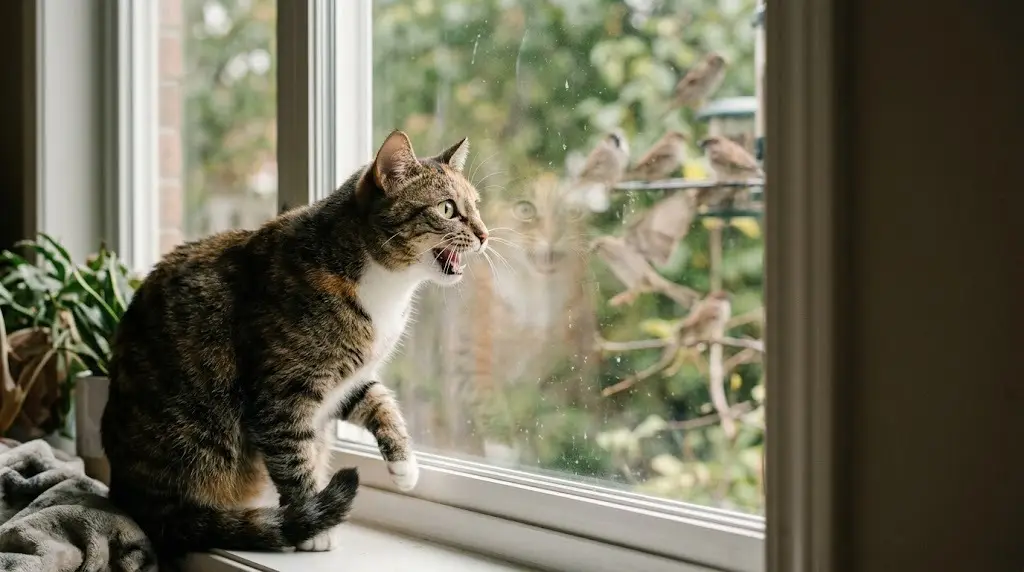
When a cat sits at the window staring at a bird, jaw moving fast, making clicks or little chirps, it has spotted prey it would like to hunt. The ASPCA describes exactly this: a cat watching out of the window becomes focused, twitches the end of its tail and moves its mouth to make a strange chattering sound, because it has detected prey. Nobody knows for certain why cats make this particular noise, and Cats Protection, the UK cat charity, sets out several theories. None of them suggests anything is wrong with the cat.
What chattering looks and sounds like
The jaw moves very fast, so the teeth click or the lips smack, and some cats add short chirps or tweets. Cats Protection notes that it tends to happen when the prey is out of reach, such as on the other side of a closed window. A cat that has a real chance to hunt usually stays as silent as possible so it does not scare its prey away.
You may see it alongside the rest of the hunting sequence. The ASPCA describes a cat’s predatory sequence as silent stalking, watching and waiting for the right moment, with the rear end wobbling from side to side and the tail twitching, then a sprint and a strike with the front paws.
The theories
Cats Protection lists these explanations, and is clear that none is proven:
- Excitement or frustration. The chattering could be excitement, or the result of a surge of adrenaline at seeing prey the cat wants to catch but cannot reach. A cat may also be letting you know it wants to go out and hunt, especially if chattering has got it let outside before.
- Copying the prey. The chirps sound a little like birds and rodents, so the cat could be trying to mimic its prey to get closer.
- Mimicking the kill. The jaw movement may copy the bite a cat gives to the back of its prey’s neck. Cats Protection calls this theory unlikely, although the bite itself is real: the ASPCA notes that cats kill prey with a bite to the back of the neck.
- Warning the animal off. Also called unlikely by Cats Protection, since a cat will usually want to hunt the animal.
What the theories share is that chattering belongs to hunting. Our piece on why cats bring you dead animals covers the same instinct from the other end, when the hunt succeeds.
Is it a problem?
For most cats, no. Cats Protection calls chattering a natural behaviour that is usually nothing to worry about. Two situations deserve a closer look:
- Frustration that spills over. The ASPCA describes redirected aggression: a cat aroused by an animal it cannot get at, for example through a window, may turn and lash out at a person, dog or cat that is nearby or approaches it. Watching birds or squirrels is one of its common triggers, and the attack can come long after the arousal, even hours later. The ASPCA advises never approaching an agitated cat.
- A change in the chattering. If it is new, or much more frequent than usual, a vet check comes first (Cats Protection).
Give the hunting drive somewhere to go
You cannot remove the instinct, and there is no reason to try. Cats Protection suggests these:
- Play that ends in a catch. When your cat chatters at animals outside, distract it with a toy and let it stalk, pounce and catch it. Fishing rod toys work well, moved like prey: along the ground like a rodent or through the air like a bird. Regular short play sessions every day help satisfy its hunting instincts. Our guide to choosing cat toys goes into the kinds of toys that hold a cat’s interest.
- Block the view if it gets wound up. Cover the lower part of the windows or doors your cat likes to look out of with something opaque, such as cardboard or a window sticker, so it cannot see the wildlife outside.
A cat knocking things off tables is another everyday habit worth reading about if you are trying to understand how your cat spends its energy.
A note on birds outside
If your cat goes outdoors, chattering at the feeder is a reminder that the birds nearby are within its reach. Cats Protection notes that play gives a cat an outlet that also keeps wildlife outside safe, and it has further advice on deterring cats from hunting. Rules and advice on outdoor cats differ by country and local area, so check what applies where you live.
For an indoor cat, the chattering at the glass is mostly a sign that it has seen something it would like to hunt. A play session with a toy that flies and lands may be exactly what it needs.
Sources
- Cats Protection, “Why do cats chatter and chirp at birds?” (read 28 October 2026): cats.org.uk
- ASPCA, “Aggression in Cats”, sections on redirected aggression and predatory behaviour (read 28 October 2026): aspca.org
Recommended Gear on Amazon
- Wand toys - browse current options and reviews on Amazon.
- Frosted window film - browse current options and reviews on Amazon.
- Puzzle feeder - browse current options and reviews on Amazon.
As an Amazon Associate, we earn from qualifying purchases - at no extra cost to you. This helps us keep producing free, in-depth guides.