Why Your Dog Follows You Everywhere
The short answer: following you around is often learned or part of a dog's nature, and a clingy dog is not the same as a dog with separation anxiety. How to tell the two apart, when new clinginess is worth a vet visit, and how to teach a velcro dog a little independence.
 AI illustration
Please read this first. Sudden clinginess can have medical roots. PetMD’s veterinary authors name illness, and in older dogs vision or hearing loss and cognitive decline, among the reasons a dog may suddenly become clingy. This article is a reading guide to help you tell ordinary following from a change worth investigating. It is not veterinary or behavioural advice, and we do not give any. If your dog’s following is new or comes with any other change, your own vet is the right first call.
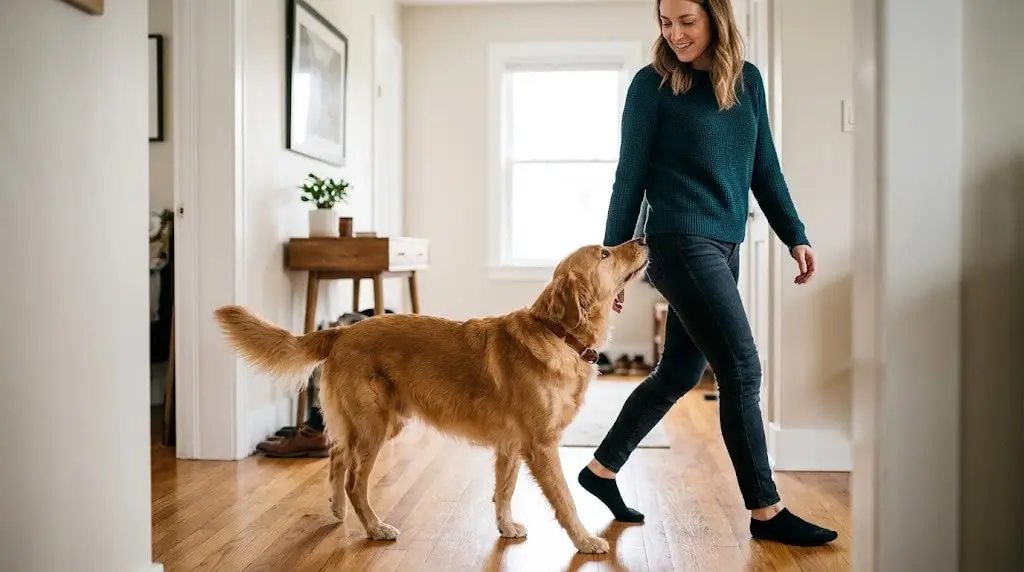
The short answer: a dog that follows you from room to room is often doing something it has learned, or something that is in its nature. Dogs that do it are often called “velcro dogs”. PetMD describes a velcro dog as one that follows you from room to room, always wants physical contact and is sensitive to separation.
What matters is not whether your dog follows you. It is whether the following is relaxed or frantic, lifelong or new, and whether the dog copes when you are out of sight.
The common reasons
PetMD’s article on velcro dogs, written and reviewed by vets, lists these:
Learned behaviour. Dogs learn to follow from the way we interact with them. If following you into the kitchen often ends with food, or lying next to you always ends with a stroke, the dog has learned that following pays. Puppies given constant attention while they are developing can grow unused to being alone.
Breed and individual nature. Sporting breeds such as Vizslas, Labrador Retrievers and Golden Retrievers were bred to work closely with people and prefer to be by their side, and companion breeds such as the Shih Tzu and the Cavalier King Charles Spaniel were selected for wanting to be close to their people. Some individual dogs want more togetherness than others.
Boredom. A bored dog may follow you because it has nothing better to do.
Stress and change. Dogs with anxiety often become clingy, and a change in daily routine or in the household can make a dog clingier. PetMD notes that dogs can also become clingy when they sense their owner’s stress.
Age and health. Senior dogs with vision or hearing loss, or with cognitive decline, can suddenly become clingy because their world is becoming unfamiliar to them, and sick dogs can become clingy too.
Following is not the same as separation anxiety
This is the distinction that matters. PetMD puts it plainly: clingy dogs want to be around you when you are home, but they do not panic when you are not there. A dog with separation anxiety panics when you are gone.
The ASPCA lists the signs of separation anxiety as things that happen when the dog is left alone or separated from its people, and usually not when they are present:
- urinating or defecating indoors;
- persistent barking or howling;
- chewing door frames or window sills, digging at doors, and other destruction around exits;
- trying to escape from where it is confined;
- pacing in a fixed path or in circles;
- eating its own excrement.
The ASPCA adds that a dog with separation anxiety usually starts barking and showing other signs of distress within a short time of being left alone, often within minutes, and some dogs become agitated while their people get ready to leave. If you are not sure what happens after you go, a phone or pet camera left recording will show you. The ASPCA also lists medical problems and other behaviour issues, such as incomplete house training, to rule out first.
A pattern like this is worth a professional conversation. The ASPCA points to certified applied animal behaviorists and board-certified veterinary behaviorists for moderate or severe cases. We have also written a separate reading guide on the seasonal version in back-to-school separation anxiety.
When new clinginess is worth a vet call
Behaviour that changes tells you more than behaviour that has always been there. PetMD advises a vet appointment if the clinginess is new, or comes with other concerns such as destructive behaviour or a lot of barking or whining when you leave. Raise it with your vet if the following:
- is new in an adult dog that used to rest alone happily;
- comes with signs of illness, or with signs that your dog is not seeing or hearing as well as before;
- comes with confusion or other changes in an older dog. We keep a reading guide on those signs in cognitive decline in dogs.
None of these are things to diagnose from a blog post, including this one.
What to do if you just want more space
If your dog is relaxed and you just want to make a cup of tea alone, PetMD suggests these steps for a clingy dog without separation anxiety:
- Enough exercise, suited to your dog’s age and health, so it has less interest in following you around.
- Interactive toys that keep the dog busy and encourage it to play on its own.
- A place of its own. Set up a spot with the dog’s bed and favourite toys, teach a cue such as “place”, and reward the dog with a treat as soon as it goes there.
- Make your movements boring. Dogs link some of your movements with food or with you leaving. Walk into the kitchen and sweep instead of getting food out, or pick up your keys and turn on the TV instead of leaving, until those movements stop meaning much.
For short practice absences, the ASPCA’s approach for anxious dogs is a useful model: teach a stay while you step behind an inside door such as the bathroom door, start with absences of one or two seconds, lengthen them slowly, and wait until your dog is completely relaxed before you step out again. If you see signs of stress, such as panting, yawning, trembling or pacing, go back to a shorter absence.
For an older dog with failing sight, PetMD suggests night-lights in dark areas and keeping the furniture where it has always been, since a dog that has lost its sight can be confused even by a chair in a new place.
And accept that some dogs want more togetherness than others.
Summary
Most following needs no fixing. Ask three questions: has this always been true, can the dog rest while it follows you, and can the dog cope when you leave the house. Three yeses mean you most likely have a sociable dog. Any no, and particularly a recent change in an adult dog, is a reason to book a vet appointment rather than to search for training tips. Related reading on the noisy end of the same spectrum lives in how to stop dog barking.
Sources
- PetMD, “Why Is My Dog So Clingy? What To Know About ‘Velcro Dogs’”, by JoAnna Pendergrass, DVM, reviewed by Jennifer Coates, DVM (read 28 October 2026): petmd.com
- ASPCA, “Separation Anxiety” (read 28 October 2026): aspca.org
Recommended Gear on Amazon
- Puzzle toys - browse current options and reviews on Amazon.
- Dog bed - browse current options and reviews on Amazon.
- Indoor gate - browse current options and reviews on Amazon.
As an Amazon Associate, we earn from qualifying purchases - at no extra cost to you. This helps us keep producing free, in-depth guides.