Irish Setter
The Irish Setter is one of the most glamorous of all gundogs - a tall, elegant bird dog cloaked in a flowing coat of deep mahogany red.
🗓️ Last reviewed: July 2026
Overview
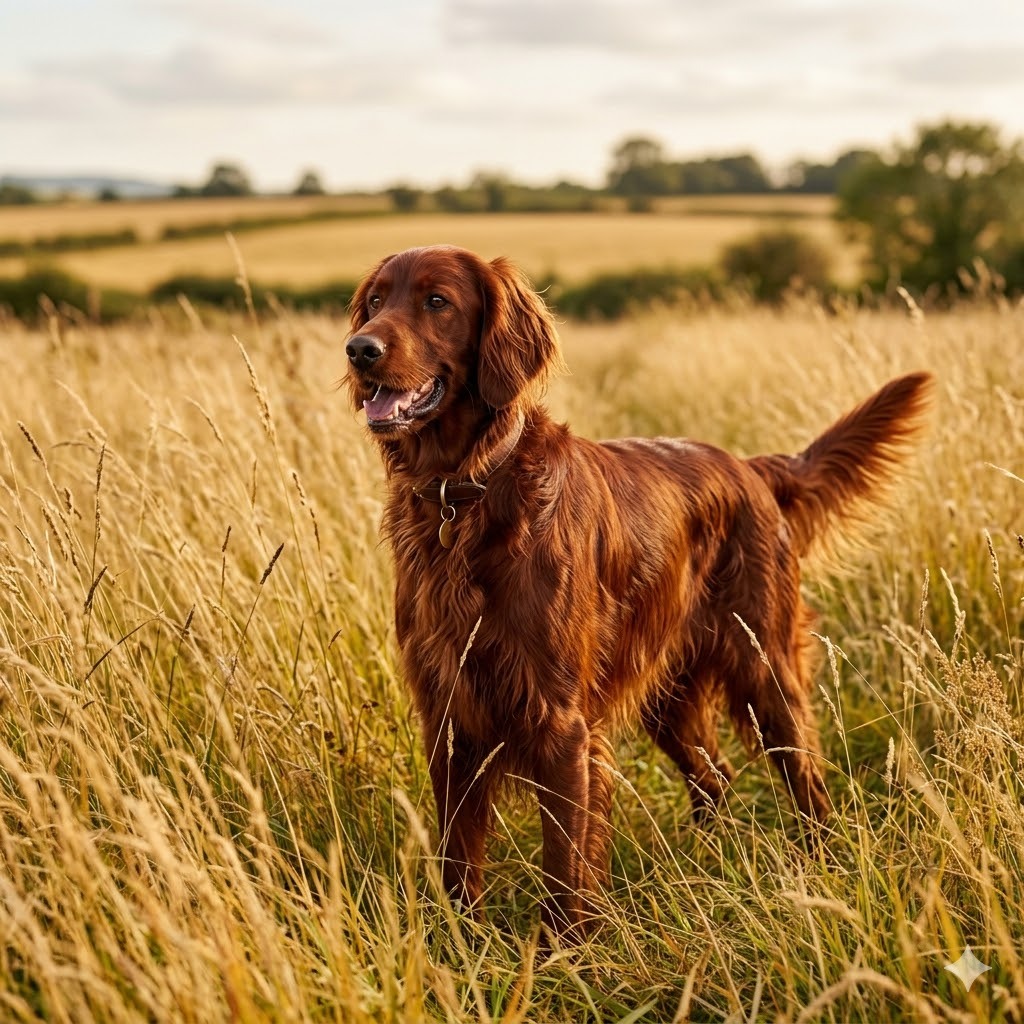
The Irish Setter is one of the most glamorous of all gundogs - a tall, elegant bird dog cloaked in a flowing coat of deep mahogany red. Beneath the beauty is an exuberant, affectionate, and endlessly enthusiastic companion, bred to range wide and fast across the Irish countryside in search of game birds. The breed is famous for its joyful, almost clownish personality and its slow, playful maturity; an Irish Setter often stays a big puppy in spirit well into adulthood. Warm, friendly, and boundlessly energetic, it thrives with active owners who can meet its considerable exercise needs and appreciate its sunny, sociable nature.
History & Origins
The Irish Setter developed in Ireland in the 18th and 19th centuries as a bird dog used to locate game birds and then "set" - crouch or freeze - so hunters could net or shoot them. It was created from a blend of setters, spaniels, and pointers, refined by Irish sportsmen into a fast, wide-ranging field dog suited to open country.
Early Irish Setters were often red-and-white, and that colour survives today as a separate breed, the Irish Red and White Setter. The solid red dog - sometimes called the Red Setter - became fashionable in the 19th century, prized as much for its striking colour as for its field ability. Selective breeding for the rich mahogany coat drove its popularity in the show ring and as a companion.
The breed was recognised by kennel clubs on both sides of the Atlantic in the late 1800s. Its beauty made it enormously popular in the 20th century, sometimes at the expense of working ability, though dedicated breeders have preserved capable field lines. Today the Irish Setter is valued as a hunting dog, show dog, and above all a lively family companion.
Appearance
The Irish Setter is a tall, athletic, and graceful dog. Males stand around 63-67 cm (25-27 in) at the shoulder and typically weigh 27-32 kg (60-70 lb); females are somewhat smaller and lighter, often 25-29 kg. The overall impression is one of balance, refinement, and effortless movement.
Key features:
- Coat: moderately long, silky, and flat, with feathering on the ears, chest, legs, underside, and tail.
- Colour: rich chestnut to deep mahogany red, the breed's defining feature; small white markings are sometimes seen but a solid red is preferred.
- Head: long and lean with a refined muzzle and a soft, kind expression.
- Eyes: medium, dark to hazel, gentle and intelligent.
- Ears: long, low-set, and hanging in a graceful fold.
- Tail: carried level with the back, tapering and well feathered.
Temperament & Character
The Irish Setter is outgoing, affectionate, and irrepressibly enthusiastic. It loves people, greets life with visible joy, and is one of the friendliest of the sporting breeds. This is a dog that wants to be involved in everything and dislikes being left out or left alone.
The breed matures slowly, both physically and mentally. Owners should expect puppyish behaviour - bouncing, mouthing, and general silliness - to last well beyond the first year. This lively immaturity is charming but demands patience during training.
Irish Setters are typically excellent with children and sociable with other dogs, making them poor guard dogs but wonderful family companions. Their prey drive is present but moderate; they were bred to find and point birds rather than kill. They are sensitive to their owners' moods and do not respond well to harshness. Left under-exercised or under-stimulated, they become restless, destructive, and prone to attention-seeking mischief.
Care
Coat & Grooming
The silky feathered coat needs regular care to stay clean and tangle-free. Brush two to three times a week, paying particular attention to the feathering on the ears, chest, legs, and tail, where mats form easily. The long ears trap moisture and need weekly checking and cleaning to prevent infection.
Trimming around the feet, ears, and neck keeps the dog tidy, and occasional professional grooming helps maintain the coat. Irish Setters shed moderately year-round with heavier seasonal sheds. Bathe as needed, trim nails regularly, and brush teeth several times a week.
Exercise & Activity Needs
This is a high-energy sporting breed that needs a great deal of exercise - at least 60-90 minutes of vigorous activity daily, and often more. Long runs, hikes, off-lead galloping in safe areas, swimming, and field work all suit the breed. A short walk around the block is nowhere near enough.
Irish Setters excel at agility, obedience, tracking, and hunting tests, and they make wonderful running or hiking partners for active people. Mental engagement through training and games is essential; a bored Irish Setter finds its own, usually destructive, entertainment. Because the breed loves to run and range, a secure area for free exercise is a real advantage.
Health & Lifespan
Average lifespan is 12-14 years. The breed is generally healthy, but responsible breeding and screening matter.
Common concerns:
- Hip dysplasia.
- Progressive retinal atrophy and other eye conditions.
- Bloat (GDV) - a significant risk in this deep-chested breed.
- Hypothyroidism.
- Epilepsy.
- Canine leukocyte adhesion deficiency (CLAD) - a hereditary immune disorder for which reliable DNA tests exist.
Choosing a breeder who screens hips, eyes, and hereditary conditions greatly reduces risk. Bloat prevention is especially important.
Feeding & Nutrition
An adult Irish Setter typically eats around 2-3 cups of quality food per day, divided into two meals; active and working dogs need more. A balanced diet suited to the breed's size and energy level keeps it in trim, athletic condition.
Because of the serious bloat risk, feed at least two smaller meals rather than one large one, and avoid vigorous exercise for about an hour before and after eating. Slow-feeder bowls help dogs that eat too fast. Keep the dog lean; excess weight strains the joints and reduces stamina. Feathering around the mouth can pick up food and may need a quick wipe.
Pros & Cons
Pros
- Beautiful, elegant, and eye-catching.
- Exceptionally friendly and affectionate.
- Great with children and other dogs.
- Athletic and versatile; excellent for active owners.
- Generally healthy and long-lived for its size.
Cons
- Very high exercise and stimulation needs.
- Slow to mature; puppyish for years.
- Coat needs regular grooming.
- Poor guard dog; too friendly to protect.
- Prone to bloat; needs careful feeding management.
Best Suited For
- Active, outdoor-oriented owners and families.
- Homes wanting an affectionate, sociable companion.
- Owners who enjoy running, hiking, or dog sports.
- People with time for training, grooming, and company.
Not suited for sedentary households, owners wanting a guard dog, homes where the dog is left alone for long hours, or those unwilling to commit to substantial daily exercise.
Irish Setter puppy growth chart
A typical growth curve for a large breed like the Irish Setter, estimated from its adult weight of 27-32 kg. Puppies vary with sex, genetics and diet, so treat this as a guide - for your own puppy, use the puppy weight predictor.
| Age | Typical weight | % of adult |
|---|---|---|
| 2 mo | 5.9-7 kg | 22% |
| 3 mo | 8.9-10.6 kg | 33% |
| 4 mo | 11.6-13.8 kg | 43% |
| 6 mo | 16.2-19.2 kg | 60% |
| 9 mo | 21.6-25.6 kg | 80% |
| 12 mo | 24.8-29.4 kg | 92% |
| Adult | 27-32 kg | 100% |
Irish Setter - frequently asked questions
Are Irish Setters good family dogs?
Yes. They are among the friendliest sporting breeds, typically gentle and playful with children and sociable with other dogs, making them excellent companions for active families.
Do Irish Setters need a lot of exercise?
Absolutely. They need at least 60-90 minutes of vigorous daily activity, and often more. Without enough exercise and mental stimulation they become restless and destructive.
Are Irish Setters easy to train?
They are intelligent and eager to please but easily distracted and slow to mature, so they need patient, consistent, reward-based training. Expect to keep reinforcing lessons well into adulthood.
Do Irish Setters shed a lot?
They shed moderately year-round, with heavier seasonal sheds, and their feathered coat needs brushing several times a week to prevent mats.
Are Irish Setters good guard dogs?
No. They are far too friendly and welcoming to make effective guard dogs, though they may bark to announce visitors.
🧠 Test yourself: guess the dog
Three clues from our quiz bank, each about another of our dogs. Can you name them?
Clue 1.A 19th-century cross of bulldog and terrier stock, this stocky dog has a famously stubborn, clownish personality.
It's the Bull Terrier - read the full profile →
Clue 2.One of the heaviest dog breeds on Earth, this gentle giant can top 200 pounds and once guarded estates and fought in arenas.
It's the English Mastiff - read the full profile →
Clue 3.Bred to dig into setts and burrows after badgers, this dog's name literally means 'badger dog' in German.
It's the Dachshund - read the full profile →
💛 Adoptable Irish Setters near you
Real dogs of this breed (and close mixes) waiting in shelters and rescues right now, live from Petfinder. We have no affiliation and earn nothing - if someone catches your eye, the link goes straight to their shelter. New to adopting? Start with our adoption guide.
Widget not loading (some ad-blockers hide it)? Search directly on petfinder.com.