Norwegian Elkhound
The Norwegian Elkhound is an ancient Nordic spitz - a compact, sturdy, grey hunting dog bred to track and hold moose (called elk in Europe) for the hunter.
🗓️ Last reviewed: July 2026
Overview
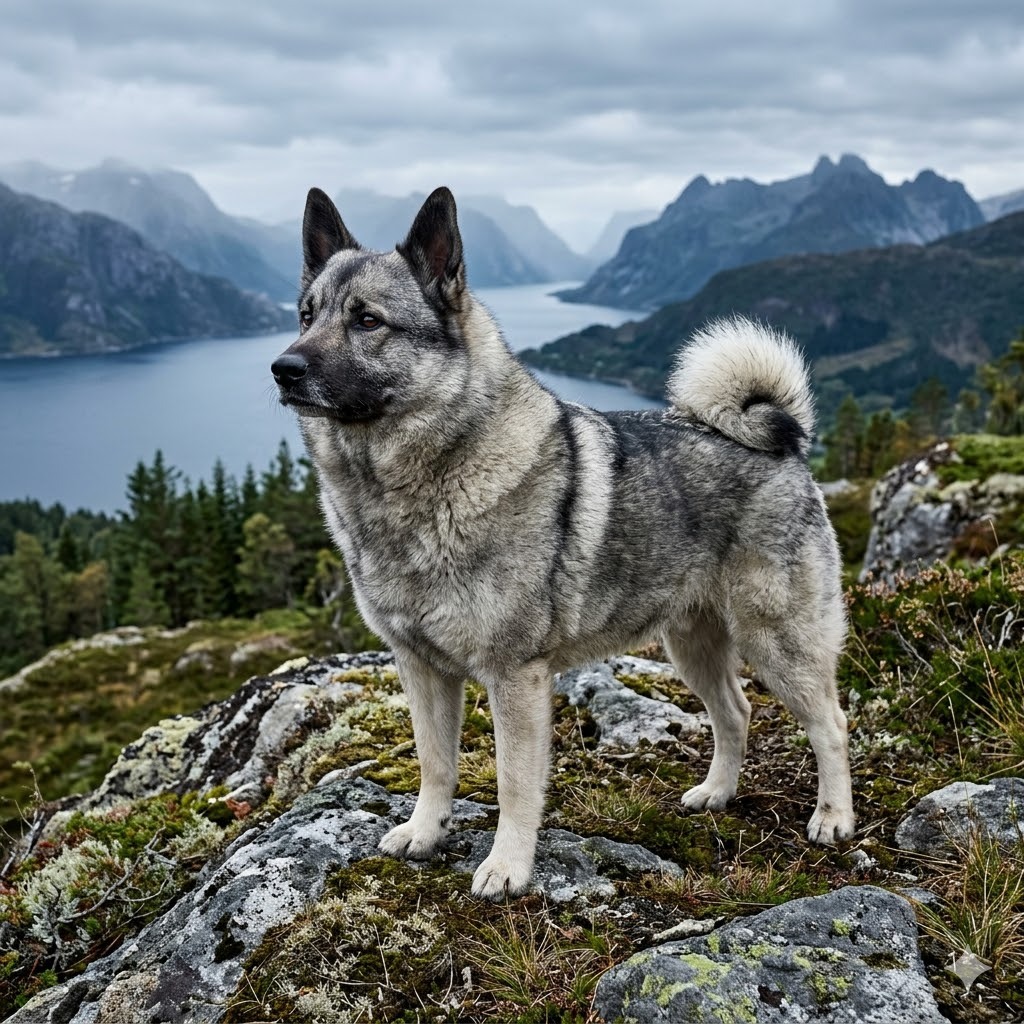
The Norwegian Elkhound is an ancient Nordic spitz - a compact, sturdy, grey hunting dog bred to track and hold moose (called elk in Europe) for the hunter. Bold, hardy, and famously vocal, the breed combines the endurance of a working hound with the loyalty and family devotion of a companion spitz. Weighing roughly 20-25 kg (44-55 lb), the Elkhound is medium-sized, thick-coated, and built for cold-weather stamina rather than speed. It is a dog of great character - confident, independent, watchful, and deeply attached to its people.
History & Origins
The Norwegian Elkhound is one of the oldest dog breeds in existence. Skeletal remains found in Norwegian excavations, buried alongside their owners, date the breed's ancestors back thousands of years to the Stone Age. Dogs almost identical to the modern Elkhound hunted with Viking warriors and Norse farmers, guarding homesteads and tracking large game across the mountains and forests of Scandinavia.
For centuries the breed's job was unchanged: locate moose by scent, track them silently over rough terrain, then bark to hold the animal at bay until the hunter arrived. This "bay and hold" style demanded courage, independence, and a powerful voice - traits still central to the breed today.
The Elkhound was formally standardised in Norway in the late 1800s, and the first breed club was founded in 1899. It remains the national dog of Norway. The AKC recognised the breed in 1913. Today the Elkhound is valued both as a versatile hunting dog and as a rugged, loyal family companion, though it has never become a mass-popular breed - which has helped keep it genetically sound.
Appearance
Medium-sized, square, and powerfully built. Males stand 49-52 cm (19-20.5 in) and weigh 23-25 kg (50-55 lb); females are smaller at roughly 20-22 kg (44-49 lb). The overall impression is of a compact, balanced spitz - never leggy or coarse.
Key features:
- Coat: thick, weatherproof double coat - a coarse, straight outer coat over a dense, soft, woolly undercoat.
- Colour: grey, with black-tipped guard hairs producing the characteristic silvery shading; darker on the saddle, lighter on the chest, mane, and legs.
- Head: broad, wedge-shaped, with a clearly defined stop.
- Eyes: dark brown, medium, oval, with an alert, friendly expression.
- Ears: erect, pointed, highly mobile.
- Tail: set high, tightly curled over the back - a classic spitz trait.
Temperament & Character
Bold, confident, and independent. The Norwegian Elkhound is a hunting dog at heart, and it thinks for itself - a legacy of centuries spent working out of sight of the hunter. This makes it self-assured and sometimes stubborn, but never neurotic. It is a steady, level-headed dog.
The breed is deeply loyal and forms strong family bonds. It is affectionate with its people, playful, and dignified. Elkhounds are excellent watchdogs - alert, territorial, and quick to announce visitors. This brings us to the breed's most important honest trait: they are loud. Elkhounds were bred to bark, and they enjoy it. Without training and outlets, barking can become a genuine nuisance.
With children they are typically gentle, patient, and protective. With strangers they are reserved but rarely aggressive. With other dogs they are generally sociable, though same-sex tension can occur. A strong prey drive means small pets are not always safe.
Care
Coat & Grooming
The dense double coat needs weekly brushing most of the year and daily attention during the twice-yearly "blowing" of the undercoat, when the dog sheds heavily for two to three weeks each spring and autumn. Expect large quantities of loose grey wool during these periods. A slicker brush and an undercoat rake are essential.
The coat is naturally clean and weather-resistant, so baths are only needed every few months. Never shave an Elkhound - the double coat insulates against both cold and heat. Clean ears weekly, trim nails every 3-4 weeks, and brush teeth several times a week.
Exercise & Activity Needs
High. The Elkhound is a hardy working dog with real stamina and needs a minimum of 60-90 minutes of vigorous daily exercise - brisk walks, hikes, jogging, and off-lead running in safe areas. It thrives in cold weather and loves rough terrain.
The breed excels at hiking, tracking, scent work, and agility, and its endurance is remarkable. Mental stimulation matters as much as physical work; a bored, under-exercised Elkhound will bark, dig, and become destructive. Because of the strong prey drive, off-lead freedom should only be given where recall is reliable and livestock or game will not be chased.
Health & Lifespan
Average lifespan is 12-15 years - long and robust for a medium breed.
Common concerns:
- Hip dysplasia - moderate.
- Progressive retinal atrophy and other eye conditions.
- Hypothyroidism.
- Obesity - the breed gains weight easily and must not be over-fed.
- Fanconi syndrome - a kidney disorder seen occasionally in the breed.
- Cysts and skin issues in older dogs.
The Elkhound is generally a hardy, healthy breed with few serious genetic problems, largely because it has never been over-bred.
Feeding & Nutrition
Adults typically eat 1½-2 cups of quality food per day in two meals. The Elkhound is a very efficient feeder that evolved to survive on limited food in harsh climates, so it gains weight extremely easily. Portion control is critical - obesity is the single most common health mistake owners make with this breed.
Measure meals, limit treats, and adjust for activity level. Avoid free-feeding. A working or active dog needs more in winter; a companion dog needs surprisingly little.
Pros & Cons
Pros
- Hardy, healthy, and long-lived.
- Loyal, devoted family companion.
- Excellent watchdog.
- Thrives in cold climates and loves the outdoors.
- Ancient, genetically sound breed with strong character.
Cons
- Very vocal - barking is a genuine challenge.
- Heavy seasonal shedding twice a year.
- Independent and stubborn - not always easy to train.
- Strong prey drive; unreliable off-lead without training.
- Gains weight easily; needs strict portion control.
Best Suited For
- Active owners who enjoy hiking and the outdoors.
- Cold-climate households.
- Families wanting a loyal, sturdy watchdog.
- Owners who can commit to firm, consistent training.
Not suited for apartment dwellers sensitive to noise, hot climates, sedentary owners, or those wanting a quiet, biddable dog.
Norwegian Elkhound puppy growth chart
A typical growth curve for a medium breed like the Norwegian Elkhound, estimated from its adult weight of 20-25 kg. Puppies vary with sex, genetics and diet, so treat this as a guide - for your own puppy, use the puppy weight predictor.
| Age | Typical weight | % of adult |
|---|---|---|
| 2 mo | 5.4-6.8 kg | 27% |
| 3 mo | 8-10 kg | 40% |
| 4 mo | 10-12.5 kg | 50% |
| 6 mo | 13.6-17 kg | 68% |
| 9 mo | 17-21.3 kg | 85% |
| 12 mo | 19.4-24.3 kg | 97% |
| Adult | 20-25 kg | 100% |
Norwegian Elkhound - frequently asked questions
Do Norwegian Elkhounds bark a lot?
Yes. They were bred to bark and hold game, and they are one of the more vocal breeds. Early training of a "quiet" cue and plenty of exercise keep it manageable, but a silent Elkhound is not realistic.
Do they shed heavily?
Yes. The thick double coat sheds year-round and blows out completely twice a year, producing large amounts of grey wool. Regular brushing is essential.
Are Norwegian Elkhounds good family dogs?
Very. They are loyal, gentle with children, protective, and steady. They suit active families who can meet their exercise and training needs.
Can they handle hot weather?
Not well. The breed is built for cold and can overheat. In hot climates they need shade, water, and exercise limited to cool parts of the day. Never shave the coat.
Are they hypoallergenic?
No. They shed heavily and produce dander.
🧠 Test yourself: guess the dog
Three clues from our quiz bank, each about another of our dogs. Can you name them?
Clue 1.Heavy, low-slung, and brachycephalic, this breed's pushed-in face causes snoring and a low tolerance for heat or swimming.
It's the Bulldog (English Bulldog) - read the full profile →
Clue 2.Originally a German water retriever, this curly-coated dog comes in standard, miniature, and toy sizes and rarely sheds.
It's the Poodle (Standard, Miniature, Toy) - read the full profile →
Clue 3.Despite weighing only a few pounds, this apple-headed breed has a famously bold, sassy temperament and shivers easily.
It's the Chihuahua - read the full profile →
💛 Adoptable Norwegian Elkhounds near you
Real dogs of this breed (and close mixes) waiting in shelters and rescues right now, live from Petfinder. We have no affiliation and earn nothing - if someone catches your eye, the link goes straight to their shelter. New to adopting? Start with our adoption guide.
Widget not loading (some ad-blockers hide it)? Search directly on petfinder.com.