Saluki
The Saluki is one of the world's oldest and most graceful sighthounds - a slender, silky, elegant hunter bred across the deserts and plains of the Middle East for extraordinary speed and endurance.
🗓️ Last reviewed: July 2026
Overview
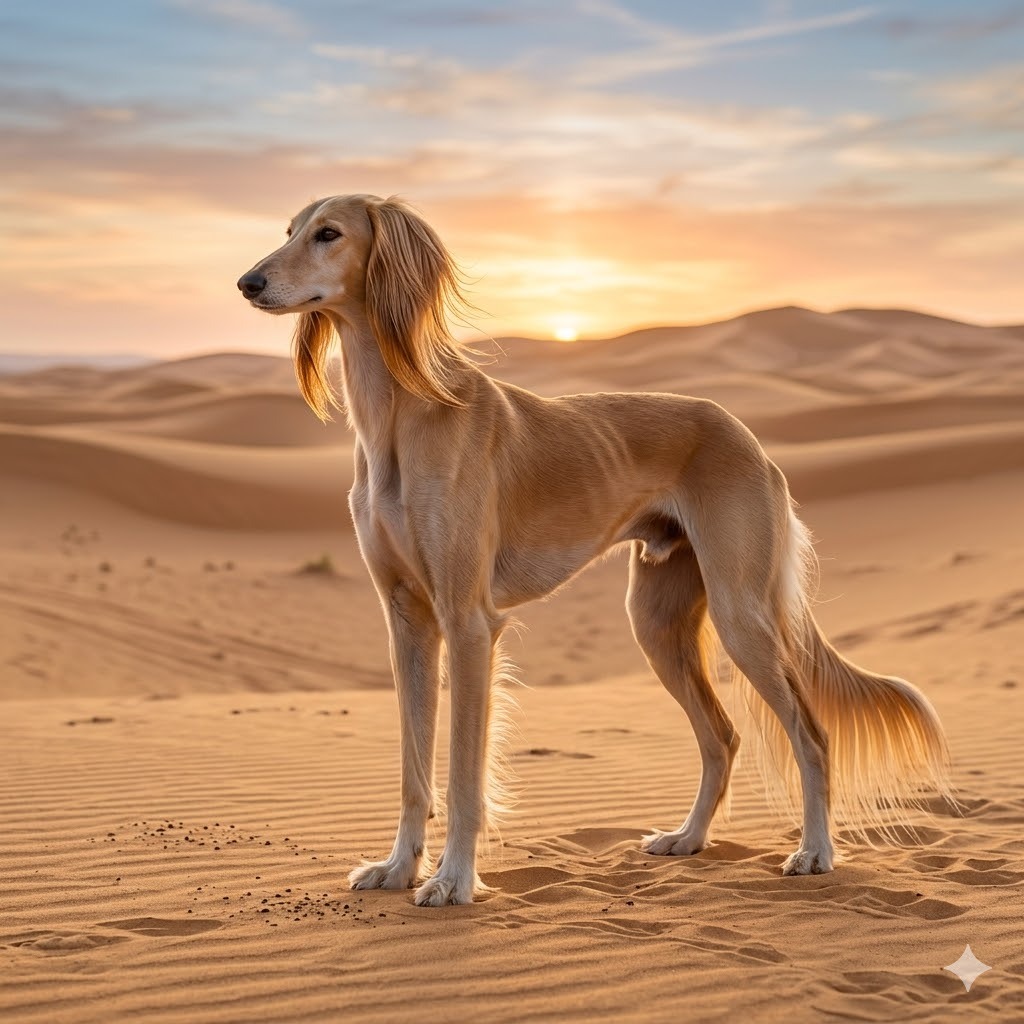
The Saluki is one of the world's oldest and most graceful sighthounds - a slender, silky, elegant hunter bred across the deserts and plains of the Middle East for extraordinary speed and endurance. Aloof, sensitive, and quietly dignified, the Saluki is a breed of contrasts: a devoted but undemonstrative companion at home, and a tireless, sight-driven runner in the field. It combines a fine, feathered coat with a lean, aerodynamic frame built to chase gazelle across open ground for miles. Like all sighthounds it has an intense prey drive, needs securely fenced space, and must never be off-leash where wildlife may run.
History & Origins
The Saluki is among the most ancient of all recognisable dog breeds, with a lineage stretching back thousands of years across the Fertile Crescent, Arabia, Persia, and the wider Middle East. Slender hunting hounds of clear Saluki type appear in ancient art and artefacts throughout the region, and the breed has long been treasured by nomadic peoples.
Prized by desert tribes, the Saluki was used to hunt gazelle, hare, and fox over sand and rocky terrain, often working alongside falcons and coursing on horseback. It was valued so highly that it was considered a noble gift rather than a bought-and-sold animal, and it lived close to its people, sheltered in tents against the desert extremes.
Because the breed spread across a vast region among many different cultures, the Saluki shows natural variety in size, colour, and coat. Western interest grew in the early 20th century, and the breed was established in Britain and later recognised by the AKC in 1929. Today the Saluki remains a treasured companion, show dog, and lure-coursing athlete, still carrying the quiet dignity of its desert heritage.
Appearance
Tall, slender, and supremely elegant, the Saluki is built for speed and endurance over distance. Adults stand 58-71 cm (23-28 in) at the shoulder and weigh 18-27 kg (40-60 lb); males are larger than females, and the breed varies naturally in size. The body is long and racy, with a deep chest, dramatically tucked waist, and long, fine legs.
Key features:
- Coat: two varieties - smooth and feathered; the feathered type has silky fringing on the ears, tail, and legs.
- Colour: a wide range, including cream, fawn, golden, red, grizzle, black-and-tan, and tricolour.
- Head: long, narrow, and refined, with a gentle stop.
- Eyes: large, dark to hazel, with a soft, far-seeing, dignified expression.
- Ears: long, mobile, and set high, often feathered with silky hair.
- Tail: long, low-set, and carried in a graceful curve, feathered in the feathered variety.
The overall impression is one of quiet grace, symmetry, and speed - a hound made for effortless, flowing movement.
Temperament & Character
The Saluki is gentle, sensitive, and aloof, forming deep but understated bonds with its family. It is not a demonstrative, always-in-your-face dog; instead it offers quiet devotion, often choosing to rest nearby rather than demand constant contact. With those it trusts, it is affectionate and loyal.
The breed is highly sensitive to atmosphere and handling - raised voices, tension, or harsh corrections distress it and erode trust. It is intelligent but independent, bred to make its own decisions at a full gallop far from its handler, and it can appear stubborn or selectively deaf.
With strangers the Saluki is reserved and dignified, rarely effusive. With children it is gentle but prefers calm, respectful company and may withdraw from rough handling. Its defining working trait is an extreme prey drive paired with remarkable endurance - once a Saluki locks onto running quarry, it can run for miles, so secure containment is vital.
Care
Coat & Grooming
Grooming needs are modest. The smooth variety needs only a weekly brush, while the feathered variety needs regular brushing of the ear, leg, and tail fringing to prevent tangles and matting. Shedding is light, and baths are needed only occasionally.
With very little body fat and a fine coat, the Saluki feels the cold sharply and needs a warm coat in winter and a soft, cushioned, draught-free bed. Check the long ears weekly, keep nails trimmed, and brush the teeth several times a week.
Exercise & Activity Needs
The Saluki is the ultimate endurance sighthound, capable of astonishing distance running, yet at home it is a calm, sprint-then-nap couch potato that loves to lounge for hours. Adults need around 60-90 minutes of daily exercise, including a chance to gallop safely.
Because of the extreme prey drive and stamina, off-leash freedom is only safe in fully enclosed, wildlife-free areas with high, secure fencing - a running Saluki can cover enormous ground and will not respond to recall in full chase. Lure coursing is an ideal outlet. Long leash walks and gentle mental enrichment keep the sensitive mind content without overwhelming it.
Health & Lifespan
Average lifespan is 12-14 years.
The Saluki is generally a healthy, long-lived breed. Points to watch:
- Anaesthetic sensitivity - marked in this lean breed; always use an experienced vet.
- Cardiac conditions - some heart issues occur; screening is worthwhile.
- Cold intolerance - the thin coat and low body fat mean chilling is a real risk.
- Hemangiosarcoma and other cancers - seen in older dogs.
- Hypothyroidism - occasionally.
With responsible breeding and sensible care, most Salukis enjoy long, active lives.
Feeding & Nutrition
Adults typically eat around 2-3 cups of quality food per day, split into two meals, adjusted for size and activity. The breed is naturally lean and racy; ribs, hips, and spine may be lightly visible in fit condition, which is normal and correct - excess weight strains the fine frame. Some Salukis can be picky eaters.
Feed a complete, balanced diet suited to an active dog. As with other deep-chested sighthounds, avoid vigorous exercise within an hour of meals to reduce bloat risk, and offer two smaller meals rather than one large one.
Pros & Cons
Pros
- Ancient, elegant, and strikingly beautiful.
- Quiet, clean, and dignified indoors.
- Deeply devoted, if understated, with family.
- Generally healthy and long-lived.
- Relatively low grooming needs.
Cons
- Extreme prey drive and endurance - unsafe off-leash near wildlife.
- Needs tall, secure fencing.
- Very sensitive - only for calm, gentle handlers.
- Independent and selectively responsive to commands.
- Sensitive to cold and can be a picky eater.
Best Suited For
- Calm, patient owners who can offer gentle handling.
- Homes with tall, secure fencing and a place to run safely.
- People wanting an elegant, quiet, dignified companion.
- Lure-coursing and sighthound enthusiasts.
Not suited for homes without secure fencing, owners wanting an off-leash trail dog in wildlife areas, harsh or impatient handlers, or busy, chaotic households that would overwhelm a sensitive dog.
Saluki puppy growth chart
A typical growth curve for a medium breed like the Saluki, estimated from its adult weight of 18-27 kg. Puppies vary with sex, genetics and diet, so treat this as a guide - for your own puppy, use the puppy weight predictor.
| Age | Typical weight | % of adult |
|---|---|---|
| 2 mo | 4.9-7.3 kg | 27% |
| 3 mo | 7.2-10.8 kg | 40% |
| 4 mo | 9-13.5 kg | 50% |
| 6 mo | 12.2-18.4 kg | 68% |
| 9 mo | 15.3-23 kg | 85% |
| 12 mo | 17.5-26.2 kg | 97% |
| Adult | 18-27 kg | 100% |
Saluki - frequently asked questions
Are Salukis affectionate?
Yes, but quietly. They are deeply devoted to their families while remaining aloof and undemonstrative, often preferring to rest nearby rather than demand constant attention.
Can a Saluki be trusted off the leash?
Only in fully enclosed, wildlife-free areas. Its prey drive and endurance are extreme, and in full chase it can run for miles and will not respond to recall.
Do Salukis need a lot of grooming?
Not a great deal. The smooth variety needs only weekly brushing; the feathered variety needs regular brushing of the ear, leg, and tail fringing to prevent matting.
Are Salukis good with children?
They are gentle but prefer calm, respectful company. They suit households with older, considerate children better than homes with boisterous toddlers.
Why are Salukis so sensitive?
The breed is highly attuned to tone and atmosphere and does not cope well with tension or harsh handling. Calm, kind, reward-based training is essential to keep its trust.
🧠 Test yourself: guess the dog
Three clues from our quiz bank, each about another of our dogs. Can you name them?
Clue 1.Bred down from a larger farm ratter, this wiry-coated companion has a stocky body and bold personality.
It's the Miniature Schnauzer - read the full profile →
Clue 2.The world's smallest dog breed, this big-eared, big-eyed pocket companion is named for a Mexican state.
It's the Chihuahua - read the full profile →
Clue 3.This imposing Italian mastiff, whose name roughly means 'bodyguard dog', descends from Roman war dogs.
It's the Cane Corso - read the full profile →
💛 Adoptable Salukis near you
Real dogs of this breed (and close mixes) waiting in shelters and rescues right now, live from Petfinder. We have no affiliation and earn nothing - if someone catches your eye, the link goes straight to their shelter. New to adopting? Start with our adoption guide.
Widget not loading (some ad-blockers hide it)? Search directly on petfinder.com.