Xoloitzcuintli
The Xoloitzcuintli - pronounced "show-low-eets-QUEENT-lee" and usually shortened to "Xolo" - is the ancient Mexican Hairless Dog, one of the oldest and most distinctive breeds on earth.
🗓️ Last reviewed: July 2026
Overview
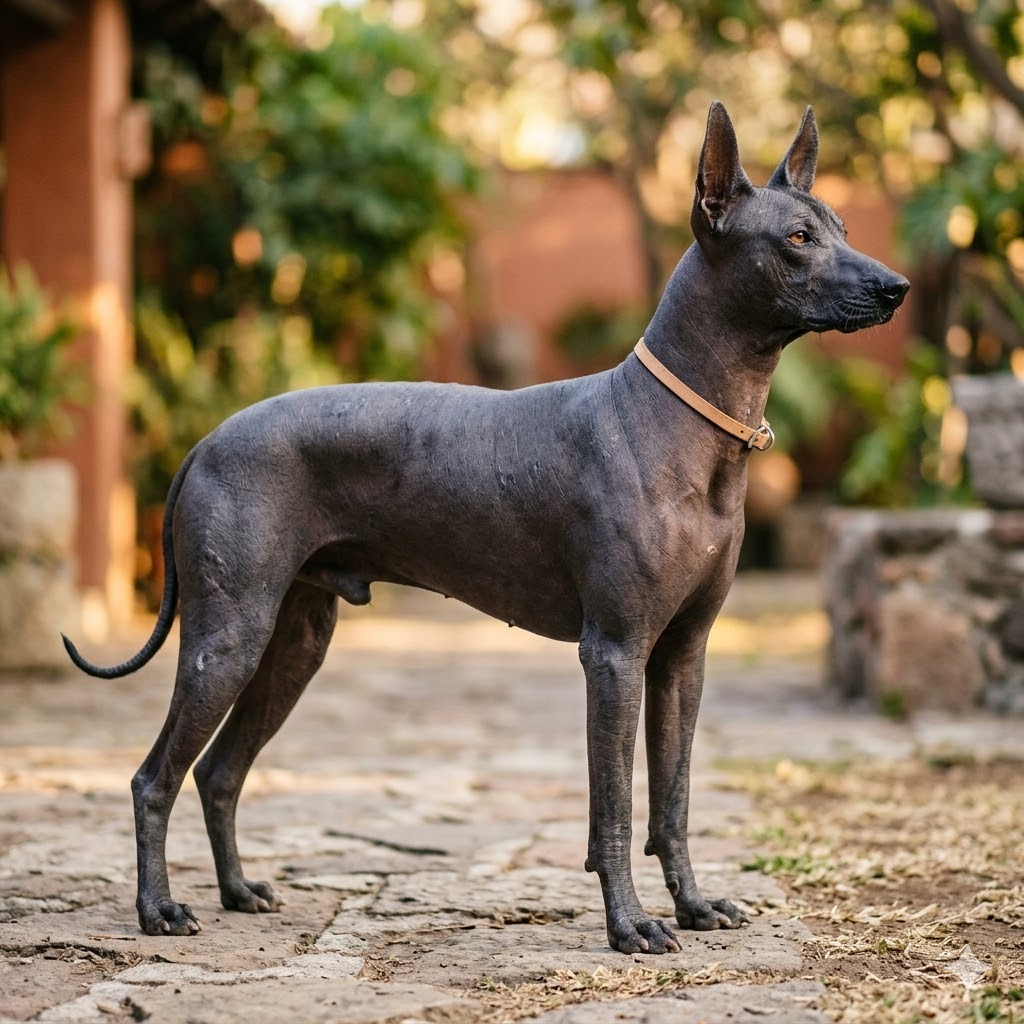
The Xoloitzcuintli - pronounced "show-low-eets-QUEENT-lee" and usually shortened to "Xolo" - is the ancient Mexican Hairless Dog, one of the oldest and most distinctive breeds on earth. Calm, loyal, watchful, and deeply devoted, the Xolo is a dignified companion with a history stretching back over three thousand years to the civilisations of ancient Mesoamerica. It comes in a hairless variety and a less common coated variety, and in three sizes - toy, miniature, and standard - spanning roughly 4-25 kg (9-55 lb). The hairless coat brings unique skin-care and temperature needs, but the breed is otherwise remarkably hardy, healthy, and long-lived.
History & Origins
The Xoloitzcuintli is among the most ancient of all dog breeds, with archaeological and genetic evidence tracing it back more than 3,000 years in Mexico and Central America. Its name comes from the Aztec god Xolotl, deity of lightning and death, and "itzcuintli," the Aztec word for dog. The Aztecs and earlier peoples believed the Xolo guided the souls of the dead through the underworld, and the dogs were revered as sacred guardians, healers, and companions.
Clay and ceramic figures of these hairless dogs have been found in ancient tombs across Mexico. The breed survived colonisation and centuries of change largely in rural Mexico, but by the mid-1900s it had become rare and was at risk of disappearing entirely.
In the 1950s a dedicated expedition organised by the Mexican Kennel Club searched remote villages to find and preserve the remaining pure Xolos, saving the breed. The Xolo was declared a national treasure and cultural symbol of Mexico. It gained international recognition, with the AKC restoring it to full recognition in 2011. Today the Xolo is celebrated as a living piece of Mesoamerican heritage and a distinctive, loyal companion.
Appearance
An elegant, well-muscled, and enduring dog in three sizes. Toy: 25-35 cm (10-14 in), roughly 4-8 kg (9-18 lb). Miniature: 35-45 cm (14-18 in), roughly 8-14 kg (18-31 lb). Standard: 45-60 cm (18-23 in), roughly 15-25 kg (33-55 lb).
Key features:
- Coat: the hairless variety has smooth, tough, close-fitting skin with hair usually only on the top of the head, feet, and tail tip; the coated variety has a short, flat, close coat over the whole body.
- Colour: dark and uniform is preferred - black, slate, grey-black, red, liver, or bronze; some white markings occur.
- Skin/head: the hairless skin is thick, smooth, and warm to the touch; the head is elegant and wolf-like with a broad skull.
- Eyes: almond-shaped, dark, with an alert, intelligent expression.
- Ears: large, elegant, and erect (hairless variety); may be softer in the coated variety.
- Tail: long, fine, and tapering.
Missing or incomplete teeth are common and normal in the hairless variety - a genetic quirk linked to the hairlessness gene.
Temperament & Character
Calm, loyal, and reserved. The Xolo is a quietly dignified dog - watchful and alert rather than boisterous, deeply bonded to its family, and famously devoted to its chosen people. It is affectionate and gentle with those it loves, often following its owner from room to room, but it is naturally aloof and cautious with strangers, which makes it an excellent, discreet watchdog.
This is a thinking, sensitive breed, not a hyperactive one. Adult Xolos are typically composed and settled indoors, content to relax close to their family once their moderate exercise needs are met. They are quiet dogs compared with most spitz and terrier breeds - rarely nuisance barkers.
With children in their own family they are gentle and patient. With strangers and unfamiliar dogs they are reserved and benefit from good socialisation. The breed can be sensitive and does not thrive on harshness or on being left alone for long periods; it wants to be with its people.
Care
Coat & Grooming
The hairless Xolo needs skin care rather than coat care. The exposed skin must be kept clean; gentle washing every week or two and occasional light moisturising keep it healthy, though over-bathing or heavy products can cause breakouts, so a careful balance is needed. Sun protection is essential - the skin can sunburn, so shade and canine-safe sunscreen on exposed areas are important in strong sun.
Because it is hairless, the Xolo is sensitive to cold and needs a coat or sweater in chilly weather. The coated variety is extremely low-maintenance, needing only occasional brushing. Both varieties benefit from weekly ear cleaning, nail trims every 3-4 weeks, and regular teeth brushing - especially important given the breed's tendency toward missing or crowded teeth. The breed sheds very little.
Exercise & Activity Needs
Moderate. The Xolo needs 45-60 minutes of daily exercise - walks, play, and free running in safe areas - scaled to its size, with standards needing more than toys. It is athletic and enjoys activity, but it is not a frantic or tireless breed; once exercised it settles calmly at home.
The breed does well at agility, obedience, and other dog sports when trained positively, and it enjoys hiking and outdoor time in comfortable weather. Because of its temperature sensitivity, exercise should be adjusted for conditions: protected from sun and heat in summer, and kept warm in winter. Mental stimulation through training and play keeps this intelligent breed content.
Health & Lifespan
Average lifespan is 13-18 years - exceptionally long-lived and one of the healthiest of all breeds.
Common concerns:
- Skin issues - acne, sunburn, and irritation on the exposed hairless skin, largely manageable with proper care.
- Dental irregularities - missing or crowded teeth are normal in the hairless variety and need dental attention.
- Sensitivity to heat and cold due to the lack of coat.
- Occasional joint issues in some lines.
The Xolo is remarkably free of the widespread genetic diseases that trouble many modern breeds - a benefit of its ancient, natural, minimally-manipulated heritage. It is one of the hardiest and healthiest breeds a companion owner can choose.
Feeding & Nutrition
Feeding scales with size: a toy Xolo may eat around ½-1 cup a day, a standard up to 2-2½ cups, always divided into two meals. The breed is generally a sensible eater and maintains condition well, but portions should be measured and treats accounted for to avoid weight gain.
A quality diet matched to size and activity suits the breed. Some owners find a diet supporting skin health beneficial for the hairless variety. Given the dental irregularities common in hairless Xolos, kibble size and dental care should be considered. Fresh water should always be available.
Pros & Cons
Pros
- Ancient, unique, and culturally rich breed.
- Exceptionally healthy and very long-lived.
- Calm, loyal, and devoted companion.
- Minimal shedding; low grooming for the coat itself.
- Quiet compared with most companion breeds.
Cons
- Hairless skin needs sun protection and regular care.
- Sensitive to both cold and heat; needs coats in winter.
- Reserved with strangers; requires thorough socialisation.
- Strongly bonded; dislikes being left alone for long.
- Dental irregularities common in the hairless variety.
Best Suited For
- Owners wanting a calm, loyal, low-shedding companion.
- Homes in moderate climates, or willing to manage temperature needs.
- People who appreciate a dignified, sensitive, ancient breed.
- Households where someone is home much of the day.
Not suited for owners wanting a boisterous playmate, those unwilling to manage skin and temperature care, homes with extreme unmanaged climates, or people away long hours.
Xoloitzcuintli puppy growth chart
A typical growth curve for a medium breed like the Xoloitzcuintli, estimated from its adult weight of 4-25 kg. Puppies vary with sex, genetics and diet, so treat this as a guide - for your own puppy, use the puppy weight predictor.
| Age | Typical weight | % of adult |
|---|---|---|
| 2 mo | 1.1-6.8 kg | 27% |
| 3 mo | 1.6-10 kg | 40% |
| 4 mo | 2-12.5 kg | 50% |
| 6 mo | 2.7-17 kg | 68% |
| 9 mo | 3.4-21.3 kg | 85% |
| 12 mo | 3.9-24.3 kg | 97% |
| Adult | 4-25 kg | 100% |
Xoloitzcuintli - frequently asked questions
Are hairless Xolos completely bald?
Mostly. The hairless variety has smooth skin with hair usually only on the top of the head, the feet, and the tip of the tail. There is also a fully coated variety with a short flat coat over the whole body.
Do Xolos need special skin care?
Yes. The exposed skin should be kept clean and protected from the sun with shade and canine-safe sunscreen, and they need a sweater or coat in cold weather. Over-bathing should be avoided to prevent breakouts.
Are Xoloitzcuintli healthy dogs?
Remarkably so. The breed is one of the healthiest and longest-lived of all dogs, commonly reaching 13-18 years, thanks to its ancient, natural heritage and minimal genetic manipulation.
Are they good family pets?
Yes. Xolos are calm, loyal, gentle with their own family, and quiet compared with most breeds. They bond deeply and suit homes that can give them company and moderate exercise.
Are Xolos hypoallergenic?
No dog is truly hypoallergenic, but the hairless variety sheds very little and produces less loose hair, which some allergy sufferers tolerate better. Dander can still cause reactions.
🧠 Test yourself: guess the dog
Three clues from our quiz bank, each about another of our dogs. Can you name them?
Clue 1.Once called the 'bobtail,' this drovers' dog has a loud, distinctive 'pot-casse' or cracked-bell bark.
It's the Old English Sheepdog - read the full profile →
Clue 2.With an arched back and a high-stepping, prancing trot, this thin-coated dog gets cold very easily.
It's the Italian Greyhound - read the full profile →
Clue 3.Bred by a Siberian people to herd reindeer and pull sleds, this thick-coated spitz has a brilliant snow-white coat.
It's the Samoyed - read the full profile →
💛 Adoptable Xoloitzcuintlis near you
Real dogs of this breed (and close mixes) waiting in shelters and rescues right now, live from Petfinder. We have no affiliation and earn nothing - if someone catches your eye, the link goes straight to their shelter. New to adopting? Start with our adoption guide.
Widget not loading (some ad-blockers hide it)? Search directly on petfinder.com.