Glowlight Tetra
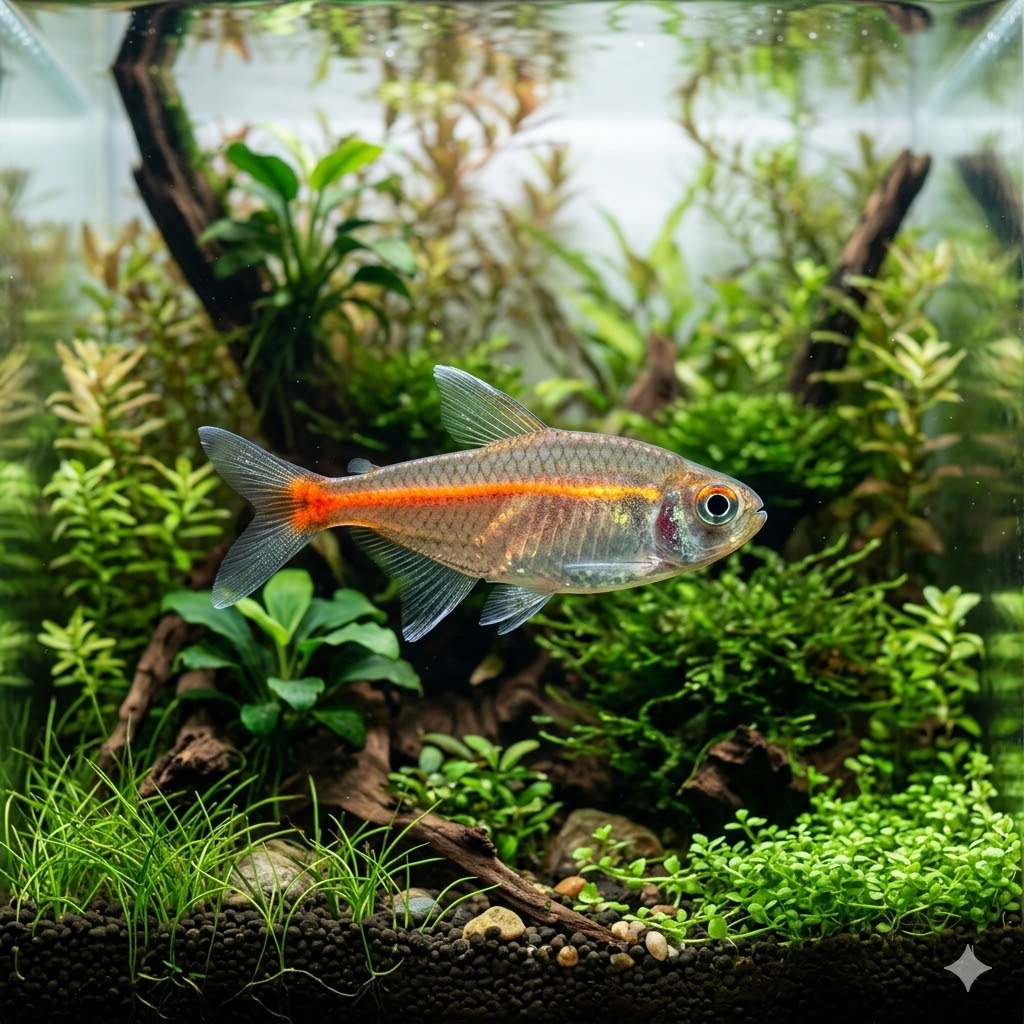
The glowlight tetra (Hemigrammus erythrozonus) is a small, peaceful nano tetra famous for the glowing orange-red stripe that runs the length of its otherwise translucent silver body, like a filament of neon light.
🗓️ Last reviewed: July 2026
Overview
The glowlight tetra (Hemigrammus erythrozonus) is a small, peaceful nano tetra famous for the glowing orange-red stripe that runs the length of its otherwise translucent silver body, like a filament of neon light. Adults reach only about 4 cm, and in a planted tank with soft, gently coloured lighting the stripe seems to shine from within. Calm, undemanding and beautiful in a school, they are a superb community and nano-tank fish. They are less flashy than their neon and cardinal cousins but arguably more refined, offering a single warm line of colour that reads beautifully against green plants and dark wood. For a keeper who wants a gentle, elegant shoal that gets along with almost everything small and peaceful, the glowlight is hard to beat.
Natural History
Native to the Essequibo River basin in Guyana, South America, where they live in slow, soft, tannin-stained blackwater streams shaded by forest. The dark, mineral-poor water and dim, dappled light of these habitats explain their preference for soft water, subdued lighting and plenty of cover in the aquarium. Long established in the hobby, most fish sold today are captive-bred and hardy, which means they are generally more tolerant of average tap water than truly wild-caught specimens, though they still colour up best and stay healthiest when their soft, gently acidic origins are respected.
They belong to the same broad group as neon and cardinal tetras, and share the same love of schooling. Where neons flash blue and red, the glowlight glows a single warm orange line, giving it a quieter, more elegant look. Their blackwater heritage is worth keeping in mind: adding a little botanical matter such as leaf litter or a piece of driftwood to release gentle tannins recreates the tea-coloured water they evolved in, softening the light and intensifying their colour just as it would in the wild.
Appearance
Slim, translucent silvery body with a single bright orange-to-red horizontal stripe running from the snout to the base of the tail. The top edge of the dorsal fin often carries a matching red touch. The body is see-through enough that the stripe stands out vividly, and colour deepens over a dark substrate and in tannin-tinted water. Males tend to be slimmer, females a little rounder when carrying eggs. The effect is at its best when a whole shoal moves in loose formation, dozens of glowing lines drifting together and catching the light at slightly different angles, which is why a single fish never does the species justice.
Tank Size & Setup
Minimum tank size is around 40 litres for a proper school, with a longer footprint preferred for swimming room. Recreate their blackwater home with a dark substrate, driftwood, live plants and some floating cover to soften the light. Gentle filtration and gentle flow suit them. They must be kept as a school of at least 6, and ideally more - a good-sized group makes them bolder, brighter and more natural, while lone or paired fish become shy and washed-out. They mix well with other small, peaceful community fish. Avoid strong, direct lighting and bare, open layouts, both of which leave them nervous and pale; a mature planted tank with plenty of visual breaks lets them settle and display. A well-cycled, stable tank matters more to them than any single piece of equipment.
Water Parameters
- Temperature: 24-28°C.
- pH: 6.0-7.0 - slightly acidic and soft is ideal.
- Soft water preferred.
- Ammonia 0, nitrite 0, nitrate low.
Diet
Micro-predator and omnivore. They readily take quality micro-pellets and crushed flake, and thrive on small live and frozen foods such as daphnia, baby brine shrimp, micro-worms and finely chopped bloodworm. A varied diet keeps the orange stripe vivid and supports good condition and colour. Rotating a few different foods through the week not only deepens their colour but also encourages the natural foraging darting that makes a school so lively to watch. Feed small portions the fish can finish quickly to protect water quality.
Health & Lifespan
Average lifespan is 4-6 years.
Hardy and peaceful when kept in stable, soft, clean water. Common concerns:
- Stress and fading colour in bright, bare tanks or too-small schools.
- Ich (white spot) during temperature swings.
- Fin rot in poor water quality.
- Sensitivity to hard, alkaline water over the long term.
Pros & Cons
Pros: peaceful and beginner-friendly; glowing orange stripe is striking in a school; ideal nano and community fish; gets along with almost any small, gentle tank-mate. Cons: small and shy if under-schooled; prefers soft, slightly acidic water; colour is muted under harsh lighting; easily out-competed by boisterous fish.
Glowlight Tetra - frequently asked questions
How big do they get?
About 4 cm - a true nano fish.
How many should I keep?
At least 6, and more is better. As a schooling fish they are brighter and calmer in a decent-sized group.
Are they good for beginners?
Yes - they are peaceful, hardy and easy to feed, provided the water is soft and clean.
What makes the stripe glow?
The bright orange-red pigment against a translucent body catches the light, and the effect deepens over dark substrate and in tannin-tinted blackwater conditions.
What tank-mates suit them?
Other small, peaceful community fish and shrimp - avoid large or fin-nipping species. Good companions include other small tetras, rasboras, corydoras and dwarf shrimp, all of which share their preference for calm, gently lit, well-planted tanks.
🧠 Test yourself: guess the fish
Three clues from our quiz bank, each about another of our fish. Can you name them?
Clue 1.Diamond-shaped with long flowing dorsal and anal fins, this popular tank fish needs a tall aquarium to accommodate its towering body.
It's the Angelfish - read the full profile →
Clue 2.Domesticated from a dull carp over a thousand years ago in China, this orange fish is one of the oldest kept pets.
It's the Goldfish - read the full profile →
Clue 3.Males of this small, vividly colored labyrinth fish are so territorial that two cannot share a tank without fighting, giving rise to a fierce nickname.
It's the Betta (Siamese Fighting Fish) - read the full profile →