Neon Tetra
The Neon Tetra (Paracheirodon innesi) is the iconic small community fish - a tiny silvery fish with brilliant electric blue and red horizontal stripes.
Updated: October 2026
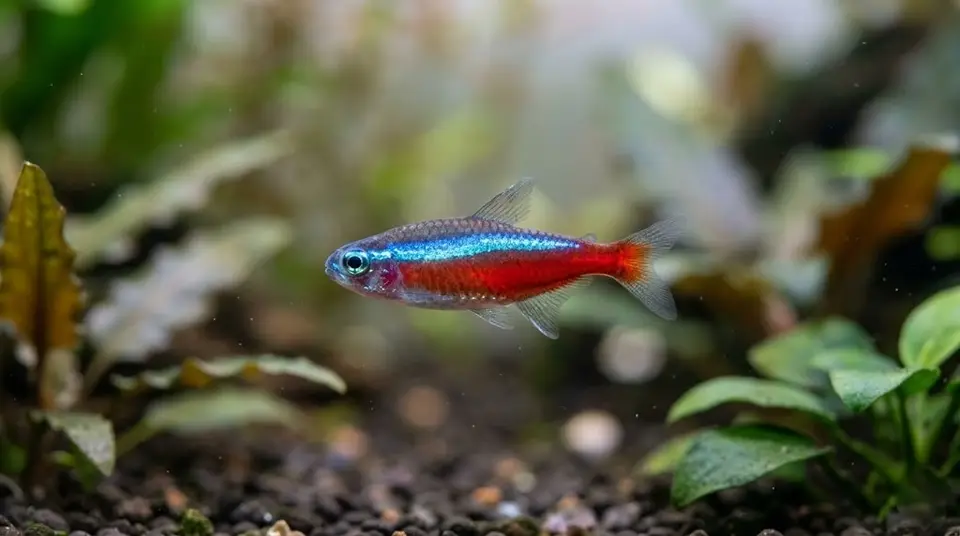
Overview
The Neon Tetra (Paracheirodon innesi) is the iconic small community fish - a tiny silvery fish with brilliant electric blue and red horizontal stripes. Schooling, peaceful, and beautiful, Neons have decorated home aquariums since the 1930s.
Natural History
Native to the western Amazon basin of South America. Lives in slow-moving forest streams with tannin-stained water (blackwater).
Appearance
Adults 3-4 cm length. Blue stripe along upper body and red stripe along lower rear. Silvery underside.
Temperament & Tankmates
Peaceful schooling fish. Must be kept in groups of at least six and is more active in groups of 8-12 or more (Wikipedia).
Excellent in community tanks with other small peaceful species. Avoid with large fish (Angelfish eat adult Neons).
Tank Size & Setup
At least 38 L (10 US gallons), by Wikipedia; a larger, densely planted tank gives a shoal more swimming room.
Soft water, gentle current, planted tank with dim lighting suits them best.
Water Parameters
- Temperature: 22-24°C in the aquarium; wild waters run 20-28°C (Wikipedia).
- pH: 6.0-7.0 (6.0-8.0 tolerated).
- Soft water: GH below 10 dGH, KH 1-2 dKH, nitrate under 20 ppm (Wikipedia).
Diet
Omnivore. Neon tetras take most flake foods if the flakes are small enough, and Wikipedia advises adding small foods such as brine shrimp, daphnia and bloodworms, plus micro pellets; a tropical sinking pellet suits them well (Wikipedia).
| Give | Avoid |
|---|---|
| Small tropical flakes, micro pellets or a tropical sinking pellet as the staple | Flakes too large for their small mouths |
| Brine shrimp or daphnia, frozen packs fully thawed first (RSPCA) | Goldfish flakes: their nutrient levels are different (RSPCA) |
| Frozen or freeze-dried bloodworms now and then for variety (Wikipedia) | More food than the fish eat in two to five minutes, and holiday feeding blocks (RSPCA) |
Feed two or three times a day, as much as the shoal eats within two to five minutes; underfeeding is safer than overfeeding, since fish suffer more from poor water quality (RSPCA).
Health & Lifespan
Normally 2-3 years in an aquarium, though they can live as long as 10, according to Wikipedia.
Common concerns:
- Neon Tetra disease (NTD) - incurable parasitic infection; quarantine new fish.
- Ich.
- Fin rot.
- Tank-cycle deaths from being added too early.
Pros & Cons
Pros: brilliant colours, peaceful schooling, attractive in planted tanks. Cons: mass-bred stock often fragile; Neon Tetra disease; sensitive to water quality.
Everyday gear for aquariums
Links go to Amazon or a partner brand's own store and may earn us a commission at no extra cost to you. As an Amazon Associate we earn from qualifying purchases. An Amazon link leads to a type of gear and you choose the exact product; a card that names a store leads to that partner's own shop.
Neon Tetra - frequently asked questions
What do neon tetras eat?
Small flakes, micro pellets or a tropical sinking pellet as the staple, with brine shrimp, daphnia and bloodworms as extras (Wikipedia), fed two or three times a day and only as much as they eat in two to five minutes (RSPCA).
How many do I need?
At least six, and they are more active in groups of 8-12 or more (Wikipedia).
Neon vs Cardinal Tetra?
Cardinal has red running the full length of body; Neon has red only the rear half. Neons are more widespread, as cardinals were long difficult to breed in captivity (Wikipedia).
How long do they live?
Normally 2-3 years in an aquarium, as long as 10 at most (Wikipedia).
Beginner fish?
After tank is cycled (4-6 weeks). Sensitive to ammonia/nitrite.
Sources
Sources this profile draws on, as linked in the text:
Test yourself: guess the fish
Three clues from our quiz bank, each about another of our fish. Can you name them?
Clue 1.Domesticated from a dull carp over a thousand years ago in China, this orange fish is one of the oldest kept pets.
It's the Goldfish - read the full profile →
Clue 2.Easy to breed and colorful, the males of this small species sport flashy fan-shaped tails to court drab females.
It's the Guppy - read the full profile →
Clue 3.This category of hardy tropical fish includes the swordtail and platy and breeds readily in home tanks.
It's the Molly / Platy / Swordtail (Livebearers) - read the full profile →