Tiger Barb
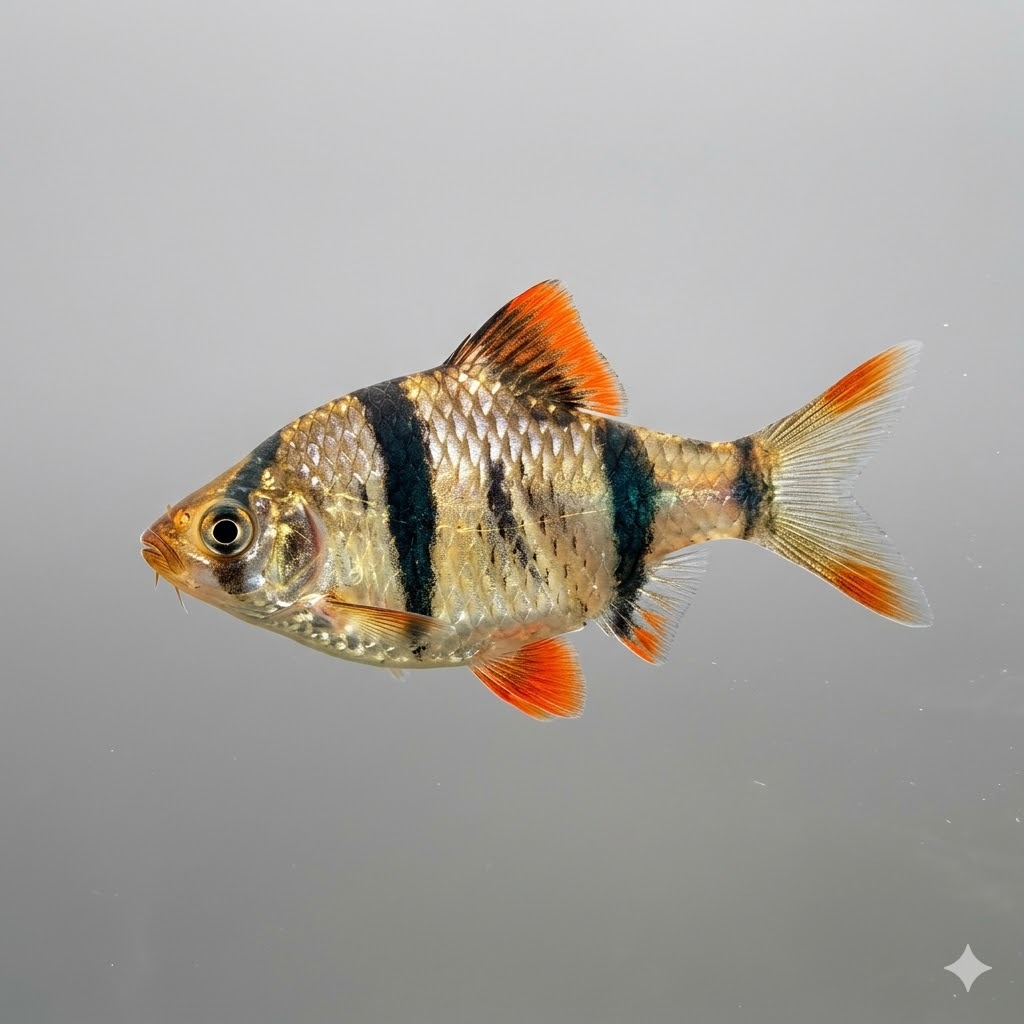
The Tiger Barb (Puntigrus tetrazona) is a small, active, boisterous schooling fish from Southeast Asia, recognised by its silvery-gold body crossed with four bold black vertical bars and bright orange-red trim on the snout and fins.
🗓️ Last reviewed: June 2026
Overview
The Tiger Barb (Puntigrus tetrazona) is a small, active, boisterous schooling fish from Southeast Asia, recognised by its silvery-gold body crossed with four bold black vertical bars and bright orange-red trim on the snout and fins. Hardy and full of energy, it is a long-time favourite, but its busy, semi-aggressive nature means it must be kept in proper groups and matched with the right tankmates.
Natural History
Native to the clear and slightly tannin-stained streams, tributaries, and forest pools of Sumatra and Borneo, with established populations elsewhere in Southeast Asia. These waters are warm, well-oxygenated, and often flowing, with sandy or gravelly beds, driftwood, and patches of vegetation. The species lives in active groups in open water, constantly on the move.
Appearance
Adults reach 5-7 cm. The body is silvery-gold to amber, marked by four crisp black vertical bars - one through the eye, one behind the gills, one mid-body, and one at the tail base. The snout, dorsal edge, and fins carry a vivid orange-red flush, brightest in dominant males. Selectively bred forms exist too, including green (moss), albino, and long-finned varieties.
Temperament & Tankmates
Lively, bold, and shoaling - but also semi-aggressive and prone to fin-nipping. Tiger barbs must be kept in groups of at least 6, ideally 8-10 or more. In proper numbers they direct their energy into chasing and squabbling within their own school, which keeps them busy and greatly reduces nipping of other fish. In small groups they turn that pestering on their tankmates.
They suit robust, fast-moving community fish of similar size: other barbs, danios, larger rasboras, rainbowfish, and many catfish such as corydoras and plecos. Avoid slow or long-finned tankmates - bettas, angelfish, guppies, and fancy goldfish - whose trailing fins are an irresistible target. Do not house them with timid or much smaller fish.
Tank Size & Setup
Minimum: 75 L (20 gallon) for a group of 6-8.
These are fast swimmers that need open horizontal length to cruise and chase, so a longer tank is far better than a tall one. Provide a sandy or fine-gravel bed, driftwood, rockwork, and planting around the sides and back, leaving a clear central running lane. They appreciate good flow and high oxygen from the filter outlet. A firm lid is essential - active barbs can jump.
Water Parameters
- Temperature: 22-27°C.
- pH: 6.0-7.5 (slightly acidic to neutral preferred).
- Soft to moderately hard water.
- Ammonia 0, nitrite 0, nitrate <30 ppm.
Diet
Hungry, eager omnivore. Offer a quality flake or sinking micro-pellet staple, supplemented with frozen or live bloodworms, daphnia, and brine shrimp, plus occasional blanched vegetable matter or spirulina to round out the diet. Feed small portions once or twice daily and avoid overfeeding - they will beg constantly.
Health & Lifespan
5-6 years.
Common concerns:
- Ich (white spot).
- Fin rot from poor water quality.
- Stress and aggression from being kept in too-small groups.
- Tank-cycle deaths from being added before the tank is established.
Pros & Cons
Pros: hardy, active, striking colour and pattern, entertaining behaviour, easy to feed. Cons: semi-aggressive fin-nipper; must be kept in proper groups; unsuitable with long-finned or timid tankmates; needs open swimming length.
Tiger Barb - frequently asked questions
How many tiger barbs should I keep?
At least 6, ideally 8-10 or more. Larger groups keep their nipping focused within the school and far away from other fish.
Why do tiger barbs nip fins?
It is natural pecking-order behaviour. Kept in too-small groups, they redirect it onto tankmates - especially slow, long-finned fish. A proper-sized school is the fix.
Are they good beginner fish?
Yes for their hardiness, but they are not a peaceful community fish. They are best for beginners who plan around their boisterous nature rather than mixing them with delicate species.
What can I keep them with?
Robust, fast fish of similar size: other barbs, danios, rainbowfish, larger rasboras, corydoras, and plecos. Avoid bettas, angelfish, guppies, and fancy goldfish.
🧠 Test yourself: guess the fish
Three clues from our quiz bank, each about another of our fish. Can you name them?
Clue 1.Unlike most aquarium fish, this beginner-friendly group gives birth to free-swimming young instead of laying eggs.
It's the Molly / Platy / Swordtail (Livebearers) - read the full profile →
Clue 2.A popular tank-cleaning bottom dweller from South American rivers, it rasps biofilm with a suckermouth and enjoys driftwood to graze.
It's the Bristlenose Pleco - read the full profile →
Clue 3.This tall, triangular freshwater fish from the Amazon basin swims with trailing fin filaments and is a graceful staple of community aquariums.
It's the Angelfish - read the full profile →