Harlequin Rasbora
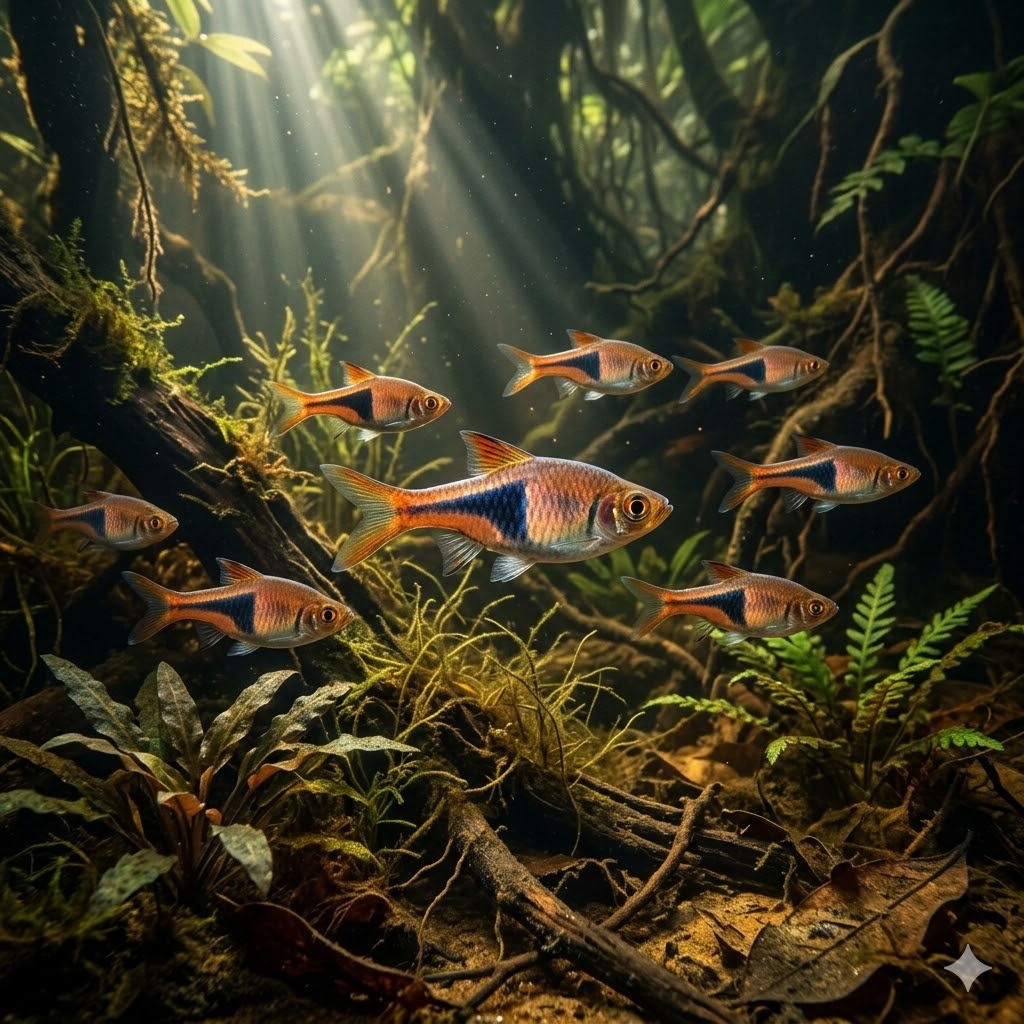
The Harlequin Rasbora (Trigonostigma heteromorpha) is a small, peaceful schooling fish from Southeast Asia, instantly recognised by its warm copper-pink body and bold black triangular patch over the rear half.
🗓️ Last reviewed: June 2026
Overview
The Harlequin Rasbora (Trigonostigma heteromorpha) is a small, peaceful schooling fish from Southeast Asia, instantly recognised by its warm copper-pink body and bold black triangular patch over the rear half. Hardy, undemanding, and beautiful in a planted tank, it is one of the classic community species and an excellent choice for beginners.
Natural History
Native to the blackwater streams, peat swamps, and forest pools of Malaysia, Thailand, Sumatra, and Singapore. These habitats are soft, acidic, and stained brown with tannins from decaying leaves, with dense vegetation and gentle flow. The species shoals in open mid-water among submerged plants.
Appearance
Adults reach 4-5 cm. The body is a warm copper to rosy-pink, marked by a distinctive black "pork chop" triangle running from mid-body to the tail base. Fins carry a soft orange-red tint. A blue-line variant and selectively bred colour forms also exist.
Temperament & Tankmates
Gentle, peaceful, and shoaling. Harlequin rasboras should be kept in groups of at least 8-10; in larger shoals they colour up better, swim more confidently, and display natural behaviour. Small groups become shy and faded.
They are ideal community fish, mixing well with other small peaceful species such as tetras, other rasboras, corydoras, dwarf gouramis, and dwarf shrimp. Avoid large or aggressive tankmates that intimidate or prey on them.
Tank Size & Setup
Minimum: 60 L (15 gallon) for a shoal of 8-10.
A planted blackwater-style aquarium suits them perfectly: dark substrate, driftwood, leaf litter, and gentle filtration. Soft, slightly acidic, tannin-stained water brings out their best colour. Provide open mid-water swimming space framed by planting. A lid prevents jumping.
Water Parameters
- Temperature: 22-27°C.
- pH: 6.0-7.0 (acidic preferred).
- Soft water (low hardness).
- Ammonia 0, nitrite 0, nitrate <30 ppm.
Diet
Omnivore with a small mouth. Offer a quality micro-pellet or finely crushed flake staple, supplemented with frozen or live daphnia, baby brine shrimp, and small bloodworms. Feed small portions once or twice daily.
Health & Lifespan
5-8 years.
Common concerns:
- Ich (white spot).
- Fin rot from poor water quality.
- Stress and fading from being kept in too-small groups or in hard, alkaline water.
- Tank-cycle deaths from being added before the tank is established.
Pros & Cons
Pros: peaceful, hardy, striking colour, excellent community shoaler, beginner-friendly. Cons: needs to be kept in groups; colours best only in soft acidic water; small size limits tankmate choices.
Harlequin Rasbora - frequently asked questions
How many harlequin rasboras should I keep?
At least 8-10. Larger shoals are calmer, more colourful, and far more rewarding to watch.
What water do they prefer?
Soft, slightly acidic, tannin-stained blackwater brings out their colour, though they tolerate a moderate range once acclimatised.
Are they good beginner fish?
Yes - hardy and forgiving once the tank is cycled, and one of the best peaceful community shoalers available.
What can I keep them with?
Other small peaceful fish: tetras, rasboras, corydoras, dwarf gouramis, and dwarf shrimp. Avoid large or aggressive species.
🧠 Test yourself: guess the fish
Three clues from our quiz bank, each about another of our fish. Can you name them?
Clue 1.Unlike most aquarium fish, this beginner-friendly group gives birth to free-swimming young instead of laying eggs.
It's the Molly / Platy / Swordtail (Livebearers) - read the full profile →
Clue 2.Fancy varieties of this fish include bubble-eye and telescope-eye types bred for unusual looks.
It's the Goldfish - read the full profile →
Clue 3.Often confused with a deeper-red cousin, this small fish has red only on its back half, not its whole belly.
It's the Neon Tetra - read the full profile →