Corydoras Catfish
Corydoras catfish (Corydoras genus) are small, sociable, armoured bottom-dwelling South American catfish - the perfect community fish for cleaning up uneaten food and providing entertaining bottom-dwelling activity.
Updated: October 2026
Overview
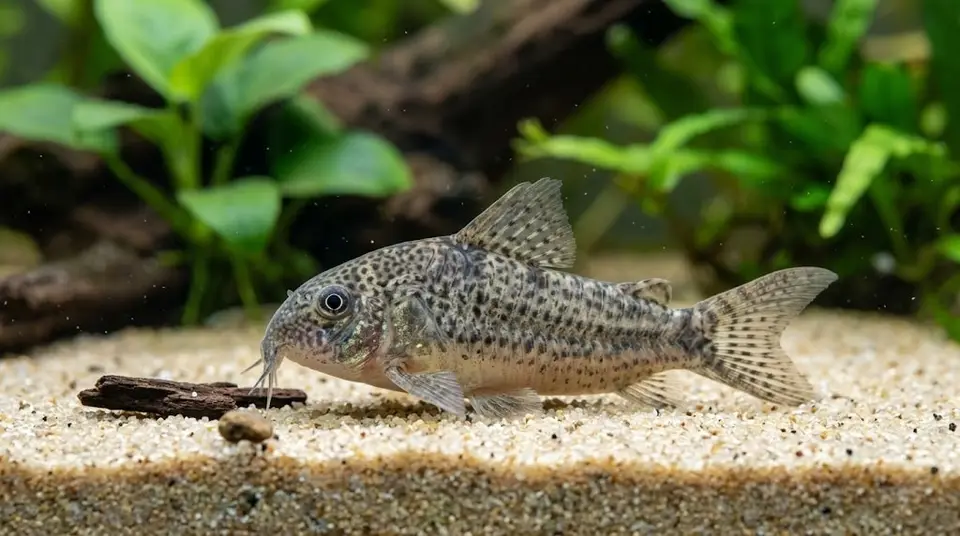
Corydoras catfish (Corydoras genus) are small, sociable, armoured bottom-dwelling South American catfish - the perfect community fish for cleaning up uneaten food and providing entertaining bottom-dwelling activity. Always kept in groups, "Cory cats" are among the most charming small fish in the hobby.
Natural History
Over 150 species traditionally placed in the Corydoras genus (since split by taxonomists into several genera, though the trade still calls them all Corydoras), native to South America's slow rivers and streams.
Common pet species:
- Bronze Corydoras (Corydoras aeneus, now Osteogaster aenea): most popular.
- Peppered Corydoras (Corydoras paleatus, now Hoplisoma paleatum).
- Panda Corydoras (Corydoras panda, now Hoplisoma panda): black eye patches.
- Sterbai Corydoras - warmer water-tolerant; popular with Discus.
- Albino, Pygmy, others.
Appearance
Adults 4-7 cm length. Stocky body with bony armoured plates.
Temperament & Tankmates
Highly social. Keep in groups of 6+ - same species. Larger groups (10+) show natural behaviour better.
Peaceful with other species. Excellent with community fish - tetras, livebearers, peaceful catfish, peaceful South American cichlids.
Tank Size & Setup
Minimum: 75 L (20 gallon) for a group of 6 small Corydoras.
Sand substrate preferred - Corydoras barbels are damaged by sharp gravel. Driftwood, hides, gentle flow.
Water Parameters
- Temperature: 22-26°C (Sterbai tolerate 28°C).
- pH: 6.0-7.5.
- Soft to moderately hard water.
Diet
Sinking pellets, sinking wafers, frozen bloodworms, blanched vegetables. Corydoras need food that reaches the bottom; floating-only feeding starves them.
Health & Lifespan
5-10 years.
Common concerns:
- Barbel erosion from sharp substrate.
- Cory cat poisoning - Corydoras release toxins when stressed (during shipping); never transport in small bags with multiple Cories.
- Ich.
- Fin rot.
Pros & Cons
Pros: peaceful, social, entertaining bottom activity, long-lived. Cons: group requirement, fine sand or smooth gravel essential.
Everyday gear for aquariums
Links go to Amazon or a partner brand's own store and may earn us a commission at no extra cost to you. As an Amazon Associate we earn from qualifying purchases. An Amazon link leads to a type of gear and you choose the exact product; a card that names a store leads to that partner's own shop.
Corydoras Catfish - frequently asked questions
How many do I need?
6+ minimum, same species. 10+ shows natural schooling behaviour.
Can different Cory species school together?
Sometimes, but each species feels safest with its own kind. Best to keep groups of 6 per species.
Will they clean my tank?
Partially. They eat uneaten food but are not vacuum cleaners. Tank cleaning is still required.
How long do they live?
The typical lifespan of the Corydoras Catfish is 5-10 years.
Test yourself: guess the fish
Three clues from our quiz bank, each about another of our fish. Can you name them?
Clue 1.Diamond-shaped with long flowing dorsal and anal fins, this popular tank fish needs a tall aquarium to accommodate its towering body.
It's the Angelfish - read the full profile →
Clue 2.Native to the rice paddies of Southeast Asia, this fish has a special organ that lets it gulp air directly from the surface to survive low-oxygen water.
It's the Betta (Siamese Fighting Fish) - read the full profile →
Clue 3.This stout algae-eating catfish has bony armor plates and males that grow fleshy tentacle-like growths on the snout.
It's the Bristlenose Pleco - read the full profile →