Betta (Siamese Fighting Fish)
The Betta (Betta splendens) is one of the most popular and most mis-housed aquarium fish.
Updated: October 2026
Overview
The Betta (Betta splendens) is one of the most popular and most mis-housed aquarium fish. Often sold in tiny cups and bowls, the Betta is actually a tropical fish requiring a heated filtered tank - and it lives 3-5 years with proper care, compared to the typical 6 months in bowls.
Natural History
Native to Thailand and surrounding regions. Lives in shallow standing water - rice paddies, slow streams. Males are intensely territorial: in the wild a beaten rival can retreat, but in a confined space fights can end in death; the species has been bred for fighting in Thailand for centuries.
Appearance
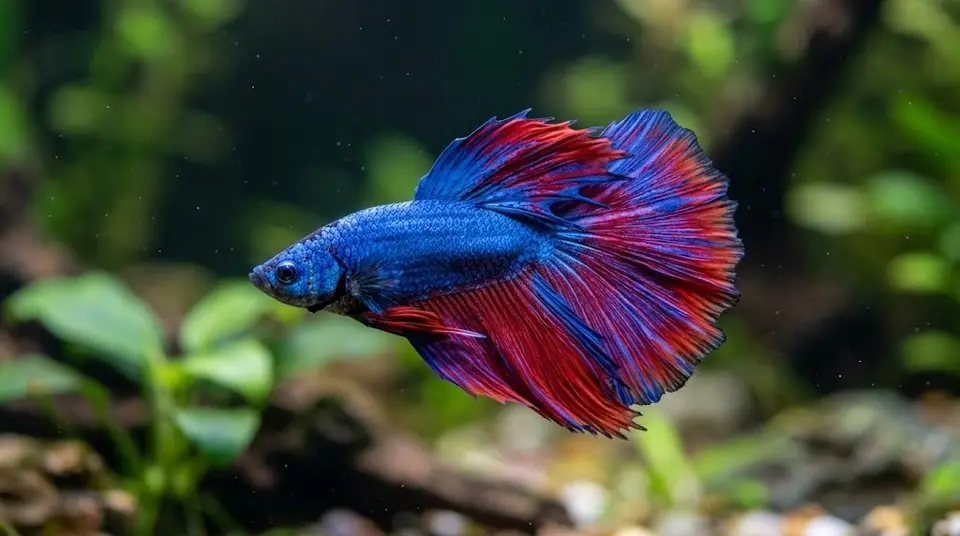
Adults 6-8 cm length. Males: long flowing fins in brilliant colours - red, blue, white, multicolour, marble, koi. Females: shorter fins, less dramatic colours.
Tail varieties: veiltail, crowntail, halfmoon, plakat, double tail, dumbo (ear-fin), and many more.
Temperament & Tankmates
Males are aggressive to other males (never house two together), and often to females except during brief breeding. Avoid:
- Other Bettas (males).
- Fish with long fins (mistaken for rivals: Guppies, Angelfish).
- Fin-nippers (Tiger Barbs).
Acceptable tankmates: small peaceful fish (Corydoras, Otocinclus, Neon Tetras in some cases), nerite snails, shrimp (some Bettas eat shrimp).
Female Bettas can sometimes live in groups ("sororities") but require careful setup.
Tank Size & Setup
At least 5 litres for one betta is the absolute minimum in the AAGB care guidelines, and the Practical Fishkeeping editor who printed them aims for about 20 litres for a single male; kept with other fish, a betta needs at least 45 litres (Wikipedia). Bare tanks and bowls may cause stress, as the fish has nowhere to hide (AAGB).
Provide:
- Gentle filter: avoid strong surface movement, since bettas breathe at the surface (AAGB).
- Thermostatic heater for 24-28°C (AAGB).
- Live plants, with floating ones for surface cover (AAGB).
- Caves and hiding spots.
- Close-fitting cover (AAGB).
Water Parameters
- Temperature: 24-28°C with minimal swings; kept too cold, bettas turn sluggish, eat poorly and fall ill more easily (AAGB guidelines).
- pH: wild habitats range from 6.9 to 8.2 (Wikipedia).
- Regular partial water changes with dechlorinated tap water; no salt except as a short disease treatment (AAGB).
Diet
Carnivore. Wild bettas eat zooplankton, small crustaceans, aquatic insect larvae such as mosquito larvae, insects that fall into the water, and algae; whatever some pet-trade marketing says, they cannot live on plants or plant roots alone (Wikipedia). The care guidelines of the Anabantoid Association of Great Britain (AAGB) advise a good-quality dry diet that covers all of a betta's needs, with cultured live or frozen foods as extras (Practical Fishkeeping).
| Give | Avoid |
|---|---|
| A good-quality dry betta food as the staple (AAGB) | Plants or plant roots as the only food, as in vase setups (Wikipedia) |
| Cultured live or frozen foods, such as brine shrimp or daphnia, frozen packs fully thawed (AAGB, RSPCA) | Poor-quality diets, which the AAGB links to deficiencies and digestive problems |
| Small portions, as much as the fish eats in two to five minutes (RSPCA) | Holiday feeding blocks: they release a lot of food quickly and most of it may rot (RSPCA) |
The RSPCA's general advice for pet fish is two or three small feeds a day, and underfeeding is safer than overfeeding.
Health & Lifespan
3-5 years.
Common concerns:
- Fin rot.
- Velvet (parasite).
- Dropsy.
- Swim bladder disorder.
- Digestive problems, which the AAGB links to poor diets.
- Ich.
Pros & Cons
Pros: brilliant colours, small tank suitable, interactive personality, long-finned beauty. Cons: widely mis-housed in pet shops, short lifespan if poorly kept, aggressive with most tankmates.
Everyday gear for aquariums
Links go to Amazon or a partner brand's own store and may earn us a commission at no extra cost to you. As an Amazon Associate we earn from qualifying purchases. An Amazon link leads to a type of gear and you choose the exact product; a card that names a store leads to that partner's own shop.
Betta (Siamese Fighting Fish) - frequently asked questions
What do betta fish eat?
A good-quality dry betta food as the staple, with cultured live or frozen foods as extras (AAGB guidelines), in small portions the fish finishes in two to five minutes (RSPCA). In the wild they eat zooplankton, small crustaceans, insect larvae and fallen insects, and they cannot live on plant roots alone (Wikipedia).
How do I care for a betta?
The AAGB's six points: a thermostatic heater for 24-28°C; a gentle filter and regular partial water changes with dechlorinated water; at least 5 litres for one fish; live and floating plants with a close-fitting cover; a good dry diet with live or frozen extras; and no second adult male (Practical Fishkeeping).
Can Bettas live in bowls?
No: the AAGB guidelines call for a heated, filtered tank of at least 5 litres with plants and a cover, and say bare tanks or bowls may cause stress because the fish has nowhere to hide (Practical Fishkeeping).
Can two males live together?
Never. Two or more adult males will fight, often to the death (AAGB).
Can a Betta live with a female?
Briefly for breeding. Otherwise no - males may injure or kill females.
How long do they live?
3-5 years in proper tanks; 6 months in bowls.
Can they breathe air?
Yes - Bettas have a labyrinth organ allowing surface breathing. This is why they survive (briefly) in oxygen-poor cups. It is not a substitute for proper housing.
Sources
Sources this profile draws on, as linked in the text:
- Practical Fishkeeping(practicalfishkeeping.co.uk)
- Wikipedia(en.wikipedia.org)
- RSPCA(rspca.org.uk)
Test yourself: guess the fish
Three clues from our quiz bank, each about another of our fish. Can you name them?
Clue 1.Domesticated from a dull carp over a thousand years ago in China, this orange fish is one of the oldest kept pets.
It's the Goldfish - read the full profile →
Clue 2.A popular tank-cleaning bottom dweller from South American rivers, it rasps biofilm with a suckermouth and enjoys driftwood to graze.
It's the Bristlenose Pleco - read the full profile →
Clue 3.Easy to breed and colorful, the males of this small species sport flashy fan-shaped tails to court drab females.
It's the Guppy - read the full profile →