German Blue Ram
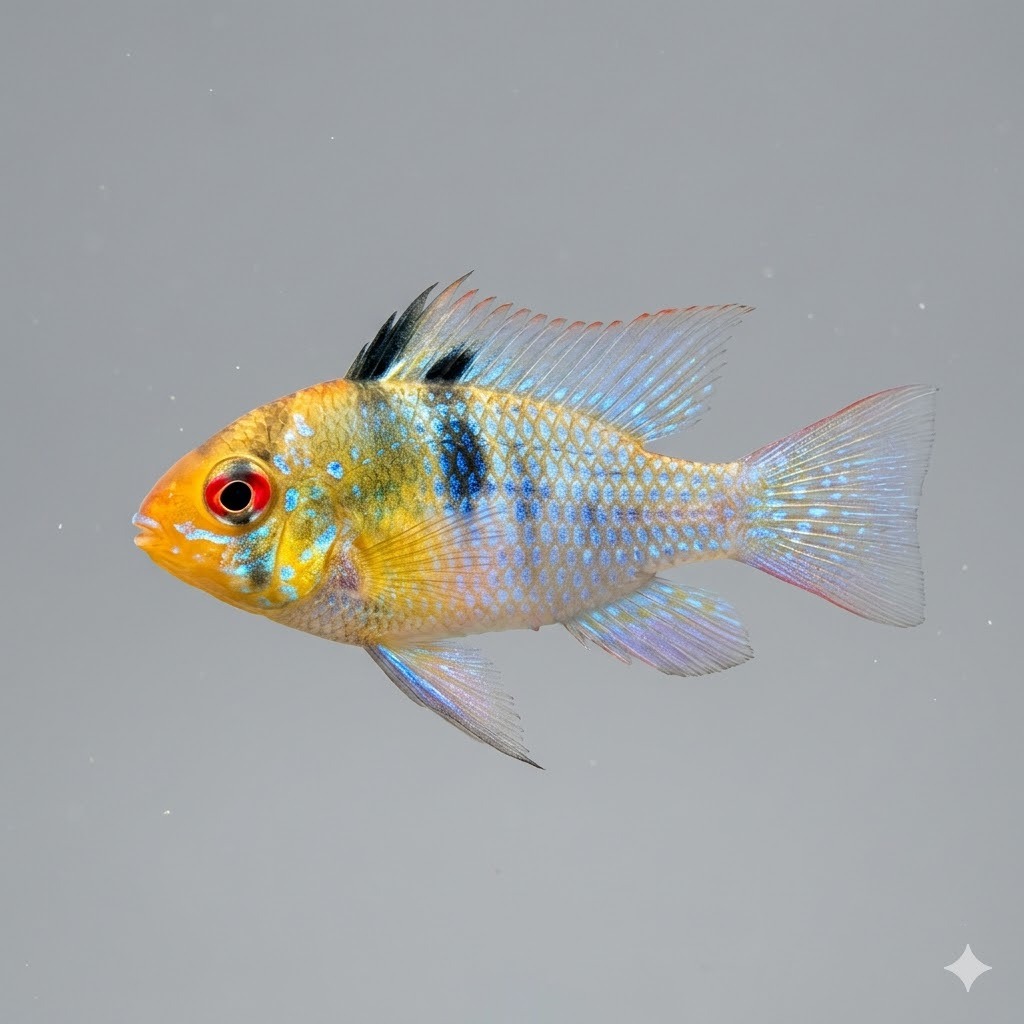
The German Blue Ram (Mikrogeophagus ramirezi) is a small, strikingly colorful dwarf cichlid from South America, with a blue-speckled body, washes of yellow and red, and a bright red eye.
🗓️ Last reviewed: June 2026
Overview
The German Blue Ram (Mikrogeophagus ramirezi) is a small, strikingly colorful dwarf cichlid from South America, with a blue-speckled body, washes of yellow and red, and a bright red eye. It is peaceful enough for a calm community, but it is a sensitive fish that is not a good beginner choice. It needs warm, soft, very clean and stable water in a mature, well-filtered planted tank, and it rewards careful keepers with some of the most intense color of any small aquarium fish.
Natural History
Native to the warm, slow-moving waters of the Orinoco River basin in Venezuela and Colombia. In the wild it lives over sandy bottoms among leaf litter and submerged roots, in soft, acidic, warm water. It is a bottom-oriented sifter that picks through fine sand for small invertebrates. Most rams in the hobby are commercially bred color forms, but they keep the sensitivity of the wild fish to poor or unstable water.
Appearance
Adults reach about 5-7 cm. The body is golden to violet-blue with a scatter of shimmering iridescent blue speckles, a yellow head and chest, and a black vertical bar through the bright red eye. A dark spot sits on the flank. Males tend to be larger with extended dorsal rays; females are often rounder with a pink-to-red belly. Electric blue, gold, and long-finned varieties exist, and some of these are more delicate than standard fish.
Temperament & Tankmates
Generally peaceful and fairly shy. German blue rams are dwarf cichlids, so a bonded pair may become mildly territorial around a chosen spawning spot, but they are not aggressive toward unrelated species. They spend much of their time in the lower half of the tank.
They suit a calm community of gentle, warmth-loving fish such as small tetras, rasboras, corydoras, and dwarf shrimp (though shrimp may be eaten). Avoid fin-nippers, boisterous fish, and anything that out-competes them at feeding time, since a stressed ram fades and stops eating quickly. They can be kept as a single fish or, more rewardingly, as a bonded pair.
Tank Size & Setup
Minimum: 80 L (20 gallon) for a pair, in an established, mature aquarium.
This is not a fish for a new tank. Rams need biologically stable, well-filtered water that has been running for at least a couple of months. A planted aquarium with fine sand, driftwood, leaf litter, gentle flow, and plenty of cover suits them best. Soft, slightly acidic, warm water brings out their color and keeps them calm. Keep the tank covered.
Water Parameters
- Temperature: 26-29°C (78-85°F). They genuinely need this warmth.
- pH: 5.5-7.0 (acidic preferred).
- Soft water (low hardness).
- Ammonia 0, nitrite 0, nitrate <20 ppm.
Stability matters as much as the numbers. Sudden swings in temperature, pH, or quality are a leading cause of ram illness and death.
Diet
Omnivore that naturally sifts sand for small invertebrates. Offer a quality sinking micro-pellet or granule staple, supplemented with frozen or live bloodworms, daphnia, baby brine shrimp, and cyclops. Because they feed low in the water and slowly, make sure faster tankmates do not take everything first. Feed small portions once or twice daily.
Health & Lifespan
2-3 years.
Common concerns:
- Stress and rapid decline when water quality slips even slightly.
- Ich (white spot) and bacterial infections, often following stress or a chill.
- Sensitivity to nitrate and to unstable, immature tanks.
- Tank-cycle deaths from being added before the tank is fully established.
- Weaker, mass-bred stock that may arrive already unwell, especially some fancy color forms.
Pros & Cons
Pros: stunning color, peaceful, interesting bottom-sifting behaviour, manageable size, good in a calm planted community. Cons: sensitive and not beginner-friendly; needs a mature, very clean, warm, soft, stable tank; short lifespan; variable stock quality.
German Blue Ram - frequently asked questions
Are German blue rams good for beginners?
Not really. They are peaceful and beautiful, but they are sensitive to poor or unstable water and to immature tanks. They are best for keepers with some experience and a settled aquarium.
What temperature do they need?
Warm - 26-29°C (78-85°F). They come from warm water and do poorly if kept too cool, so a reliable heater is essential.
Should I keep one ram or a pair?
Either works. A single ram is fine, while a bonded male-and-female pair shows the most natural and rewarding behaviour. Keep tankmates gentle in both cases.
Why do rams die so easily?
Almost always because of water quality, an uncycled or unstable tank, a chill, or already-weak stock. Stable, soft, warm, very clean water in a mature tank is the key to keeping them well.
🧠 Test yourself: guess the fish
Three clues from our quiz bank, each about another of our fish. Can you name them?
Clue 1.This tall, triangular freshwater fish from the Amazon basin swims with trailing fin filaments and is a graceful staple of community aquariums.
It's the Angelfish - read the full profile →
Clue 2.This stout algae-eating catfish has bony armor plates and males that grow fleshy tentacle-like growths on the snout.
It's the Bristlenose Pleco - read the full profile →
Clue 3.Native to the rice paddies of Southeast Asia, this fish has a special organ that lets it gulp air directly from the surface to survive low-oxygen water.
It's the Betta (Siamese Fighting Fish) - read the full profile →