Kribensis
The kribensis (Pelvicachromis pulcher) is a hardy West African dwarf cichlid and one of the easiest cichlids of all to keep and breed.
🗓️ Last reviewed: July 2026
Overview
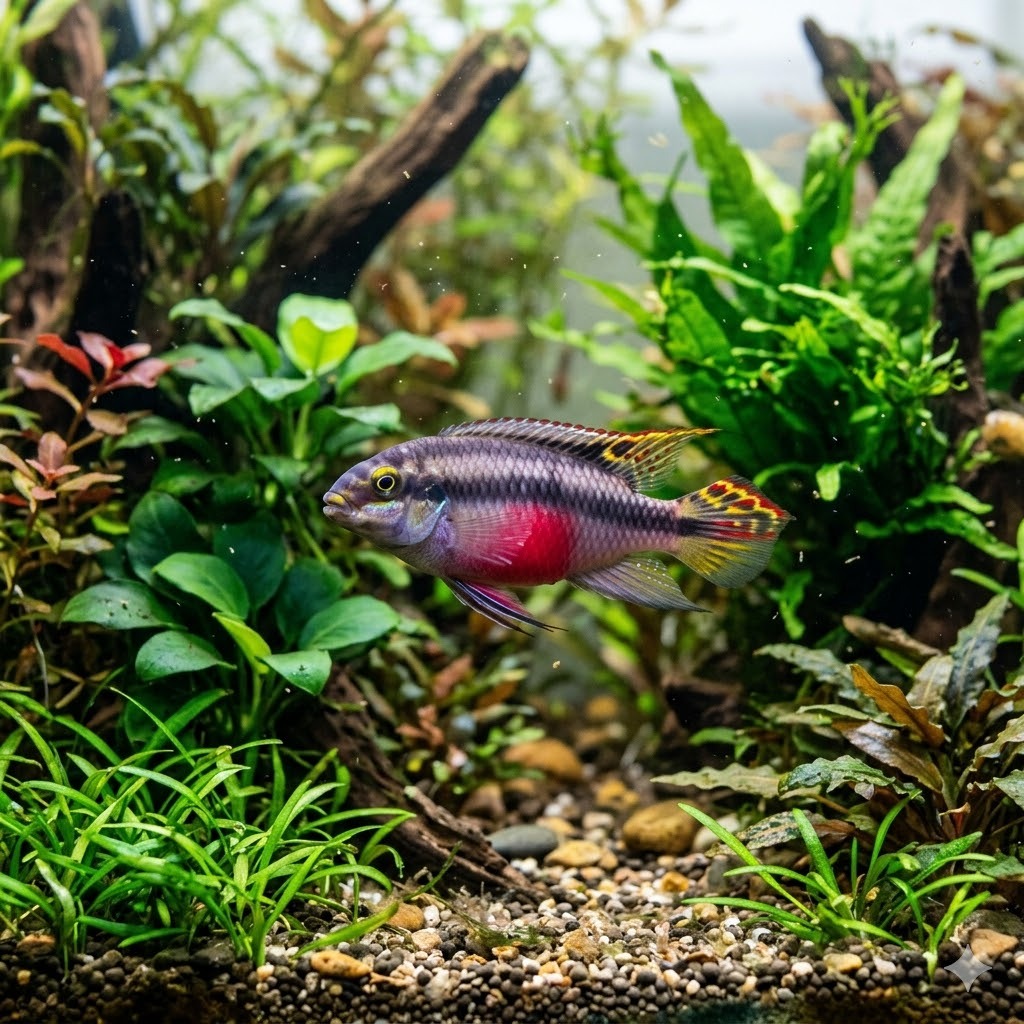
The kribensis (Pelvicachromis pulcher) is a hardy West African dwarf cichlid and one of the easiest cichlids of all to keep and breed. Nicknamed the "krib" or rainbow cichlid, it stays modest in size - adults reach around 8-10 cm - and rewards keepers with rich colour, especially the cherry-red belly the female flashes during courtship. Adaptable, colourful and forgiving, it is a superb entry point into cichlid keeping for anyone who wants a fish with personality and breeding potential without the demands of larger, more aggressive species. Its manageable size, tolerance of ordinary tap water and readiness to raise families have made it a mainstay of the hobby for generations, and a well-kept pair guarding a brood of fry is a genuinely charming sight.
Natural History
Kribensis are native to the coastal rivers and streams of southern Nigeria and Cameroon, where they inhabit slow, warm, sometimes slightly brackish waters among roots, rocks and dense vegetation. They forage close to the bottom for small invertebrates and organic matter, and shelter in the tangle of cover along riverbanks. They are cave spawners by nature, seeking out crevices and hollows in which to lay their eggs, where both parents guard the developing brood and later herd the free-swimming fry as a tight little shoal. Widely bred in the aquarium trade for decades, tank-raised kribs are extremely tolerant of a range of water conditions, which is a large part of their enduring popularity and their reputation as a dependable first cichlid.
Appearance
An elongated, low-slung cichlid with a purple-grey body, a dark horizontal stripe running along the flank, and iridescent highlights on the fins. Both sexes are attractive, but the female is arguably the showier of the two, developing a rounded, glowing cherry-red belly and often a golden or eye-spotted dorsal fin when ready to breed - a reversal of the usual pattern where the male is the flashy one. Males grow a little larger and carry more pointed dorsal and tail fins, sometimes with fine trailing extensions. Colour intensifies dramatically when a pair is in breeding mood or defending fry. Adult size is roughly 8-10 cm, with males at the upper end.
Tank Size & Setup
- Single pair: minimum tank size around 75 litres.
- Community with a breeding pair: 100 litres or more gives space for others to escape the pair's territory.
Provide caves - clay pots laid on their side, coconut shells or rock crevices - as spawning sites, ideally offering the pair a couple of options to choose between. Dense planting, driftwood and gentle water flow suit them well and give tank-mates places to retreat when the pair turns protective. A darker substrate helps their colours pop and makes them feel secure enough to display naturally. Because they will dig around their chosen cave, plant robustly or use potted plants near the spawning site, and keep the front open so you can enjoy watching them.
Water Parameters
- Temperature: 24-28°C.
- pH: 6.0-7.5 - adaptable, but soft to neutral is ideal.
- Ammonia 0, nitrite 0, nitrate low to moderate.
Kribensis tolerate a wide range of hardness and pH, which makes them very beginner-friendly and forgiving of ordinary tap water. Clean, stable water matters far more to them than hitting exact numbers. An interesting quirk of the species is that the temperature and pH at which eggs are incubated can skew the sex ratio of the resulting fry, which serious breeders sometimes exploit.
Diet
Omnivore with a healthy appetite. Kribensis accept quality flake and pellet foods readily and clearly benefit from frozen and live treats such as bloodworm, brine shrimp and daphnia, which sharpen their colour and bring them into breeding condition. A little vegetable matter, from algae wafers or blanched greens, rounds out the diet and supports good digestion. As with most cichlids, feeding a varied menu in modest amounts is far better than heavy single feeds, and it keeps water quality easier to manage.
Health & Lifespan
Average lifespan is 5-8 years.
Common concerns:
- Breeding aggression - a spawning pair becomes territorial and may harass or even injure tank-mates that stray too close to the cave.
- Poor water quality leading to fin and skin problems in neglected tanks.
- Bloat from overfeeding rich foods.
- Ich (white spot) in stressed or newly introduced fish.
Pros & Cons
Pros: hardy, adaptable, colourful, easy to breed, modest adult size, good first cichlid. Cons: becomes territorial and aggressive when breeding, may dig up plants and rearrange the substrate, can harass smaller fish near the nest.
Kribensis - frequently asked questions
How big do kribensis get?
Around 8-10 cm, with males slightly larger than females.
Are they aggressive?
Peaceful most of the time, but a breeding pair defends its cave firmly and can bully tank-mates.
Are they easy to breed?
Very - give a compatible pair a cave and stable water and they will often spawn readily. This is why they are a classic beginner cichlid.
What tank-mates work?
Peaceful mid- and upper-level fish such as tetras, rasboras and larger barbs. Give the pair space to hold their own territory.
Which one is the female?
The female is smaller with a rounded, cherry-red belly and often a rounded, spotted dorsal fin, especially when in breeding condition. Unusually, the female is the more colourful sex.
Will they harm my plants?
They may dig around their chosen cave and uproot loose plants, but they are not dedicated plant-shredders. Robust or potted plants generally survive them well.
🧠 Test yourself: guess the fish
Three clues from our quiz bank, each about another of our fish. Can you name them?
Clue 1.Diamond-shaped with long flowing dorsal and anal fins, this popular tank fish needs a tall aquarium to accommodate its towering body.
It's the Angelfish - read the full profile →
Clue 2.A peaceful nano-fish best kept in large shoals, it glows electric blue and crimson under subdued aquarium lighting.
It's the Cardinal Tetra - read the full profile →
Clue 3.Aquarists prize this small loricariid because, unlike its giant relatives, it tops out around five inches and won't outgrow a community tank.
It's the Bristlenose Pleco - read the full profile →