How to Stop a Dog Digging
The short answer: dogs dig for a reason - entertainment, prey, comfort, attention or escape - and you stop it by fixing that reason, not by punishing the hole. How to find the why and redirect it, following Humane World for Animals' guide.
 AI illustration
The short answer: dogs dig for a reason - for entertainment, to reach prey, to cool down or find shelter, to get attention, or to escape - and you stop the digging by removing or redirecting that reason, not by filling holes or telling the dog off after the fact. Humane World for Animals (formerly the Humane Society of the United States) warns that punishing a dog after the fact does not address the cause and makes digging driven by fear or anxiety worse. Find the why, meet the need a better way, and the holes become fewer.
Below is how to read what your dog is telling you, following Humane World’s guide.
First, work out why your dog digs
The same hole can mean different things, and the fix is different for each. Humane World lists these clues:
- Entertainment. Dogs may dig for fun once they learn that roots and soil “play back”. Likely if your dog is left alone in the yard for long periods, the yard is bare with no toys or playmates, it is a puppy or adolescent with no other outlet for its energy, it is a terrier or another breed bred to dig, it is an active breed that needs a job, or it has just watched you gardening.
- Prey. Dogs often dig to catch burrowing animals or insects. Likely if the digging is focused on one area rather than the edges of the yard.
- Comfort or protection. In hot weather dogs may dig holes to lie in the cool dirt, and they may also dig for shelter from cold, wind or rain, or to find water. Likely if the holes are near building foundations, large shade trees or a water source, if your dog has no shelter or its shelter is too hot or cold, or if it lies in the holes.
- Attention. Any behaviour can become a way to get attention, and even punishment is attention. Likely if your dog digs while you are watching, or has little time with you.
- Escape. Dogs may try to escape to get to something, to get somewhere or to get away from something. Likely if the digging is under or along the fence.
Watch where and when the holes appear for a few days before you do anything. The pattern points to the cause.
Comfort digging
If your dog is digging to lie in cool soil or to find shelter, the hole tells you what it is missing. Humane World suggests bringing your dog inside more often, and making sure its outdoor shelter is comfortable, protected against extreme temperatures and has water in a bowl that cannot be tipped over.
Heat also raises a safety question. Overheating is an emergency, not a behaviour problem: our first-aid page covers what to watch for, and anything beyond mild belongs with a vet, not a training article. We do not give medical advice here.
Entertainment digging
Many yard-destroying dogs are simply under-occupied. To compete with digging you have to offer something better. Humane World suggests:
- Walks at least twice a day. It calls a lack of exercise a leading cause of behaviour problems. Our exercise needs helper gives a daily target for your dog’s type and age.
- Play with active toys such as balls and flying discs as often as you can.
- Short training sessions: teach a few commands or tricks and practise them for five to ten minutes every day, or take a training class.
- Toys in the yard for when you are not around, such as treat-filled Kong-type toys or busy-box toys, rotated to keep them interesting.
This is the same principle behind stopping most nuisance behaviours: meet the underlying need and the symptom fades. It is the logic we walk through for problem barking too.
Prey, attention and escape digging
Prey. Look for signs of burrowing animals, then use safe, humane methods to fence them out, exclude them or make the garden unattractive to them. Humane World warns against any product or method that could be toxic: anything that poisons wildlife can poison your dog too.
Attention. Ignore the digging, praise your dog generously for good behaviour, and make sure it gets enough walks and play with you every day.
Escape. A loose dog is in danger, so this is a safety issue as well as a training one. Work out why your dog wants to leave and remove that reason. To secure the fence line, Humane World suggests:
- burying chicken wire at the base of the fence, with the sharp edges rolled away from your yard;
- placing large rocks, partly buried, along the bottom of the fence;
- burying the bottom of the fence 1 to 2 feet (about 30 to 60 cm) below the surface;
- laying chain-link fencing on the ground, anchored to the bottom of the fence, so walking along the fence is uncomfortable.
If the escape attempts are bound up with distress at being alone, the anxiety needs attention in its own right. Our natural calming approaches cover where to start.
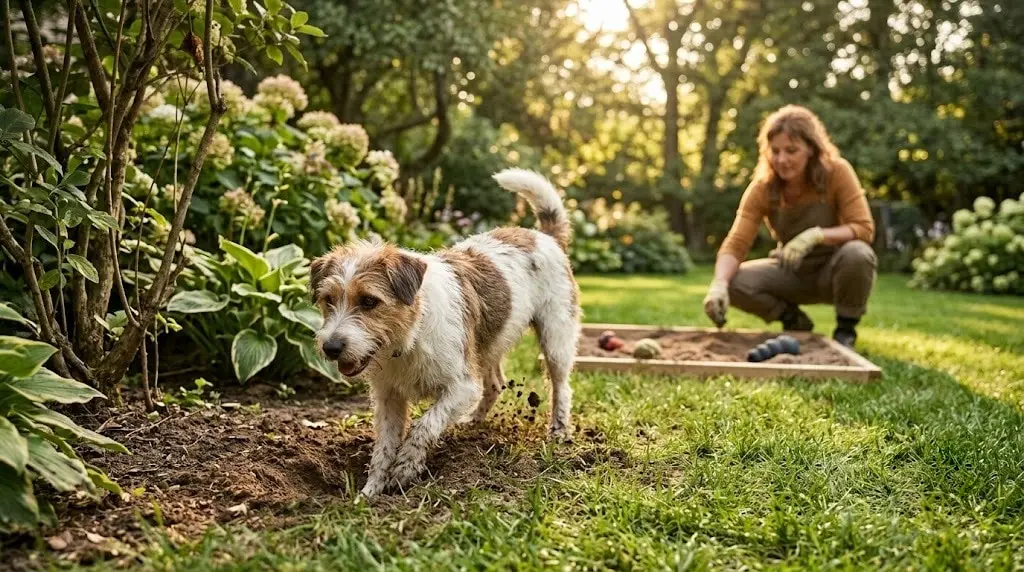
Give dedicated diggers a digging zone
For a dog that loves to dig, Humane World suggests a place where digging is allowed:
- Cover the area with loose soil or sand, or use a child-sized sandbox.
- Bury safe items such as toys for your dog to find.
- Praise your dog when it digs there.
- If you catch it digging somewhere else, interrupt it and take it straight to the digging zone.
- Make the off-limits spots unattractive for a while by placing rocks or chicken wire over them.
What does not work
- Punishing after the fact. It does not address the cause and makes digging driven by fear or anxiety worse.
- Staking the dog out next to a hole it dug, or filling the hole with water. Humane World lists both as things not to do.
If you have tried all of this and the digging continues, Humane World suggests keeping your dog indoors with you, supervising its trips into the yard, and talking to a behaviour professional.
The bottom line
Digging is a dog meeting a need it has, whether that need is fun, a mole, shelter, your attention or a way out. Spend a few days working out which one it is, fix that specific thing, and give dedicated diggers a zone of their own. Skip the diagnosis and no amount of filled holes will hold.
Sources
- Humane World for Animals (formerly the Humane Society of the United States), “How to get your dog to stop digging” (read 28 October 2026): humaneworld.org
Recommended Gear on Amazon
- Sandbox digging pit - browse current options and reviews on Amazon.
- Treat-dispensing dog toys - browse current options and reviews on Amazon.
As an Amazon Associate, we earn from qualifying purchases - at no extra cost to you. This helps us keep producing free, in-depth guides.