African Bullfrog
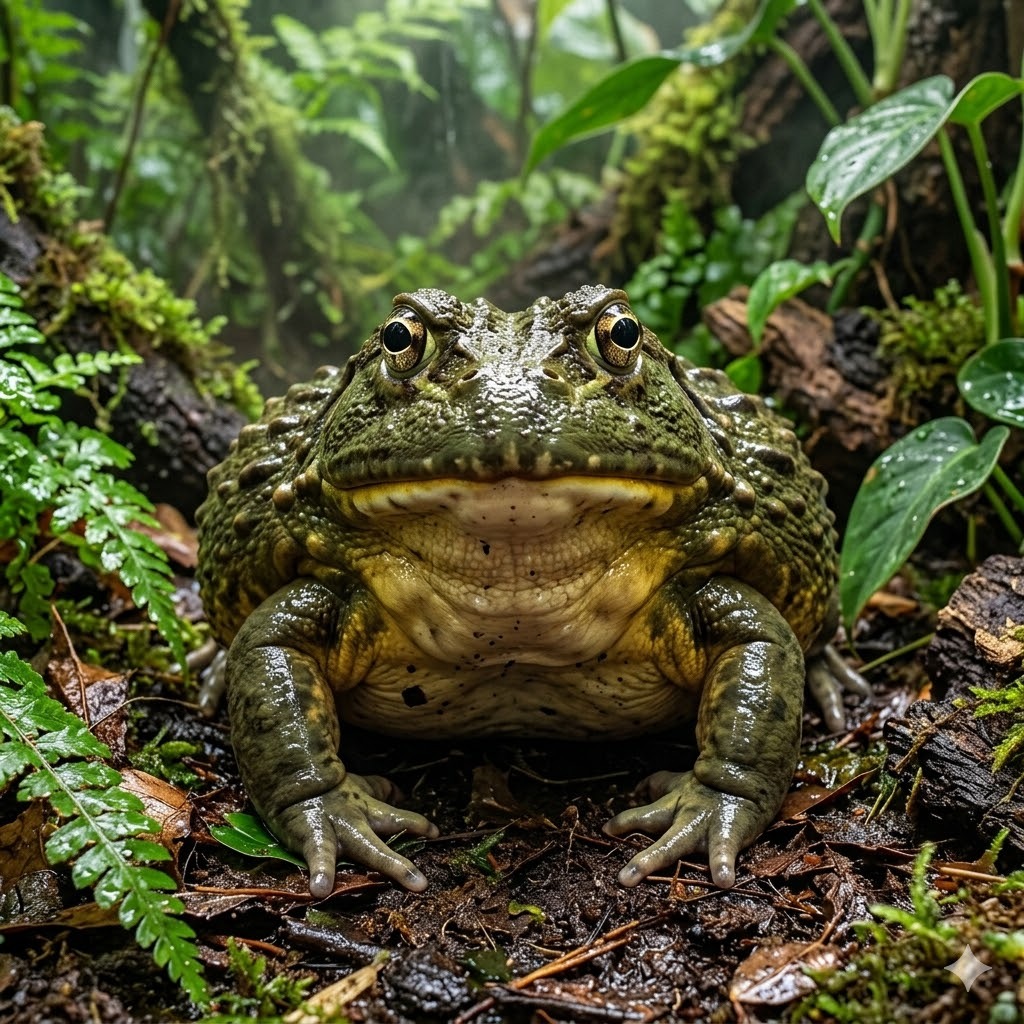
The African Bullfrog (Pyxicephalus adspersus) is one of the largest frogs on Earth and a true heavyweight of the hobby - a massive, powerful, aggressive burrowing frog with an appetite for almost anything that moves.
🗓️ Last reviewed: July 2026
Overview
The African Bullfrog (Pyxicephalus adspersus) is one of the largest frogs on Earth and a true heavyweight of the hobby - a massive, powerful, aggressive burrowing frog with an appetite for almost anything that moves. Bull-necked and broad-mouthed, it will strike at insects, mice, other frogs, and even its own tankmates, backed by bony tooth-like projections and a genuinely painful bite. It is long-lived, personable in a gruff way, and utterly unlike a delicate tree frog. Kept singly in a big, secure enclosure, it makes a fascinating, hardy display animal - but it is a look-don't-handle amphibian with real bite force, best respected rather than cuddled.
Natural History
Pyxicephalus adspersus is native to sub-Saharan Africa, across savanna and grassland from Nigeria and Kenya south to South Africa. It endures a harsh, seasonal climate: during the long dry season it burrows deep underground and seals itself in a moisture-retaining cocoon of shed skin, entering a dormant state called aestivation for months until the rains return.
When the rains come, bullfrogs emerge en masse to feed voraciously and breed explosively in temporary pools. Uniquely, the large males guard the eggs and swarms of tadpoles and will even dig channels to keep them in water as pools shrink - one of the few frogs to show real parental care. This dry-season burrowing and explosive wet-season feeding shapes everything about how they should be kept: a deep substrate to dig into and a rich but controlled diet. The species is common and captive-bred in the hobby; buy captive-bred animals rather than wild-caught, which are stressed, parasite-prone, and taken from natural populations.
Appearance
Males are giants - commonly 20-24 cm (8-9.5 inches) snout to vent and often over 1 kg, occasionally to 2 kg - making them far larger than the females, which reach roughly 12 cm. This reversed size difference is unusual among frogs.
The body is squat, immensely muscular, and olive to dull green, often with ridged, folded skin running down the back and a cream to yellow throat, brightest in breeding males. The head is huge, the mouth enormous, and the lower jaw carries three tooth-like bony projections (odontoids) used to grip and subdue large prey. Powerful hind legs bear a hardened spade on each foot for digging.
Temperament & Handling
Bold, food-driven, and aggressive. An African bullfrog treats almost any movement as potential prey and will lunge, snap, and clamp down hard - the bite can break skin and is genuinely painful. It is a strictly look-don't-handle animal. Never free-handle one; if it must be moved, use a suitable container rather than bare hands, and wet clean hands with dechlorinated water only when truly unavoidable, keeping fingers clear of the mouth. Its skin, like all amphibians', also absorbs oils and residues, giving a second reason to keep handling to a minimum. Despite the attitude many become tame enough to recognise feeding routines and are engaging to watch.
Enclosure
Keep one frog per enclosure - always single. Housed together, African bullfrogs will attack, injure, and eat one another.
Minimum: a floor area of at least 90 x 45 cm (roughly 36 x 18 inches) for an adult male; bigger is better for these bulky, ground-dwelling frogs. Height is less important than floor space.
Provide:
- A deep, moisture-retaining substrate (coco fibre or soil-and-sand mix) at least 10-15 cm deep for burrowing.
- A large, shallow, easily cleaned water area of dechlorinated water big enough for the frog to soak in - it will foul this, so change it often.
- Sturdy hides and a few robust plants (many get flattened or eaten).
- A heavy, absolutely secure lid; these are strong, powerful animals.
Heating, Lighting, Humidity
- Temperature: 24-30°C by day with a gentle night drop, using an under-tank heater or overhead source to create a warm gradient. Avoid cold.
- Humidity: moderate to high, around 60-80%, maintained with a damp substrate and regular misting using dechlorinated water.
- Lighting: no strong UVB requirement, though low-level UVB and a normal 12-hour day-night cycle do no harm and can benefit health. Keep out of harsh direct sun.
Diet
Carnivore - and voracious.
- Large insects (crickets, roaches, locusts, nightcrawlers) as a staple.
- Occasional appropriately sized rodents (pinkie to adult mouse, depending on frog size) as an infrequent treat, not a routine food.
- Other whole-prey items suited to its size.
Dust insect feeders with calcium and vitamin D3 regularly to support their heavy bones. These frogs overeat easily - obesity is the single most common health problem in captive bullfrogs. Feed juveniles frequently to fuel their fast growth, but adults only every few days to once weekly, and never rodents too often, which leads to fatty, unhealthy, short-lived animals. A varied insect-based diet with occasional whole prey keeps a bullfrog in far better condition than a rodent-heavy one. Never house feeder animals long-term with the frog, and always supervise feeding so the frog does not accidentally take substrate along with its prey.
Health & Lifespan
Long-lived - commonly 15-20 years in captivity, with some individuals reported beyond.
Common concerns:
- Obesity from overfeeding, especially too many rodents - the single most common care mistake.
- Metabolic bone disease from poor calcium supplementation.
- Impaction from swallowing loose gravel or oversized prey.
- "Red leg" and skin infections from dirty, fouled water - change soaking water frequently.
- Chemical poisoning - sensitive to chlorine and chloramine; always use dechlorinated water.
- Bite injuries if housed with any other animal.
Have an amphibian-experienced exotics vet available.
Pros & Cons
Pros:
- Impressive size and character - a genuine showpiece amphibian.
- Very hardy and long-lived, often 15-20 years.
- Simple single-frog setup once established.
- Fascinating burrowing and feeding behaviour.
Cons:
- Powerful, painful bite - not for handling.
- Must be kept strictly alone.
- Prone to obesity from overfeeding.
- Fouls water quickly; needs frequent cleaning.
Best Suited For
- Experienced or committed keepers wanting a large, characterful amphibian.
- People who want a long-term (15-20 year) display animal.
- Adults who respect its bite and its need to live alone.
Not suited for anyone wanting a handleable or communal frog, small children, or keepers unwilling to manage a heavy feeder that fouls its water.
African Bullfrog - frequently asked questions
Can I keep two together?
No - never. African bullfrogs are cannibalistic and will attack and eat one another. Always keep one frog per enclosure.
Does the bite really hurt?
Yes. They have strong jaws and tooth-like bony projections and will clamp down. A bite from a large adult can break skin and is painful, so keep fingers away from the mouth.
Why does mine bury itself for weeks?
That is aestivation - a natural dormancy triggered by drier or cooler conditions. In a stable warm, humid setup it is less common, but occasional burrowing is normal.
How big do they get?
Males are huge - often 20-24 cm and over a kilogram; females stay much smaller at around 12 cm.
How long do they live?
Commonly 15-20 years in captivity, sometimes longer.
🧠 Test yourself: guess the amphibian
Three clues from our quiz bank, each about another of our amphibians. Can you name them?
Clue 1.A hardy arboreal amphibian whose waxy skin secretions help it resist drying out, allowing it to bask more than most frogs.
It's the White's Tree Frog - read the full profile →
Clue 2.Critically endangered in the wild, this Mexican amphibian is native to just a single lake system near a major capital city.
It's the Axolotl - read the full profile →
Clue 3.A common aquarium amphibian only a couple of inches long, it has four webbed feet and is often kept underwater rather than in a terrarium.
It's the African Dwarf Frog - read the full profile →