African Clawed Frog
The African Clawed Frog (Xenopus laevis) is a fully aquatic, exceptionally hardy, long-lived frog that has been kept in homes and laboratories for decades.
🗓️ Last reviewed: June 2026
Overview
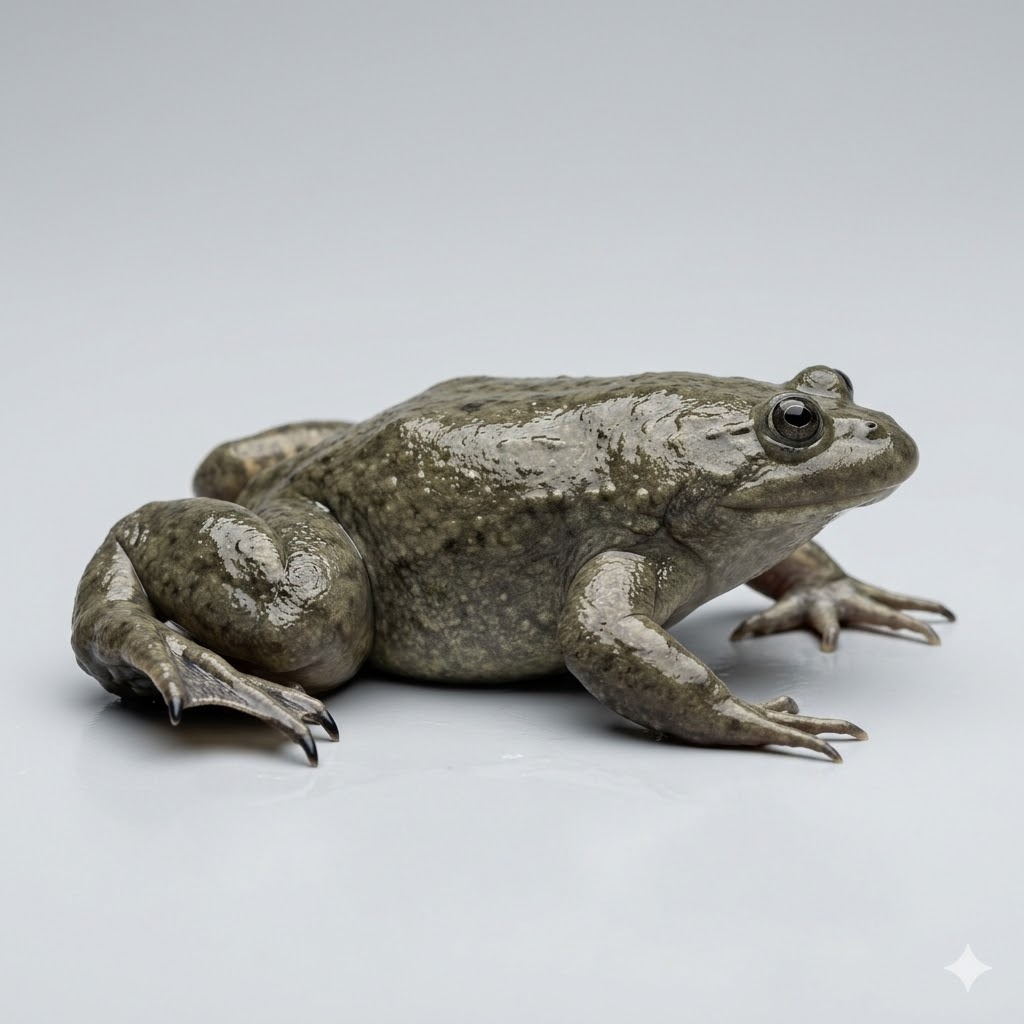
The African Clawed Frog (Xenopus laevis) is a fully aquatic, exceptionally hardy, long-lived frog that has been kept in homes and laboratories for decades. It has a flat body, smooth skin, small upward-facing eyes on top of its head, no visible eardrums, and no tongue. Instead it uses tiny claws on its hind toes to shred food and stuff it into its mouth. It is a tough, easy-going, and rewarding aquarium animal, but it is messy and predatory, so it is best kept on its own with good filtration.
Natural History
Native to ponds, slow rivers, and seasonal water bodies across sub-Saharan Africa, the African clawed frog is built for a life spent almost entirely underwater. It is a generalist that can survive in murky, low-oxygen water and even move short distances over land between pools in wet conditions. Its hardiness made it a classic laboratory animal, and the same toughness makes it a forgiving pet. Because it adapts so easily, it has become an invasive species where it has escaped or been released, so it must never be let loose into the wild.
Appearance
Adults reach about 10-13 cm in body length, with females noticeably larger and rounder than males. The body is flat and streamlined with smooth, slippery skin in shades of olive, grey, or brown above and a paler, often mottled belly. The eyes are small, lidless, and sit on top of the head, pointing upward. There is no tongue and no visible ear. The powerful, fully webbed hind feet carry three small dark claws each, used for tearing food. Albino (pinkish-white) forms are common in the pet trade.
Temperament & Handling
Bold, active, and food-motivated, the African clawed frog is an engaging swimmer that learns to associate its keeper with feeding. It is a hands-off, observation animal: its skin is delicate and coated in protective slime, so handling should be avoided except when necessary, and then only with clean, wet hands. It is also a predator and will eat anything small enough to fit in its mouth, including smaller tankmates, so it is generally best housed alone or only with others of its own kind and size.
Enclosure
Minimum: a 40-75 L (10-20 gallon) aquarium for one frog; add roughly 40 L (10 gallons) per additional frog.
Provide:
- A fully aquatic tank - no land area is needed, as this frog lives underwater and surfaces only to breathe.
- Water depth of at least 20-30 cm so the frog can swim, with easy access to the surface for air.
- A gentle but effective filter; these frogs are messy eaters and foul water quickly.
- Smooth gravel or bare bottom, sturdy plants (live or artificial), and caves or hides for security.
- A secure, tightly fitting lid - clawed frogs are strong and will jump or push out of any gap.
Heating, Lighting, Humidity
- Temperature: comfortable at typical room temperature, ideally 18-24°C. They tolerate a wide range but avoid extremes.
- Humidity is not a concern, as the animal is fully aquatic; what matters is water quality, not air moisture.
- Lighting: low to moderate; no basking lamp is needed. A standard planted-tank light on a day/night cycle is fine, and these frogs are comfortable in dim conditions. A heater is usually only needed in cold rooms.
Diet
Carnivore.
- Sinking carnivore pellets formulated for aquatic frogs or carnivorous fish.
- Frozen or live bloodworms, blackworms, and earthworms.
- Occasional treats such as appropriately sized pieces of thawed fish, or feeder insects.
These frogs find food by smell and touch, using their clawed hind toes to shred larger items. Feed adults a small amount every 2-3 days and young frogs more often, removing uneaten food promptly to protect water quality.
Avoid: overfeeding (a common cause of obesity and fouled water), and live feeder fish, which can introduce disease.
Health & Lifespan
15 years or more, sometimes approaching 20 in excellent care.
Common concerns:
- Poor water quality - the leading problem; ammonia and nitrite build up fast without good filtration and water changes.
- Obesity from overfeeding.
- Bloat and dropsy - fluid swelling that warrants prompt veterinary attention.
- Skin and bacterial infections from dirty water or injury.
- Chytrid fungus, a serious amphibian disease.
- Chemical poisoning - very sensitive to chlorine and chloramine; always use dechlorinated water.
Pros & Cons
Pros:
- Extremely hardy and forgiving.
- Long-lived, often 15+ years.
- Fully aquatic and simple to house - no land area needed.
- Active, bold, and entertaining to watch.
Cons:
- Messy; needs good filtration and regular water changes.
- Predatory; will eat smaller tankmates.
- Strong escape artist; needs a secure lid.
- Must never be released - an invasive species and disease carrier.
Best Suited For
- Beginners wanting a tough, low-fuss aquatic amphibian.
- Keepers who enjoy a fully aquatic setup.
- Anyone able to maintain clean water with a good filter.
Not suited for community tanks with small fish or shrimp, keepers wanting a frog to handle, or anyone unwilling to keep up with water changes.
African Clawed Frog - frequently asked questions
Is this the same as an African dwarf frog?
No, and this is the most important distinction. African clawed frogs are much larger (10-13 cm versus about 4 cm), have eyes on top of the head rather than on the sides, and have fully webbed hind feet but front feet without webbing. They are also messier and predatory, and will eat smaller tankmates, whereas the smaller African dwarf frog is a peaceful community animal. If a "frog" eats your fish and has upward-facing eyes, it is almost certainly a clawed frog.
Do they need land or a basking area?
No. African clawed frogs are fully aquatic and only come to the surface to breathe air. A land section is unnecessary; what they need is enough water depth to swim and a secure lid.
Can I keep them with fish?
It is risky. Anything small enough to swallow is likely to be eaten, and larger fish may nip the frog or compete for food. They are safest kept alone or with others of their own kind and size.
How long do they live?
Commonly 15 years or more, and sometimes close to 20 with excellent care, so they are a long-term commitment.
🧠 Test yourself: guess the amphibian
Three clues from our quiz bank, each about another of our amphibians. Can you name them?
Clue 1.Critically endangered in the wild, this Mexican amphibian is native to just a single lake system near a major capital city.
It's the Axolotl - read the full profile →
Clue 2.This tiny fully aquatic amphibian spends its whole life underwater, surfacing only to gulp air, and is a popular tank companion for small fish.
It's the African Dwarf Frog - read the full profile →
Clue 3.This stocky, burrowing amphibian is one of the largest land-dwelling salamanders, marked with yellowish bars or blotches on dark skin.
It's the Tiger Salamander - read the full profile →