American Green Tree Frog
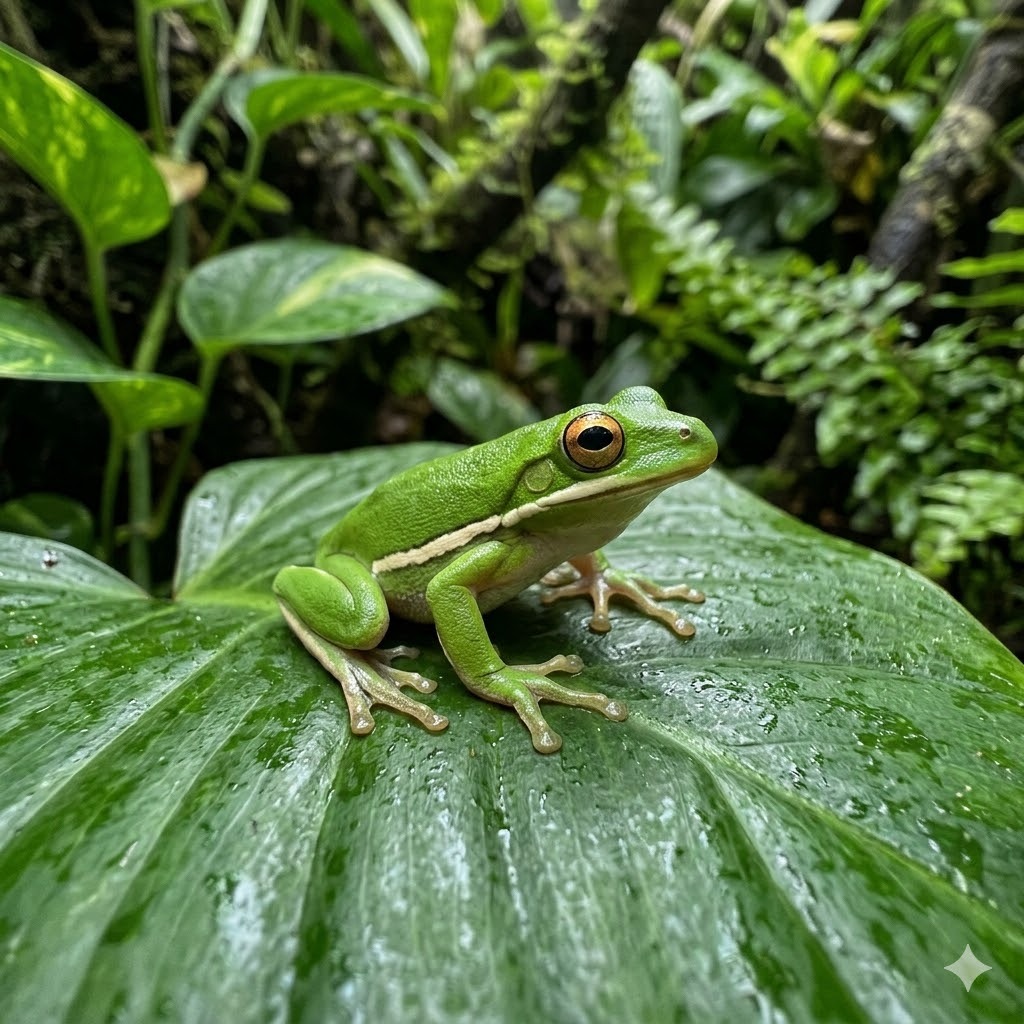
The American Green Tree Frog (Hyla cinerea) is a small, bright-green arboreal frog native to the southeastern United States.
🗓️ Last reviewed: July 2026
Overview
The American Green Tree Frog (Hyla cinerea) is a small, bright-green arboreal frog native to the southeastern United States. Slender, long-legged, and famous for the loud nasal "quonk" call of breeding males, it is one of the best beginner tree frogs in the hobby. Hardy, long-lived for its size, and endlessly watchable, it thrives as a display animal in a tall planted vivarium. It is not a frog to handle - like all amphibians its permeable skin absorbs oils, salts, and residues from your hands - but as a look-don't-touch pet it rewards keepers with vivid colour, climbing acrobatics, and a distinctive nightly chorus.
Natural History
Hyla cinerea ranges across the coastal plains of the southeastern US, from Virginia and Florida west to Texas. It favours warm, humid wetlands - the edges of ponds, swamps, marshes, and slow rivers - where dense vegetation and cattails give it perches above the water. It is nocturnal, spending days clinging motionless to broad leaves and stems, then becoming active at dusk to hunt insects.
Breeding is triggered by warm summer rains. Males gather at water's edge and call in loud choruses, a sound many Southerners associate with humid summer nights. Females lay clutches of hundreds of eggs in shallow water, where tadpoles develop over five to eight weeks before emerging as tiny froglets. In the wild the species is so common in some states that it is the official state amphibian of Georgia and Louisiana. The species is captive-bred in good numbers and stock is widely available - always choose captive-bred animals rather than wild-caught, which carry parasites, adapt poorly to captivity, and are taken from natural populations. A captive-bred juvenile settles far more readily and lives longer.
Appearance
Adults reach roughly 3.2-6 cm (1.25-2.5 inches) snout to vent, with females slightly larger than males. Weight is only a few grams.
The body is smooth and typically bright leaf-green, though it can shift toward olive, yellow-green, or grey-brown depending on temperature, light, and mood. Most individuals show a crisp white or cream stripe running along each side from the jaw down the flank, sometimes flecked with tiny gold spots. The belly is pale cream. Large toe pads let it grip glass and leaves with ease, and long hind legs make it a strong jumper. Males have a slightly wrinkled, darker throat (the vocal sac) and are the callers.
Temperament & Handling
Calm, sedentary by day, and active climber by night. This is a display frog, not a handling frog. Its thin skin readily absorbs lotions, soaps, salts, and oils, and the stress and abrasion of handling can harm it. Look, don't handle. If you must move a frog - for a cleaning or a vet trip - wet your hands with clean dechlorinated water first, handle briefly and gently, and never with any product on your skin. Males will call loudly at night, especially before rain or when humidity rises; this is normal and part of the charm, though light sleepers should note it.
Enclosure
Minimum: a tall 45 x 45 x 60 cm (roughly 18 x 18 x 24 inch) vertical vivarium suits one to three adults; taller is better because these are climbers, not floor-dwellers.
Provide:
- Vertical height and lots of climbing surfaces - cork bark, branches, and broad-leaved live or silk plants (pothos and philodendron work well).
- A shallow, easily cleaned water dish of dechlorinated water, kept spotless.
- A moisture-holding substrate such as coco fibre or a bioactive mix, kept damp but never waterlogged.
- Leaf litter and hides at multiple heights.
- A secure, fine-mesh or glass top - these frogs are excellent escape artists.
Small groups can be kept together if all are a similar size and well fed.
Heating, Lighting, Humidity
- Temperature: 22-28°C by day, with a slight night drop to around 18-22°C. A low-wattage heat source on one side creates a gradient; avoid overheating.
- Humidity: 50-70%, raised by daily misting with dechlorinated water. Allow slight drying between mistings to prevent bacterial and fungal blooms.
- Lighting: a low-level UVB bulb is beneficial though not strictly essential, and a planted vivarium benefits from full-spectrum light on a 12-hour cycle. Keep the tank out of direct sun.
Diet
Insectivore.
- Appropriately sized crickets as a staple.
- Flightless fruit flies and small roaches.
- Occasional waxworms or silkworms as a treat (fatty).
Dust feeders with a calcium and vitamin D3 supplement several times a week, and a multivitamin roughly weekly. Feed prey no wider than the space between the frog's eyes to avoid choking or impaction. Adults eat every two to three days; growing juveniles daily. Feeding at dusk suits their nocturnal rhythm, and many keepers enjoy watching the frog track and snap at insects with a flick of its sticky tongue. Remove uneaten insects, which can nibble and stress a resting frog overnight.
Health & Lifespan
Typically 6-10 years in good captive care, sometimes longer.
Common concerns:
- Metabolic bone disease from poor calcium or lack of UVB - soft or bent limbs.
- Chytrid and other skin infections - always quarantine new animals and buy captive-bred.
- Bacterial "red leg" from dirty water or poor hygiene.
- Chemical poisoning - highly sensitive to tap-water chlorine and chloramine, and to soaps and aerosols. Always use dechlorinated water and keep the room free of sprays.
- Obesity from too many fatty feeders.
Find an exotics vet experienced with amphibians before you need one.
Pros & Cons
Pros:
- Hardy and forgiving - an excellent beginner tree frog.
- Vivid green colour and charming climbing behaviour.
- Beautiful in a planted vertical vivarium.
- Long-lived for such a small frog.
Cons:
- Cannot be handled.
- Males call loudly at night.
- Needs live insect feeders.
- Sensitive to water quality and airborne chemicals.
Best Suited For
- First-time frog keepers wanting an arboreal display animal.
- Keepers who enjoy planted vivariums.
- Older children and adults who understand look-don't-touch.
Not suited for anyone wanting a handleable pet, very light sleepers bothered by night calling, or homes where aerosols and sprays are used near the tank.
American Green Tree Frog - frequently asked questions
Are they easy for beginners?
Yes - they are among the hardiest and most forgiving tree frogs, provided you get temperature, humidity, and clean dechlorinated water right.
Why is my frog brown instead of green?
Green tree frogs change colour with temperature, light, and stress. Brown or grey usually means it is cool, resting, or unsettled; bright green returns when it is warm and comfortable.
Can I keep several together?
Yes, if they are all a similar size and well fed. Mismatched sizes can lead to a larger frog swallowing a smaller one.
Do I really have to avoid handling?
Yes. Their skin absorbs whatever is on your hands. Enjoy them as a display animal and only handle briefly with clean, wet hands when truly necessary.
How long do they live?
Typically 6-10 years, sometimes more with excellent care.
🧠 Test yourself: guess the amphibian
Three clues from our quiz bank, each about another of our amphibians. Can you name them?
Clue 1.A robust North American amphibian named for its bold striped or spotted markings, it spends much of its life hidden underground.
It's the Tiger Salamander - read the full profile →
Clue 2.A hardy arboreal amphibian whose waxy skin secretions help it resist drying out, allowing it to bask more than most frogs.
It's the White's Tree Frog - read the full profile →
Clue 3.This aquatic salamander never undergoes metamorphosis, keeping its feathery external gills and living its entire life underwater in its larval form.
It's the Axolotl - read the full profile →