American Bobtail (Felis catus)
The American Bobtail is a muscular, medium-to-large natural breed best known for its short, expressive "bobbed" tail and its wild, almost bobcat-like appearance.
🗓️ Last reviewed: June 2026
Overview
The American Bobtail is a muscular, medium-to-large natural breed best known for its short, expressive "bobbed" tail and its wild, almost bobcat-like appearance. Despite that rugged look, it is a thoroughly affectionate, easygoing, and remarkably dog-like cat - loyal, playful, leash-trainable, and an excellent traveller. The breed arose from a natural genetic mutation, comes in both shorthair and longhair, and is generally hardy and healthy. No two bobtails have quite the same tail, which makes each cat a little different.
History & Origins
The American Bobtail is a relatively young North American breed that traces back to the late 1960s. The founding story centres on a short-tailed brown tabby kitten named Yodie, found by a travelling couple, John and Brenda Sanders, near an Arizona reservation. Bred to a domestic female, Yodie passed on his distinctive short tail, and from those early litters the breed slowly took shape.
The name reflects exactly what the cat is: an American cat with a natural bobtail. Early breeders worked to fix the look and temperament while keeping the breed a healthy, randomly-bred-derived cat rather than a heavily inbred one, deliberately drawing on a wide gene pool of non-pedigreed domestic cats.
Importantly, the American Bobtail's short tail comes from a natural dominant gene that affects only the tail. It is not the same mutation as the Manx, whose tailless gene can cause serious spinal problems. The bobtail gene is generally considered safe and does not produce the health issues associated with the Manx. The breed was accepted by TICA, gaining championship status in 2002, and is also recognised by other registries. It remains uncommon and is prized as much for its character as its looks.
Appearance
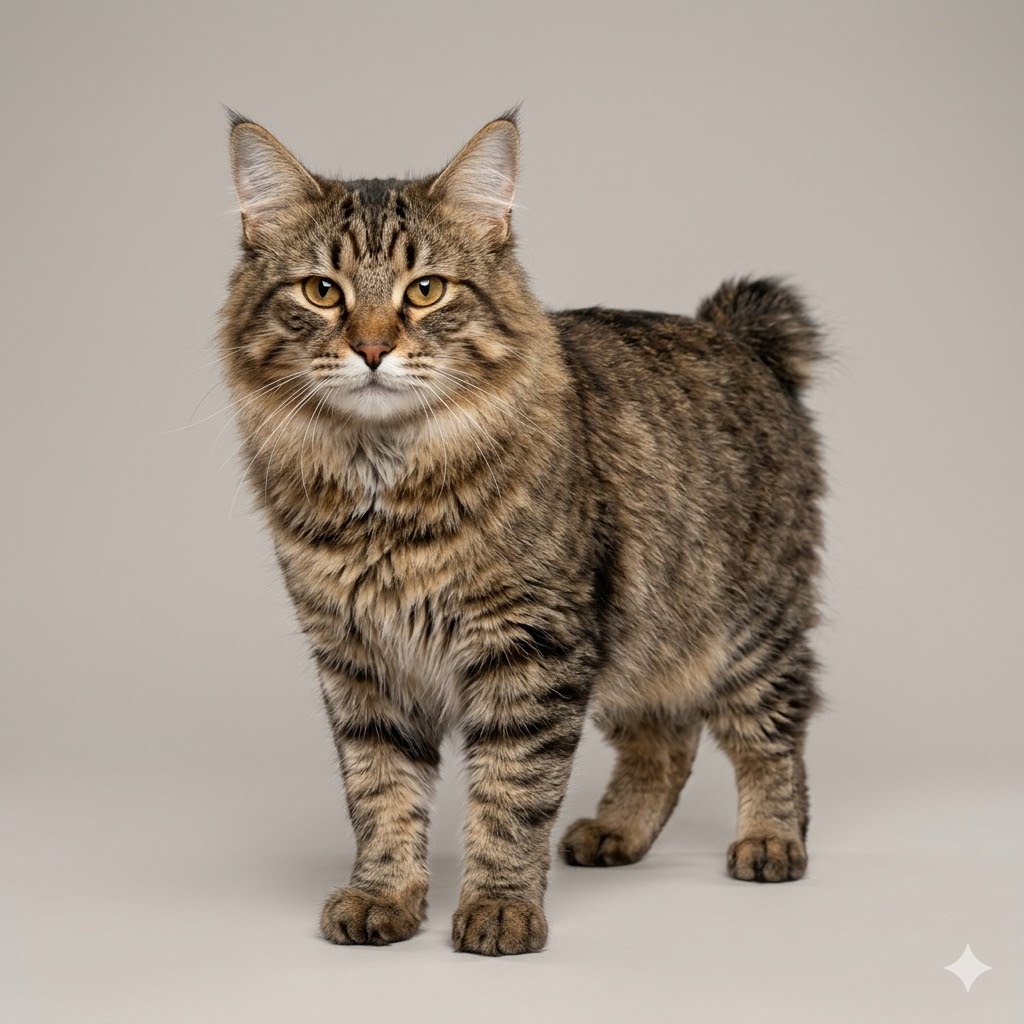
Medium-to-large, substantial, and powerfully built, with a muscular, athletic body and a wild, untamed look. Males weigh 3-7 kg (7-16 lb); females 3-5 kg (7-11 lb). The breed is slow to mature, often taking 2-3 years to reach full size and development.
Key features:
- Tail: the breed's signature trait - a short, expressive "bobbed" tail roughly 1-4 inches long (about a third the length of a normal cat's tail). Every tail is unique, may be straight, slightly curved, or knotted, and is flexible and clearly visible above the back.
- Coat: comes in two lengths - a shaggy, semi-dense shorthair and a medium-long longhair - both with a double coat that is weather-resistant and somewhat unkempt in appearance.
- Colour: comes in essentially all colours and patterns, though the tabby patterns suit the breed's wild "bobcat" look especially well.
- Head: a broad, modified wedge with gently curved contours, a strong brow, and prominent whisker pads that give an alert, hunting expression.
- Eyes: large, almost almond-shaped, and slightly slanted, deep-set under a distinct brow.
- Ears: medium-sized, wide at the base, with rounded tips, often lightly tufted, and sometimes lynx-tipped.
- Body: rectangular and substantial with a deep chest, muscular hips, and longer hind legs, giving a natural, athletic, slightly raised-rump stance.
Temperament & Character
The American Bobtail is affectionate, easygoing, and famously dog-like. It bonds closely with its family, enjoys being involved in daily activities, and is happy to greet visitors rather than hide from them. Many owners describe the breed as a devoted companion that follows them from room to room.
This is an intelligent, playful, and moderately active cat with a strong love of games. Bobtails are known for fetching, learning tricks, and even walking on a harness and leash, and their problem-solving streak means they can learn to open doors and undo simple latches. They tend to be quiet, communicating in chirps, trills, and clicks rather than loud meows.
The breed is notably adaptable and calm under change, which makes it an outstanding traveller and a popular choice as a therapy cat. Bobtails ride well in cars and RVs, settle into new environments, and cope with disruption better than most cats.
Friendly and sociable, the American Bobtail generally gets on very well with children, other cats, and cat-friendly dogs, and it suits active, social households where it gets plenty of interaction. It is a people-oriented breed that does not enjoy being ignored for long stretches.
Care
Coat & Grooming
Grooming needs are moderate and depend on coat length. The shorthair's shaggy double coat needs brushing once or twice a week, while the longhair benefits from two to three sessions a week to prevent matting, with extra attention during seasonal shedding.
Both coats are reasonably self-maintaining and weather-resistant, so baths are rarely needed. Routine care covers the basics: check and gently clean the ears as needed, and keep an eye on the short tail, which has no extra grooming requirements of its own.
For all bobtails, trim claws every 2 weeks and brush teeth several times weekly to support dental health.
Exercise & Enrichment
The American Bobtail is athletic, clever, and playful and needs daily activity and mental stimulation. Provide sturdy cat trees, climbing space, puzzle feeders, and interactive wand-toy sessions, and rotate toys to keep this inquisitive breed engaged.
Because the breed is so trainable and game-loving, fetch, clicker training, and harness walks are especially rewarding, and many bobtails happily learn tricks. A bored bobtail may invent its own entertainment, so shared, interactive play is the best outlet for its energy and intelligence.
Health & Lifespan
Average lifespan is 13-18 years - the breed is generally healthy and hardy, helped by its broad, naturally-derived gene pool. Critically, the bobtail's short tail comes from a dominant gene that affects only the tail and does not carry the spinal defects seen in the Manx breed.
Common concerns:
- Hip dysplasia - as in many larger, muscular breeds, worth awareness and good breeding practice.
- Routine feline cardiac concerns (HCM) - worth normal veterinary monitoring as in most breeds.
- Dental disease - common across cats; regular tooth brushing helps.
- Obesity - a sturdy, food-motivated cat can gain weight without portion control and play.
- Standard genetic screening - responsible breeders test breeding cats appropriately.
Choose a breeder who is transparent about health and lines and screens breeding cats appropriately.
Feeding & Nutrition
Adults typically eat 50-80 g of quality cat food per day, scaled to this larger breed's size, build, and activity level.
A high-protein, balanced diet supports the bobtail's muscular frame and athletic nature. Feed measured meals rather than free-feeding, since the breed enjoys its food and can put on weight, and monitor body condition over time.
Fresh water should always be available; a mix of wet and dry food supports hydration and urinary health.
Living With
Litter
Standard provisions: 1 + 1 box per cat, scooped daily. A larger box suits this medium-to-large breed, and low-dust unscented litter is generally preferred.
Multi-cat households
The sociable American Bobtail usually enjoys company and does very well with other cats and cat-friendly dogs, often forming strong bonds. Its easygoing, confident nature makes introductions relatively smooth, and a companion helps keep this social breed content.
Indoor vs outdoor
Indoor-only, or supervised outdoor access via a secure catio or harness, is recommended. The bobtail's trusting, dog-like temperament and value make it ill-suited to roaming free, and its harness-friendly nature means safe outdoor time is easy to provide. A stimulating indoor home with climbing space suits the breed well.
Pros & Cons
Pros
- Affectionate, easygoing, and dog-like.
- Striking, wild bobcat-like appearance.
- Highly intelligent, playful, and trainable.
- Excellent traveller and popular therapy cat.
- Good with children, cats, and cat-friendly dogs.
Cons
- Slow to mature - takes 2-3 years to fully develop.
- People-oriented; dislikes being ignored for long.
- Food-motivated and can gain weight without portion control.
- Longhair coat needs regular brushing.
- Rare and often expensive.
Best Suited For
- Owners wanting an affectionate, interactive, dog-like cat.
- Active, social households with plenty of interaction.
- People who want a cat that travels well or does therapy work.
- Families with children and cat-friendly pets.
- Owners who enjoy training, fetch, and harness walks.
Not suited for people away long hours with no company, owners wanting a quiet, aloof, low-interaction cat, or those unwilling to manage portions and provide daily play.
American Bobtail (Felis catus) - frequently asked questions
Why is the American Bobtail's tail short?
It comes from a natural dominant genetic mutation that affects only the tail. Each cat's tail is unique and roughly 1-4 inches long - about a third of a normal cat's tail.
Is the bobtail gene dangerous like the Manx gene?
No - this is an important difference. The American Bobtail's short tail comes from a different, dominant gene that does not cause the spinal and neurological problems associated with the Manx's tailless gene. The breed is generally hardy and healthy.
Are American Bobtails really like dogs?
Many are - they fetch, learn tricks, walk on a harness, greet visitors, and bond closely with their families, which is why they are often described as the most dog-like of cats.
Do they make good travel or therapy cats?
Yes - their calm, adaptable temperament means they handle cars, RVs, and new environments unusually well, and they are popular as therapy animals.
Are they hypoallergenic?
No - American Bobtails have a full double coat and produce dander and the Fel d 1 protein in saliva and skin, so no cat is truly hypoallergenic.
🧠 Test yourself: guess the cat
Three clues from our quiz bank, each about another of our cats. Can you name them?
Clue 1.This cat is famous for being born tailless, the result of a natural mutation on a British island.
It's the Manx - read the full profile →
Clue 2.Bred as a hardy New England farm cat, this breed has snowshoe-like furry paws and matures slowly over years.
It's the Maine Coon - read the full profile →
Clue 3.This round-faced cat is instantly known by ears that fold forward and down, flat against the head.
It's the Scottish Fold - read the full profile →
💛 Adoptable American Bobtail (Felis catus)s near you
Real cats of this breed (and close mixes) waiting in shelters and rescues right now, live from Petfinder. We have no affiliation and earn nothing - if someone catches your eye, the link goes straight to their shelter. New to adopting? Start with our adoption guide.
Widget not loading (some ad-blockers hide it)? Search directly on petfinder.com.