Pointer
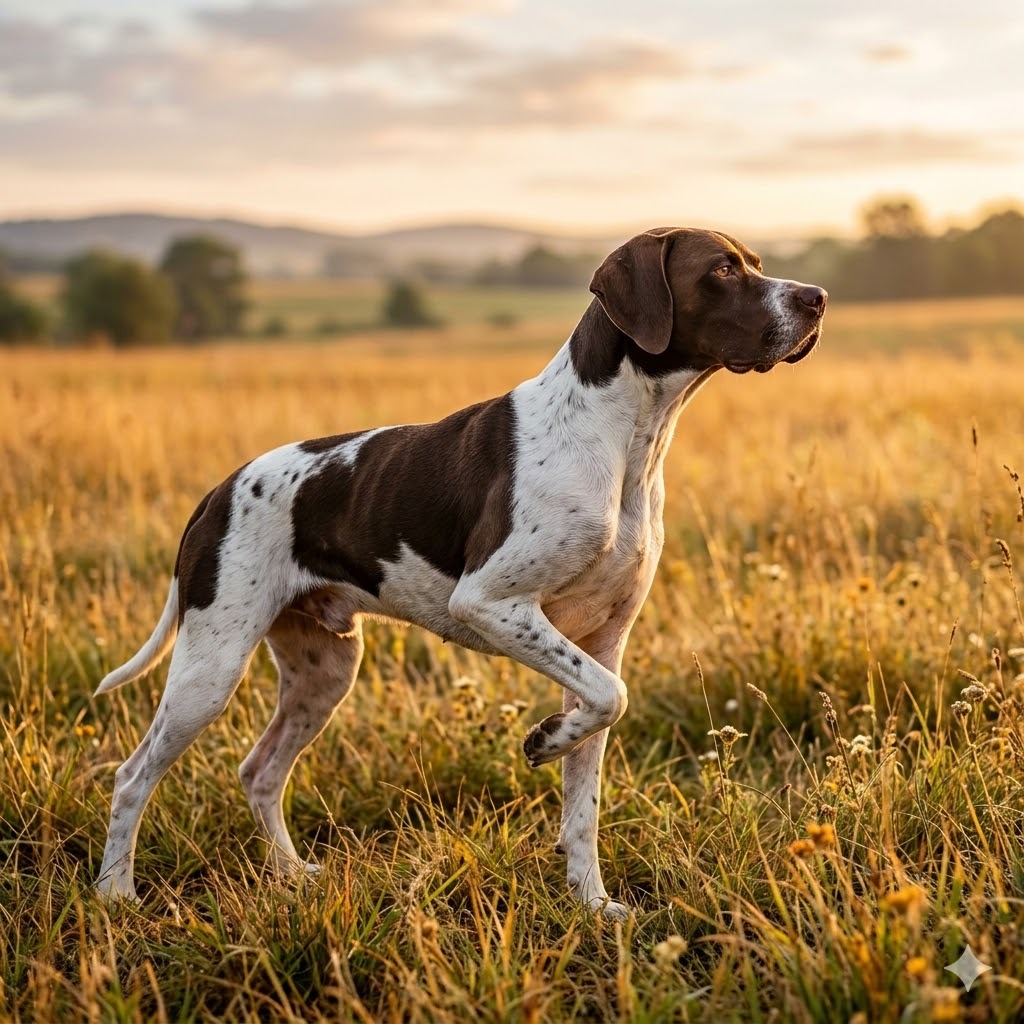
The Pointer - often called the English Pointer - is the classic bird dog: a lean, powerfully built gundog bred over centuries to quarter open ground at speed, catch scent on the air, and freeze into a dramatic, motionless "point" the instant it locates game.
🗓️ Last reviewed: July 2026
Overview
The Pointer - often called the English Pointer - is the classic bird dog: a lean, powerfully built gundog bred over centuries to quarter open ground at speed, catch scent on the air, and freeze into a dramatic, motionless "point" the instant it locates game. Standing tall and racy with a short, hard coat, this is a serious athletic breed built for the hunt. Adults weigh roughly 20-34 kg. Away from the field the Pointer is affectionate, even-tempered, and surprisingly gentle with family, but make no mistake - this is one of the highest-drive, hardest-running sporting dogs in the world, and it needs a lifestyle to match.
History & Origins
The Pointer emerged in England in the 1600s, though its exact ancestry is debated. Most authorities credit a blend of foxhound, greyhound, bloodhound, and imported Spanish pointing dogs. The greyhound and foxhound gave the breed its speed and stamina; the Spanish pointer contributed the instinct to locate and hold game.
Originally the Pointer was used to find hares for coursing greyhounds - the dog would point the hare, and the greyhounds would be released. As wing-shooting with firearms grew fashionable through the 18th century, the Pointer was refined into the definitive upland bird dog, ranging wide to find partridge, grouse, and pheasant, then holding rock-steady while the guns approached.
By the Victorian era the Pointer was a fixture of the English sporting estate and one of the first breeds shown competitively - a Pointer featured at the very first dog show in Newcastle in 1859. The breed reached North America early and became a dominant force in field trials, where its style, range, and intensity remain prized to this day.
Appearance
The Pointer is a medium-to-large, aristocratic, athletic dog built along clean racing lines. Males stand 63-71 cm (25-28 in) and weigh 25-34 kg (55-75 lb); females are smaller, roughly 20-30 kg. The silhouette is all function - deep chest, tucked loin, long powerful legs, and a low centre of gravity that translates into ground-covering speed.
Key features:
- Coat: short, dense, smooth, and hard, with a distinct sheen.
- Colour: liver, black, orange, or lemon, either solid or in combination with white. Often ticked or patched.
- Head: noble, with a well-defined stop and a slightly dished muzzle.
- Eyes: rounded, dark, with a soft, intelligent expression.
- Ears: set at eye level, hanging close to the head, with fine leather.
- Tail: carried straight and lively, tapering to a point, often "cracking" side to side when the dog is working.
The trademark of the breed is the point itself - body rigid, one foreleg lifted, nose and tail forming a straight line toward the hidden bird.
Temperament & Character
At home the Pointer is even-tempered, affectionate, and companionable - far softer in the house than its field intensity suggests. It is friendly with people, generally sociable with other dogs, and devoted to its family. Many owners are surprised by how calm and cuddly a well-exercised Pointer can be indoors.
The catch is that "well-exercised" is doing enormous work in that sentence. The Pointer is a driven, high-energy working dog whose whole being is wired to run and hunt. Deprived of an outlet, it becomes restless, anxious, destructive, and prone to bolting. This is not a breed that adapts to a sedentary life.
Pointers are sensitive and eager to please but can be independent and easily distracted once a scent takes hold. With children they are typically gentle and tolerant, though a young Pointer's exuberance can bowl over a toddler. The strong prey drive means small pets need careful management.
Care
Coat & Grooming
The short, hard coat is about as low-maintenance as a dog's gets. A weekly once-over with a rubber curry or hound mitt removes loose hair and keeps the coat gleaming. Baths are needed only occasionally. The breed does shed, though the fine hairs are less obtrusive than a heavy double coat.
With little insulation, the Pointer has limited cold tolerance and appreciates a coat in harsh winter weather. Check and clean the pendant ears weekly to head off infection, trim nails every few weeks, and brush teeth regularly.
Exercise & Activity Needs
This is the heart of Pointer ownership. Adults need a bare minimum of 90-120 minutes of genuine, vigorous exercise every day - and more is better. A leash walk around the block does nothing for this breed. Pointers need to run hard, ideally off-leash in safe open space, plus hunting, field work, canicross, bikejoring, or dog sport.
The breed excels at field trials, agility, and any activity that channels its stamina and drive. Mental engagement matters too - scent games and training keep the busy mind occupied. An under-exercised Pointer is a genuinely difficult dog; a properly exercised one is a joy.
Health & Lifespan
Average lifespan is 12-15 years - excellent for a dog of this size, reflecting the breed's working soundness.
Common concerns:
- Hip dysplasia - the most significant orthopaedic issue.
- Elbow dysplasia.
- Progressive retinal atrophy and other eye conditions.
- Deafness - occurs in some lines, associated with white pigment.
- Skin allergies and sensitivities.
- Neurotropic osteopathy - a rare inherited nerve disorder.
- Bloat (GDV) - a risk in any deep-chested breed.
Reputable breeders screen hips, eyes, and hearing. Overall the Pointer is a robust, functionally healthy breed.
Feeding & Nutrition
A working Pointer burns enormous calories. Adults typically eat 2.5-3.5 cups of quality food per day in two meals, and hard-working field dogs need considerably more, often on a higher-fat performance formula during the season. Off-season, watch condition and adjust to keep the dog lean and muscular rather than heavy.
Feed two smaller meals rather than one large one, and avoid vigorous exercise within an hour either side of eating to reduce bloat risk. Puppies should grow slowly on a large-breed formula to protect developing joints.
Pros & Cons
Pros
- Gentle, affectionate, even-tempered at home.
- Superb athletic and hunting ability.
- Short coat is extremely easy to groom.
- Long-lived and generally sound.
- Sociable with people and often other dogs.
Cons
- Enormous exercise requirement - no shortcuts.
- Strong prey drive and unreliable recall on scent.
- Becomes destructive and anxious if under-exercised.
- Limited cold tolerance.
- Too much dog for sedentary or first-time owners.
Best Suited For
- Active hunters and field-sport enthusiasts.
- Runners, cyclists, and dog-sport competitors.
- Rural or suburban homes with space and access to open land.
- Owners who can commit to serious daily exercise year-round.
Not suited for apartment dwellers without huge activity, sedentary households, full-time-office homes with no midday coverage, or first-time owners who underestimate the breed's drive and stamina.
Pointer puppy growth chart
A typical growth curve for a large breed like the Pointer, estimated from its adult weight of 20-34 kg. Puppies vary with sex, genetics and diet, so treat this as a guide - for your own puppy, use the puppy weight predictor.
| Age | Typical weight | % of adult |
|---|---|---|
| 2 mo | 4.4-7.5 kg | 22% |
| 3 mo | 6.6-11.2 kg | 33% |
| 4 mo | 8.6-14.6 kg | 43% |
| 6 mo | 12-20.4 kg | 60% |
| 9 mo | 16-27.2 kg | 80% |
| 12 mo | 18.4-31.3 kg | 92% |
| Adult | 20-34 kg | 100% |
Pointer - frequently asked questions
Are Pointers good family dogs?
Yes, for active families. At home they are gentle, affectionate, and good with children. The requirement is heavy daily exercise - a Pointer that gets it is a calm, loving companion.
What is the difference between an English Pointer and a German Shorthaired Pointer?
The English Pointer specialises in finding and pointing birds and tends to run wider and faster. The German Shorthaired Pointer is a versatile all-rounder that points, retrieves, and tracks, and usually works closer. The English Pointer has a shorter, finer coat and a more racing build.
Do Pointers make good running partners?
Excellent ones, once mature. Their stamina is built for it. Wait until the dog is fully grown (around 18 months) before high-impact distance running to protect the joints.
Are Pointers easy to train?
They are intelligent and willing but independent and easily distracted by scent. Positive, consistent training succeeds; harsh methods backfire. Reliable recall takes real work.
Do Pointers shed a lot?
They shed moderately year-round. The short, fine hairs are less noticeable than a heavy coat, and weekly grooming keeps it under control.
🧠 Test yourself: guess the dog
Three clues from our quiz bank, each about another of our dogs. Can you name them?
Clue 1.Despite its name suggesting the outback, this medium herding dog was actually developed on American ranches and is often born with a naturally short tail.
It's the Australian Shepherd - read the full profile →
Clue 2.A member of the bichon family, this lapdog has a curled tail and a distinctive bouncy, springy gait.
It's the Havanese - read the full profile →
Clue 3.Developed for herding before becoming a top police and military dog, this breed starred as Rin Tin Tin in early films.
It's the German Shepherd - read the full profile →
💛 Adoptable Pointers near you
Real dogs of this breed (and close mixes) waiting in shelters and rescues right now, live from Petfinder. We have no affiliation and earn nothing - if someone catches your eye, the link goes straight to their shelter. New to adopting? Start with our adoption guide.
Widget not loading (some ad-blockers hide it)? Search directly on petfinder.com.