Tibetan Mastiff
The Tibetan Mastiff is an ancient, imposing livestock-guardian breed from the high Himalayan plateau, built to protect flocks and monasteries from wolves, leopards, and human intruders.
🗓️ Last reviewed: July 2026
Overview
The Tibetan Mastiff is an ancient, imposing livestock-guardian breed from the high Himalayan plateau, built to protect flocks and monasteries from wolves, leopards, and human intruders. Massive, majestic, and cloaked in a thick lion-like mane, it is one of the most primitive and independent-minded of all guardian dogs. Males commonly weigh 45-70 kg (100-160 lb) and can appear even larger under the heavy coat. Aloof with strangers, deeply devoted to its own family, and famously prone to nocturnal barking, the Tibetan Mastiff is a magnificent but demanding dog that is emphatically not for novice owners.
History & Origins
The Tibetan Mastiff is one of the oldest working breeds in the world, developed over millennia by the nomadic herders and monastery communities of Tibet, Nepal, and the surrounding Himalayan regions. For centuries these dogs guarded sheep, goats, and yaks against predators, and stood watch over villages and monasteries, often working in loose pairs or groups and left largely to their own judgement.
Because Tibet was so isolated, the breed developed with little outside influence, preserving an ancient, primitive character. Historical accounts from travellers describe enormous fierce dogs kept as guardians, and many molosser and mastiff-type breeds across Asia and Europe are believed to share distant ancestry with these Himalayan guardians.
The breed reached the West in the 1800s, when examples were presented to European royalty, and again more substantially in the mid-20th century. Western breeding has sometimes exaggerated coat and size compared with the leaner working dogs still found in Tibet. The AKC recognised the breed in 2006. It remains relatively rare and specialised.
Appearance
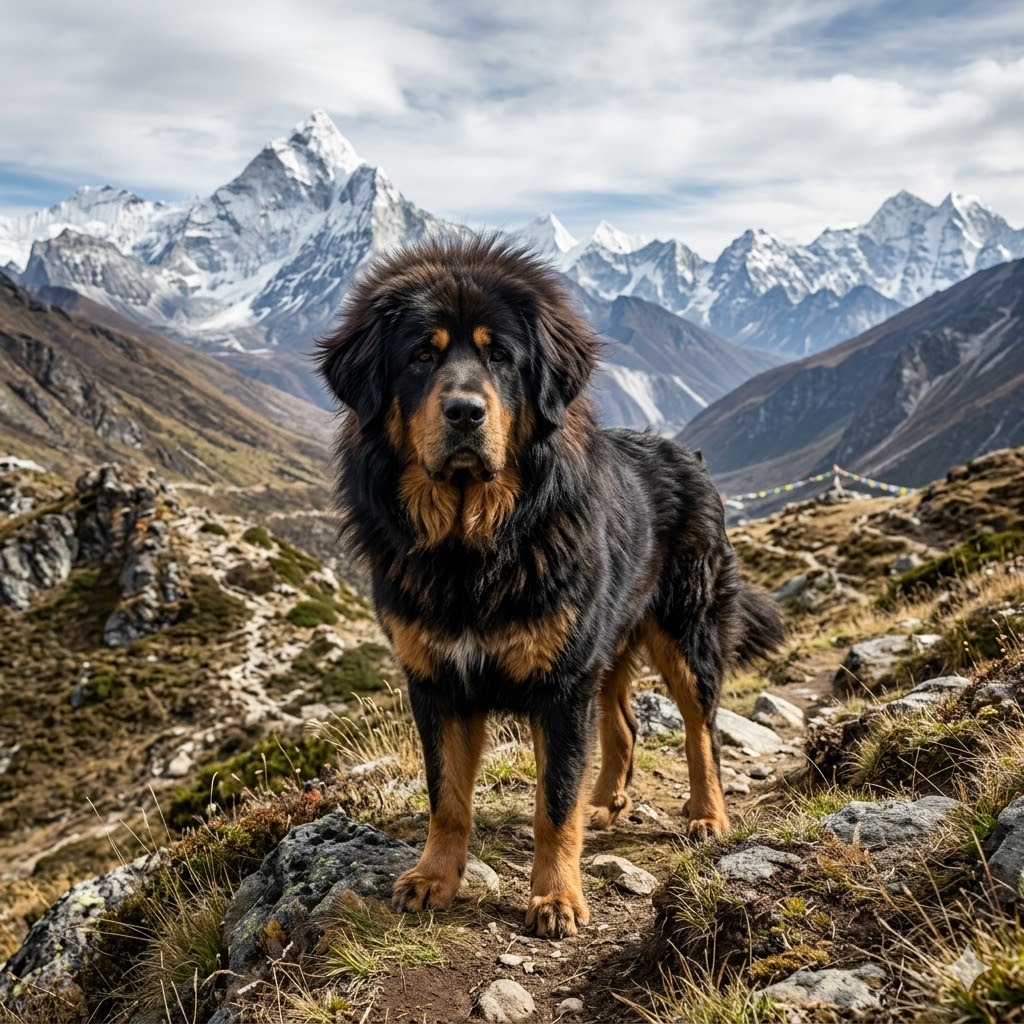
Large, powerful, and heavily coated. Males weigh 45-70 kg (100-160 lb) and stand at least 66 cm (26 in); females are smaller. The overall impression is of solemn strength and dignity, exaggerated by the dense mane around the neck and shoulders.
Key features:
- Coat: thick, long, double coat with a heavy woolly undercoat; a pronounced mane around the neck, heaviest in males.
- Colour: black, brown, and various shades of gold or red, often with tan markings; some blue-grey. Small white chest markings occur.
- Head: broad, heavy, with a strong muzzle and slight wrinkling.
- Eyes: almond-shaped, deep-set, expressive, brown.
- Ears: medium, V-shaped, drop, set high.
- Tail: well-feathered, carried curled over the back.
Temperament & Character
Independent, intelligent, and deeply territorial. The Tibetan Mastiff was bred to make its own decisions on a lonely mountainside, and that independent-thinking, self-reliant nature remains its defining trait. It bonds strongly with its family and is calm and affectionate at home, but it will never be a biddable, eager-to-please dog.
Aloof and reserved with strangers, the breed is naturally suspicious and protective. It assesses newcomers on its own terms and does not welcome uninvited guests. This guardian instinct is powerful and cannot be trained out.
The breed is a notorious nocturnal barker - guarding dogs traditionally patrol and sound off through the night, which can be a serious problem in a residential setting. Tibetan Mastiffs can be dog-aggressive, particularly with same-sex dogs, and require secure, high fencing, as many are determined escape artists and roamers.
Care
Coat & Grooming
The heavy double coat needs brushing two or three times a week to prevent matting, especially around the mane, breeches, and behind the ears. Once a year (sometimes twice), the breed "blows" its coat in a dramatic seasonal shed, releasing huge quantities of undercoat over several weeks; daily brushing is essential during this period.
Outside the blow, the coat is surprisingly low-odour and self-cleaning, and baths are only needed occasionally. Clean the ears weekly, trim nails regularly, and brush the teeth often. The breed tolerates cold beautifully but suffers in heat and humidity.
Exercise & Activity Needs
Moderate but non-negotiable. A Tibetan Mastiff needs a couple of good daily walks and time to patrol a securely fenced yard - around 60 minutes of activity - but it is not a jogging or agility partner. The breed conserves energy and is often relatively inactive indoors, dozing by day and rousing to guard at night.
Because of the strong roaming and guarding drives, off-leash exercise in open areas is risky. A large, very secure fenced space is close to essential. Puppies must not be over-exercised while their heavy frames are still developing.
Health & Lifespan
Average lifespan is 10-12 years - relatively long for such a large breed.
Common concerns:
- Hip and elbow dysplasia - screen breeding stock.
- Canine inherited demyelinative neuropathy (CIDN) - a rare inherited nerve disorder in the breed.
- Hypothyroidism.
- Entropion and other eye conditions.
- Bloat (GDV) - a risk in deep-chested dogs.
- Ear infections - the heavy drop ears trap moisture.
- Heat intolerance - the dense coat makes hot climates dangerous.
Buy from breeders who test hips, elbows, thyroid, and eyes.
Feeding & Nutrition
Despite the size, Tibetan Mastiffs are famously "easy keepers" that often eat less than expected and may skip meals for a day at a time - normal for the breed. A large-breed adult typically eats 3-5 cups of quality food daily, divided into two meals.
Feed a large-breed formula, keep the dog lean to protect the joints, and avoid overfeeding puppies to prevent too-fast growth. Split meals and limit activity around eating to reduce bloat risk, and always provide fresh water.
Pros & Cons
Pros
- Magnificent, dignified appearance.
- Devoted and protective of family.
- Calm and relatively quiet indoors by day.
- Excellent, natural property guardian.
- Thrives in cold climates.
Cons
- Independent and stubborn; hard to train.
- Notorious nocturnal barker.
- Strong roaming instinct; needs high secure fencing.
- Heavy seasonal shedding and grooming.
- Poor heat tolerance; not for novices.
Best Suited For
- Experienced owners familiar with guardian breeds.
- Rural or suburban homes with large, securely fenced land.
- Cold or temperate climates.
- People who want a protector, not an obedient companion.
Not suited for first-time owners, apartments, hot climates, close-neighbour settings where night barking is a problem, or anyone expecting an eager, biddable dog.
Tibetan Mastiff puppy growth chart
A typical growth curve for a giant breed like the Tibetan Mastiff, estimated from its adult weight of 45-70 kg. Puppies vary with sex, genetics and diet, so treat this as a guide - for your own puppy, use the puppy weight predictor.
| Age | Typical weight | % of adult |
|---|---|---|
| 2 mo | 8.1-12.6 kg | 18% |
| 3 mo | 12.6-19.6 kg | 28% |
| 4 mo | 16.7-25.9 kg | 37% |
| 6 mo | 23.4-36.4 kg | 52% |
| 9 mo | 31.5-49 kg | 70% |
| 12 mo | 37.4-58.1 kg | 83% |
| Adult | 45-70 kg | 100% |
Tibetan Mastiff - frequently asked questions
Are Tibetan Mastiffs good family dogs?
With their own family they are devoted, calm, and affectionate, and generally good with family children when raised together. But their guarding instinct and independence make them a poor fit for busy, open households.
Why do they bark so much at night?
They were bred to patrol and guard livestock through the night, sounding off at anything unusual. This nocturnal barking is instinctive and can be a serious issue near neighbours.
Can a Tibetan Mastiff be left off-leash?
Rarely safely. The breed has strong roaming and guarding drives and unreliable recall, so secure high fencing and leashed walks are the norm.
Do they shed a lot?
For most of the year shedding is moderate, but once or twice annually they "blow" the coat, dropping enormous amounts of undercoat over several weeks.
Are they suitable for first-time owners?
No. Their size, independence, guarding instinct, and stubbornness demand experienced handling. This is not a beginner's breed.
🧠 Test yourself: guess the dog
Three clues from our quiz bank, each about another of our dogs. Can you name them?
Clue 1.One of the heaviest dog breeds on Earth, this gentle giant can top 200 pounds and once guarded estates and fought in arenas.
It's the English Mastiff - read the full profile →
Clue 2.Bred in the snowy mountains of northern Japan to hunt large game like boar and bear, this thick-coated spitz-type breed is dignified and reserved with strangers.
It's the Akita - read the full profile →
Clue 3.Bred by a Siberian people to herd reindeer and pull sleds, this thick-coated spitz has a brilliant snow-white coat.
It's the Samoyed - read the full profile →
💛 Adoptable Tibetan Mastiffs near you
Real dogs of this breed (and close mixes) waiting in shelters and rescues right now, live from Petfinder. We have no affiliation and earn nothing - if someone catches your eye, the link goes straight to their shelter. New to adopting? Start with our adoption guide.
Widget not loading (some ad-blockers hide it)? Search directly on petfinder.com.