Ant Farm
An ant farm - properly called a formicarium - is a living exotic pet: you keep a real ant colony, usually started from a single queen, and watch it grow over months and years.
🗓️ Last reviewed: July 2026
Overview
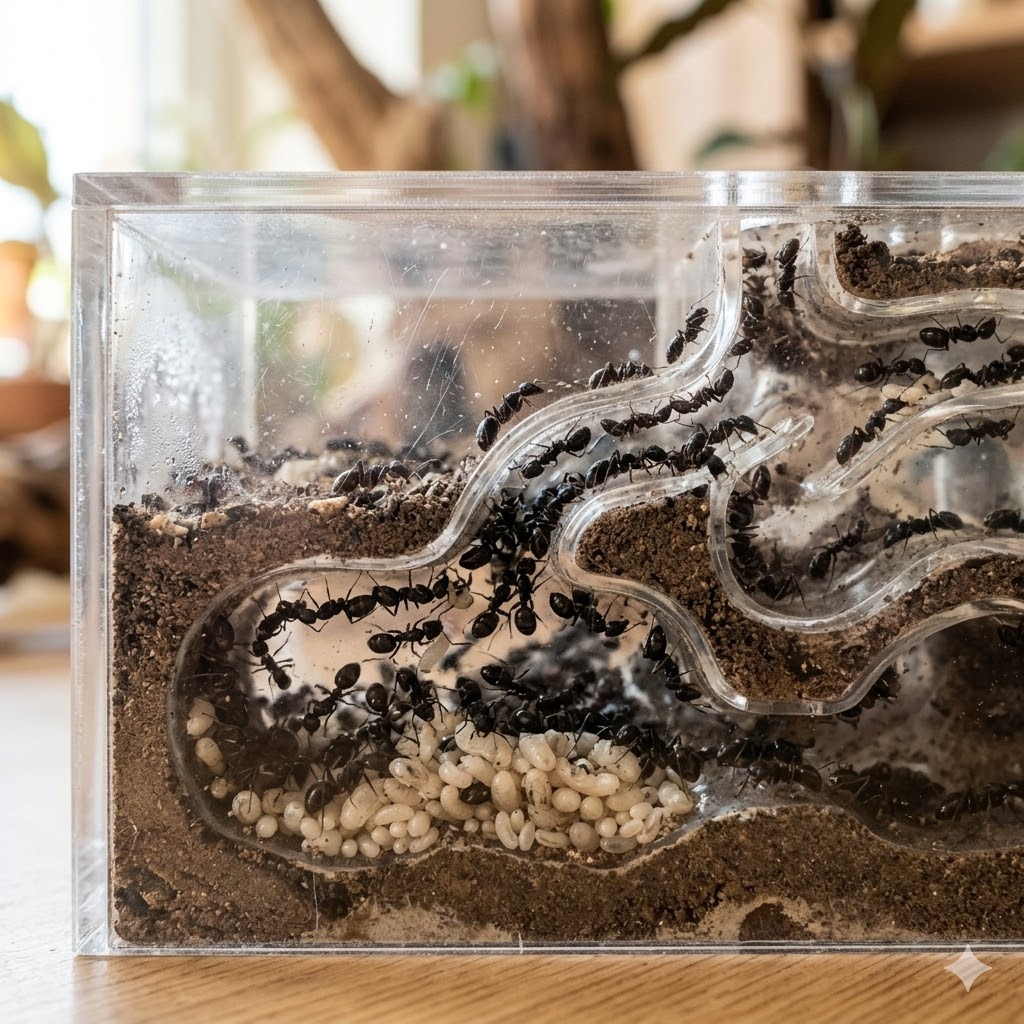
An ant farm - properly called a formicarium - is a living exotic pet: you keep a real ant colony, usually started from a single queen, and watch it grow over months and years. This is very different from the sealed gel novelty kits sold to children, which have no queen and are really just a short-lived science toy. A true formicarium begins with one mated queen who lays eggs, raises her first workers, and slowly builds a functioning society you can observe through clear tunnels and a foraging area. The appeal is behavioural, not tactile - you are not handling ants, you are watching a superorganism organise itself. Colonies dig, farm, haul food, tend brood, sort their dead into refuse piles, and even respond to the changing seasons by slowing down in winter. Over time a founding queen can grow from a handful of workers into a bustling city of hundreds or thousands, and no two colonies develop in quite the same way. Because the whole colony depends on that single queen, an ant farm is a genuine long-term commitment and a study in patience rather than a passing toy.
Common Pet Species
- Black garden ant (Lasius niger) - the classic European beginner species, hardy and forgiving.
- Harvester ants (Messor barbarus / Pogonomyrmex) - larger, seed-eating, easy to feed on grains.
- Camponotus (carpenter ants) - big, slow, impressive workers; patient starters.
- Lasius flavus - a smaller yellow underground species for calm observation.
- Tetramorium immigrans (pavement ant) - common, fast-growing, resilient.
- Always choose a species legal and native to your region.
Appearance
A single colony ranges from a lone queen a few millimetres long to thousands of workers. Queens are the largest members, often 8-15 mm depending on species, with a swollen thorax and (before their nuptial flight) a set of wings that they shed once mated. Workers are typically 2-9 mm, and in some species you will see distinct castes - smaller "minors" that tend the brood and larger "majors" or soldiers with oversized heads for defence and cracking seeds. Colours run from pale translucent yellow through warm red-brown to glossy black. The real spectacle, though, is not any single ant but the structure the colony builds - branching tunnels, dedicated brood chambers packed with white eggs, wriggling larvae and pupae, food stores, and neatly separated refuse piles - all of it visible through the formicarium walls like a living cross-section of the earth.
Temperament & Handling
Ant farms are strictly observation pets. You do not handle the ants; you watch them. Interaction means feeding, hydrating, and quietly viewing the tunnels through the clear walls. Some species can bite, and a few can sting mildly, if the outworld is opened carelessly, so most keepers avoid reaching in and instead work through the feeding hole with tools. The reward is watching complex collective behaviour unfold - workers laying scent trails to a food source, a chain of ants carrying a single grub back to the nest, nurses shuffling brood to warmer chambers, and the whole colony reacting to a disturbance in seconds. It is a pet you engage with by watching, and that watching is genuinely absorbing.
Enclosure
A formicarium has two parts: the nest (where tunnels and brood live) and the outworld (an open foraging arena where food and water go). Beginner nests are often made of aerated concrete, gypsum, or acrylic with pre-cut chambers. Small colonies start in a simple test tube setup - a tube half-filled with water plugged by cotton, giving a moist chamber for the founding queen - then graduate to a nest as numbers grow.
Connect nest and outworld with tubing. The outworld walls need a barrier (fine talc or PTFE fluid) to stop escapes, plus a secure lid. Keep the nest shaded and the outworld lightly lit. Match nest size to colony size - too large a space stresses a small colony and dries out.
Heating, Humidity, Lighting
- Temperature: 20-26°C for most temperate species; a small heat cable or mat on one side lets ants choose warmth.
- Humidity: species-specific - many need one damp region (via the water reservoir) and one dry region.
- Lighting: the nest should be dark; ants dislike light on the brood. Use a red filter or cover for viewing.
Diet
Ants need two things: sugars for the workers' own energy and protein to raise brood. Offer a drop of sugar water or diluted honey for the workers, and small insects (crickets, fruit flies, mealworm pieces) for the growing larvae; harvester species instead need a supply of small seeds and grains that they mill into "ant bread." A colony's protein demand rises when the queen is laying heavily, so you will see feeding needs ebb and flow with the brood cycle. Feed small amounts a few times a week rather than large piles, and always remove uneaten food promptly, since decaying insects invite mould and mites that can wipe out a colony. A constant, clean water source in the outworld is essential.
Health & Lifespan
Colony health depends almost entirely on the queen. Queens are remarkably long-lived - many species' queens survive 10-15 years, and Lasius niger queens have been recorded living around 20-30 years. Individual workers live only weeks to months and are constantly replaced. Males live briefly and die after the mating flight.
Common concerns:
- Queen loss - if the queen dies, the colony slowly fades and cannot be saved.
- Mould and mites - from uneaten food or excess damp.
- Dehydration - a dry nest kills brood quickly.
- Stress from over-handling or vibration - keep the nest calm and dark.
Pros & Cons
Pros: endlessly fascinating collective behaviour, silent, odourless, tiny footprint, very cheap to feed, queens live for years. Cons: observation-only, slow to establish, the colony lives or dies by the single queen, and keeping some non-native or invasive species is illegal - always check local law before collecting or buying.
Ant Farm - frequently asked questions
Do I need to catch a queen myself?
You can collect a mated queen after a nuptial flight where it is legal, or buy a captive-started colony. The colony cannot grow without a fertile queen.
Is it legal to keep any ants I find?
Not always. Keeping non-native or invasive species is illegal in many places and ecologically harmful. Check local law and keep only species native to your area.
How long until the colony gets big?
Slowly. A founding queen may take months to raise her first workers and a year or more to reach a lively colony. Patience is part of the hobby.
What happens if the queen dies?
The colony gradually declines and eventually dies out, since workers cannot reproduce. This is the honest core risk of the hobby.
Are ant farms good for kids?
Yes, as a supervised observation project. The lesson in patience and biology is excellent, but an adult should manage feeding and humidity.
🧠 Test yourself: guess the exotic
Three clues from our quiz bank, each about another of our exotic. Can you name them?
Clue 1.A heavy-bodied arachnid kept as a pet, the females of which can live for decades, far longer than the short-lived males.
It's the Tarantula - read the full profile →
Clue 2.This ambush hunter has a single ear on its underside, tuned to detect the echolocation of hunting bats.
It's the Praying Mantis - read the full profile →
Clue 3.This twig-mimicking insect is a master of camouflage and can sometimes regrow a lost leg when it molts.
It's the Stick Insect (Phasmid) - read the full profile →