Tailless Whip Scorpion
The tailless whip scorpion (order Amblypygi) is one of the most alien-looking pets in the invertebrate hobby - and one of the most misunderstood.
🗓️ Last reviewed: July 2026
Overview
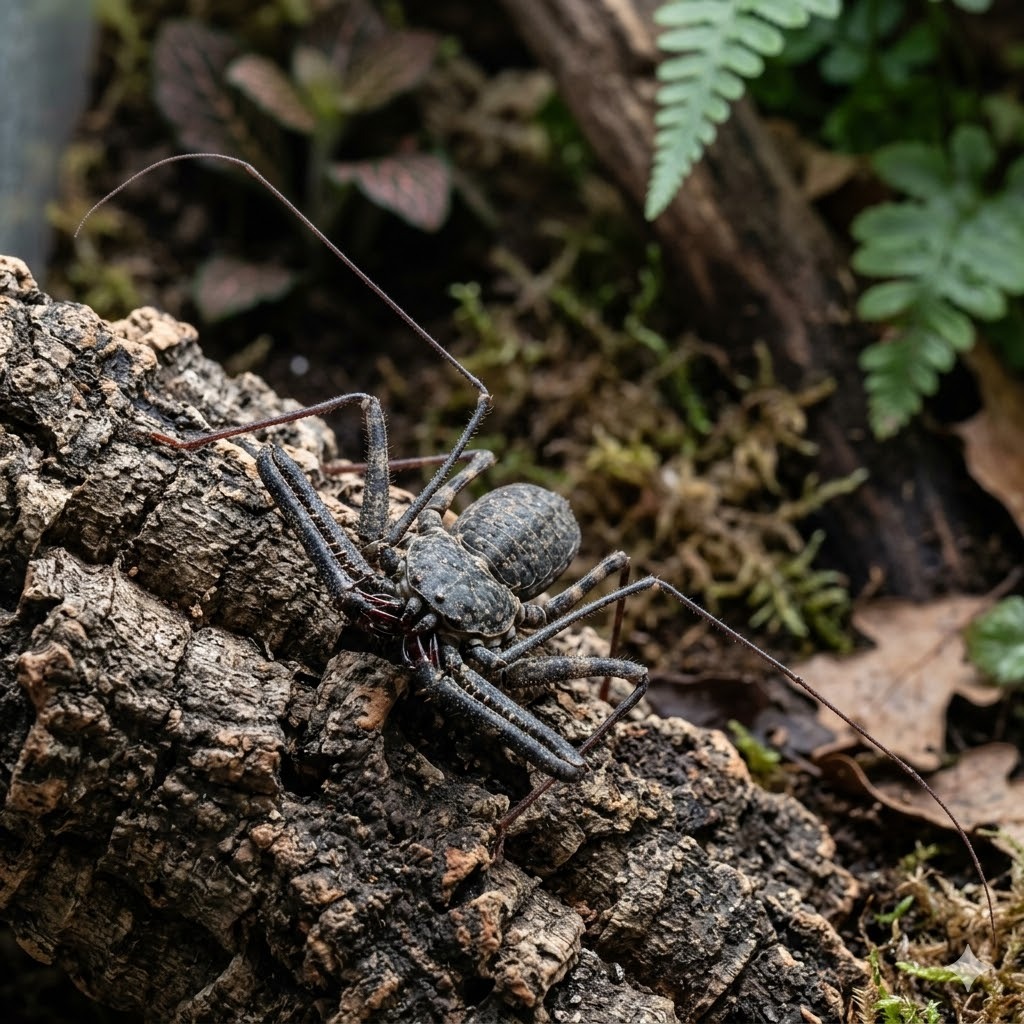
The tailless whip scorpion (order Amblypygi) is one of the most alien-looking pets in the invertebrate hobby - and one of the most misunderstood. Despite the name, it is neither a true scorpion nor a spider, and it has no tail and no sting. It is a flat, fast arachnid relative that hunts by feeling its way through the dark with a pair of extraordinarily long, whip-like front legs called antenniform legs, which it waves ahead of itself like living antennae to map the world by touch. Its spined pedipalps fold up like tiny grabbing arms and snap out to seize prey with startling speed. Crucially, it is not venomous and does not bite in any medically significant way, making it a strangely gentle exotic once you get past the sci-fi appearance. Many keepers describe it as looking terrifying and behaving like the shyest animal in the room. It has even earned a pop-culture following, and among invertebrate enthusiasts it is valued as a docile, low-maintenance, endlessly fascinating display animal.
Common Pet Species
- Damon diadema - the classic beginner amblypygid, large and hardy, sometimes kept communally.
- Damon medius - similar care, striking banded legs.
- Phrynus marginemaculatus - a smaller species that can be group-housed.
- Heterophrynus species - large and impressive but more advanced.
- Charinus species - tiny, delicate specialist amblypygids.
Appearance
The body is remarkably flat, letting the animal squeeze under bark and into the narrowest crevices where nothing can reach it. The main body is usually 1-5 cm long depending on species, but the true span is deceptive - the whip-like antenniform legs can stretch 10-25 cm or more, and in the largest species the total legspan approaches the width of a spread hand. These whip legs are not used for walking at all; they are pure sensory organs, constantly probing the air and surfaces ahead. The animal actually moves on six walking legs, holding one pair of whips out front like feelers. Coloration is mottled brown, tan and black, superb camouflage against tree bark and rock. The front pedipalps are spined and armoured, folded like miniature grabbing arms, and the animal walks with a curious crab-like sidestep, able to dart in any direction in an instant.
Temperament & Handling
Amblypygi are docile and non-aggressive - they would rather flee than fight, and they have no venom to deliver even if cornered. Some species are calm enough that they can be gently encouraged to walk across a hand, and their grip feels like the lightest tickle. However, they are still best treated as observation pets, because they are extremely fast and extremely fragile. A startled specimen bolts in a blur, and its thin legs and flat body damage easily if it falls or is squeezed. Handling therefore risks the animal far more than the keeper. If one must be moved, it should be coaxed onto a leaf or piece of bark rather than grabbed by the legs, which can detach. The real reward is watching it come alive at night, "tasting" the enclosure with sweeping whips before pouncing on prey with its folding arms.
Enclosure
Because amblypygids climb and hang upside down, the enclosure should be taller than it is wide. A vertical terrarium with slabs of cork bark leaning against the back wall gives essential vertical surface for the animal to cling to and hang under - this is where it will spend nearly all its time. A footprint of roughly 20 x 20 cm with 30 cm or more of height suits a single adult of the common species.
Add a moisture-holding substrate such as coco fibre, a hide, and gentle ventilation so the air stays humid without going stagnant. Keep the enclosure secure but humid, and give the animal several vertical hiding spots so it can always retreat out of sight. Provide branches and rough bark texture; a smooth glass box alone is stressful for a species built entirely to grip and hang. Because these are nocturnal ambush hunters, they appreciate clutter - overlapping bark slabs and a few live or artificial plants both raise humidity and give the animal the sense of cover it needs to feel safe and hunt naturally.
Heating, Humidity, Lighting
- Temperature: 24-28°C, matching the warm tropical range these species come from.
- Humidity: high, roughly 70-80%, maintained by misting and a damp substrate.
- Lighting: no UV needed; these are nocturnal animals that prefer dim, shaded conditions and hide from bright light.
Diet
A committed insectivore. Feed live insects - crickets, roaches, and other appropriately sized feeders no wider than the animal's body - which it ambushes and snatches with its spined pedipalps in a movement almost too fast to follow. Adults eat every few days to weekly; fast-growing juveniles need feeding more often. Offer prey after dark, when the animal is naturally active, and remove any uneaten insects promptly so they cannot nibble a resting or moulting amblypygid, which is defenceless during a moult. A shallow water source, or simply regular misting that leaves droplets on the bark, keeps it hydrated and supports the high humidity it needs.
Health & Lifespan
With good humidity and warmth these are hardy animals. Lifespan is typically around 5-10 years for the larger species such as Damon diadema, with smaller species living shorter lives. They moult periodically to grow, and moulting is the most vulnerable moment.
Common concerns:
- Failed moults - usually caused by low humidity; the animal needs vertical space and moisture to moult hanging down.
- Dehydration - from a dry, under-misted enclosure.
- Injury from falls or rough handling - the flat body and thin legs are fragile.
- Mites - from uneaten food or excess damp.
Pros & Cons
Pros: completely harmless and non-venomous, docile, silent, odourless, fascinating alien behaviour, some species can be kept communally. Cons: observation-only, very fast and fragile, needs a tall humid setup with cork bark, and the appearance frightens some people despite being harmless.
Tailless Whip Scorpion - frequently asked questions
Is it dangerous or venomous?
No. Amblypygi have no venom and no sting. They are among the most harmless arachnids kept in the hobby.
Can I handle it?
It is best not to. They are docile but extremely fast and fragile, so handling risks injuring the animal. Observation is the point.
Why does it look so scary if it is harmless?
The flat body, grabbing pedipalps, and long whip legs look menacing, but those whips are sensory feelers, not weapons. It is all bluff and biology.
Can I keep more than one together?
Some species, notably Damon diadema and Phrynus marginemaculatus, tolerate group housing if well fed and given space. Others should be kept singly.
What is the most important thing to get right?
Vertical cork bark and high humidity. Get those two right and these are hardy, long-lived pets.
🧠 Test yourself: guess the exotic
Three clues from our quiz bank, each about another of our exotic. Can you name them?
Clue 1.From a single island nation, this glossy brown roach gives live birth and males sport bumpy 'horns.'
It's the Madagascar Hissing Cockroach - read the full profile →
Clue 2.New World species of this arachnid defend themselves by kicking urticating hairs, while Old World species rely on faster, more potent bites.
It's the Tarantula - read the full profile →
Clue 3.With triangular head, swiveling neck, and grasping front limbs, this stick-mimicking insect strikes prey in a fraction of a second.
It's the Praying Mantis - read the full profile →