Vinegaroon
Vinegaroons, also called whip scorpions, are harmless arachnids kept as calm, low-maintenance exotic pets.
🗓️ Last reviewed: July 2026
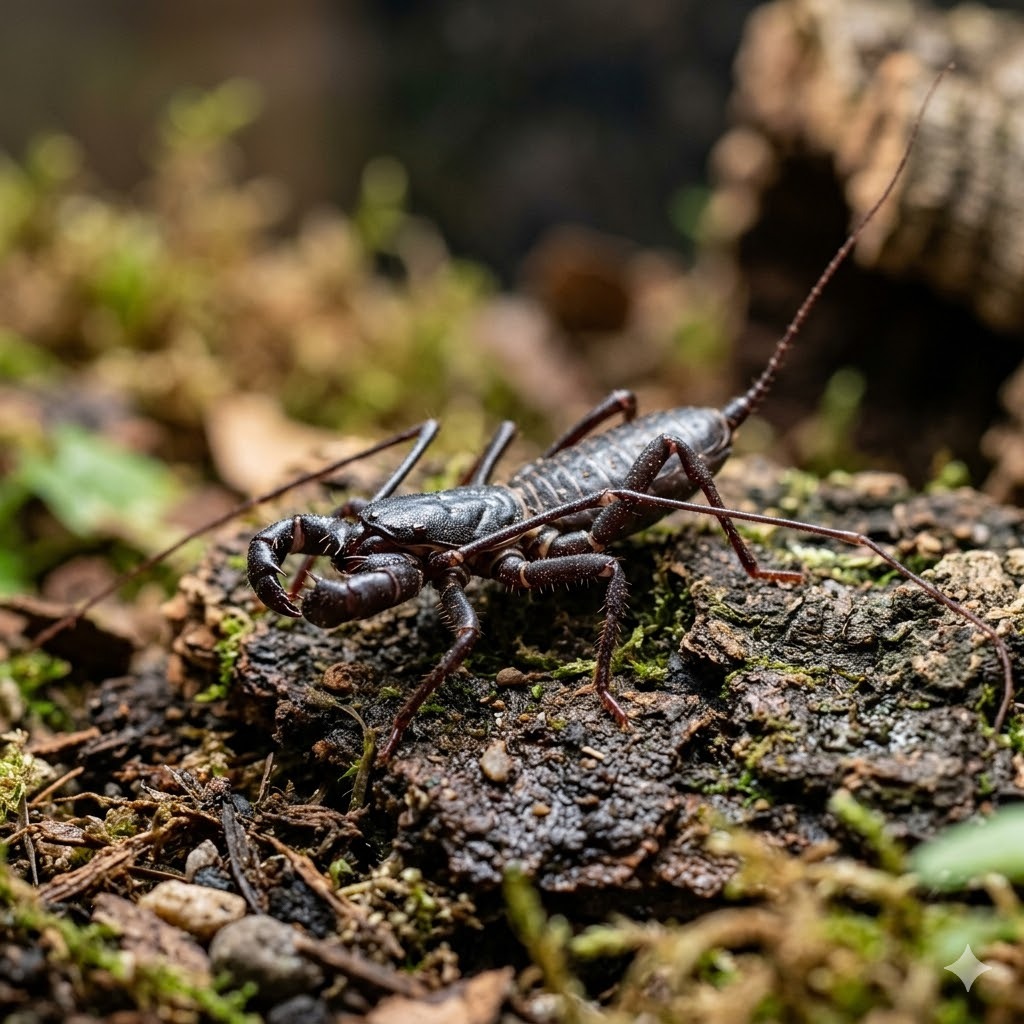
Overview
Vinegaroons, also called whip scorpions, are harmless arachnids kept as calm, low-maintenance exotic pets. Despite the fearsome name and armoured appearance, they are not true scorpions and have no venom and no sting. Their only real defence is a fine spray of acetic acid - essentially a vinegar mist - fired from the base of the whip-like tail, which smells sharp but is harmless to healthy skin. The most commonly kept species is the giant vinegaroon (Mastigoproctus giganteus) from the southern United States and Mexico. These are patient, nocturnal burrowers that spend the day hidden and emerge at night to hunt insects. For anyone who wants an unusual arachnid without the risk of a scorpion or an aggressive spider, the vinegaroon is one of the gentlest choices in the hobby.
Because they are so undemanding and completely non-venomous, vinegaroons have quietly become a favourite "gateway" arachnid for keepers who want something more unusual than a tarantula but with less risk. They are hardy, tolerant of small mistakes, and endlessly interesting to watch once you learn to observe them at night. A vinegaroon spends much of its time excavating and reshaping burrows, and a well-set-up enclosure lets you watch this natural engineering. They are also long-lived by invertebrate standards, so a single animal can become a familiar fixture in the home for several years. First-time keepers are often surprised by how much personality a slow, deliberate arachnid can show as it patrols its territory and ambushes prey.
Common Pet Species
- Giant Vinegaroon (Mastigoproctus giganteus) - the classic North American pet species.
- Mastigoproctus cinteotl - a related, similar-care species.
- Asian Vinegaroon (Typopeltis species) - occasionally available, similar care.
- Thelyphonus species - smaller Asian whip scorpions.
Appearance
Body 4-7 cm, with a total length of 8-13 cm including the thin, whip-like tail (the flagellum) that gives the group its name. The body is flattened, glossy, and dark brown to black, built low to the ground for pushing through burrows. The front pair of legs is long and thin and works as feelers rather than for walking, sweeping the ground ahead to sense prey and surroundings, while the heavy front pincers (pedipalps) are used to grab and crush prey. Females are usually a little larger than males, and both sexes look almost identical apart from size and the shape of the underside near the tail.
Temperament & Handling
Docile and slow-moving. Vinegaroons rarely try to pinch and almost never spray unless roughly grabbed or squeezed. They are best kept as observation pets, but brief, gentle handling is possible - let one walk onto a flat palm rather than picking it up from above.
If it does spray, the mist is acetic acid (vinegar). It is harmless on skin but can sting if it reaches the eyes, so avoid handling near the face and wash hands afterwards. Because they are nocturnal, a vinegaroon lifted during the day may simply freeze or slowly walk off, and a red night-light is the best way to watch its natural hunting and burrowing behaviour without disturbing it.
Enclosure
A single adult is comfortable in a 20-30 litre enclosure, roughly 30 x 20 x 20 cm, with more floor space than height. The most important feature is a deep layer of substrate for burrowing, as a vinegaroon that cannot dig will be stressed and refuse to settle.
Substrate: a moisture-holding mix of coco fibre, topsoil, and a little sand, 10-15 cm deep, kept damp so burrows hold their shape without collapsing. Pack it firmly rather than leaving it loose and fluffy. Add a cork bark hide or half flowerpot to give a ready-made retreat, plus a shallow water dish that cannot drown the animal. A few pieces of bark or flat stone on the surface give extra cover. A secure lid is essential - they can climb slightly and will push at loose covers, and a lost vinegaroon quickly dries out. Keep the enclosure out of direct sunlight, which can overheat it and dry the burrows.
Vinegaroons are best kept singly. They are not social, and housing two together risks fighting or cannibalism, especially around moulting time.
Heating, Humidity, Lighting
- Temperature: 24-28°C.
- Humidity: 70-80%; keep the lower substrate damp at all times.
- No UV needed; they are nocturnal and dislike bright light.
Diet
Live insects: crickets, dubia roaches, mealworms, and the occasional earthworm. Adults eat 1-3 prey items per week, while growing juveniles eat more often. They grab prey with the heavy pincers and crush it, and are efficient, patient night hunters that ambush insects near the mouth of the burrow. Offer prey no larger than the vinegaroon's body to avoid stress or injury. Remove uneaten insects so they cannot disturb or nibble the vinegaroon, especially before and during a moult, when it becomes soft and vulnerable. Dust prey lightly with a calcium supplement now and then to support healthy moulting. A vinegaroon that stops eating and seals itself into its burrow is usually preparing to moult, and this is normal - simply leave it undisturbed until it re-emerges and hardens.
Health & Lifespan
Lifespan is 4-7 years in captivity, sometimes longer, with females tending to live longer than males. Growth is slow and involves several moults before adulthood.
Common concerns:
- Dehydration - the single biggest killer; substrate must stay damp.
- Failed moults - usually caused by air that is too dry.
- Impaction - from swallowing loose sand or gravel.
- Injury - from falls or from being handled too roughly.
Pros & Cons
Pros: completely harmless, quiet, odourless, cheap to feed, hardy, long-lived for an invertebrate, and fascinating nocturnal behaviour to watch. Cons: mostly hidden by day, needs constant humidity, can spray vinegar if mishandled, best kept alone, and not a cuddly or interactive pet.
Vinegaroon - frequently asked questions
Are vinegaroons dangerous?
No. They have no venom and no sting. The worst they can do is a mild pinch or a harmless vinegar spray.
Why are they called vinegaroons?
Because of the acetic-acid mist they can spray when threatened, which smells strongly of vinegar.
Can you handle them?
Yes, gently and briefly. Let one walk onto your open hand rather than grabbing it, and keep it away from your face.
How long do they live?
Usually 4-7 years, with females often outliving males.
Are they good for beginners?
Yes. They are hardy, harmless, and undemanding, as long as the enclosure stays humid.
Can I keep two together?
It is safer to keep them singly. They are not social and may fight or eat each other, particularly around moulting.
🧠 Test yourself: guess the exotic
Three clues from our quiz bank, each about another of our exotic. Can you name them?
Clue 1.Kept as a low-maintenance pet abroad, this slow nocturnal animal needs calcium to build its huge spiral shell.
It's the Giant African Land Snail - read the full profile →
Clue 2.A heavy-bodied arachnid kept as a pet, the females of which can live for decades, far longer than the short-lived males.
It's the Tarantula - read the full profile →
Clue 3.This crustacean has a soft, spiraled abdomen and must borrow an empty snail shell to protect its body.
It's the Hermit Crab - read the full profile →