Cherry Barb
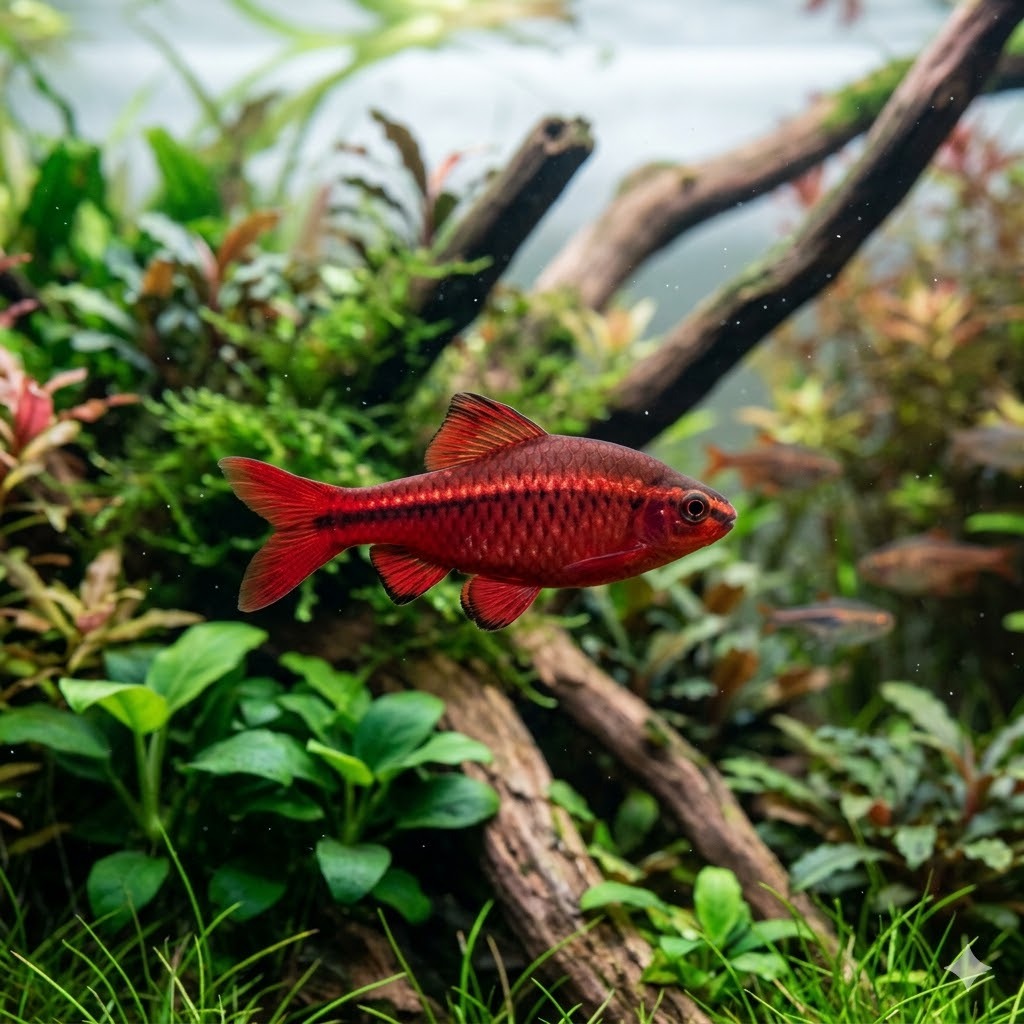
The cherry barb (Puntius titteya) is a small, peaceful schooling fish prized for the deep cherry-red colour that males develop, especially when spawning.
🗓️ Last reviewed: July 2026
Overview
The cherry barb (Puntius titteya) is a small, peaceful schooling fish prized for the deep cherry-red colour that males develop, especially when spawning. Adults reach about 5 cm and typically live 4-6 years, making them one of the hardier and more beginner-friendly barbs for a planted community tank.
Natural History
The cherry barb is native to Sri Lanka, where it lives in shaded, slow-moving streams and rivers among leaf litter and dense bankside vegetation. These forest waters are soft, often stained brown with tannins, and dimly lit by an overhead canopy, which is why the fish shows its best colour in a subdued, planted setting rather than a bright, bare tank. Wild populations have declined due to habitat loss and collection, so most fish in the hobby today are captive-bred, which has made them very adaptable to aquarium life and forgiving of a range of conditions. In nature they move in loose groups through the shallows, staying close to cover and darting between plants when startled, and this instinct to stay near shelter carries straight over into the aquarium.
Appearance
Cherry barbs have a slim, torpedo-shaped body with a single dark lateral stripe running from snout to tail. Males show the famous cherry-red to brick-red colour that intensifies during courtship, deepening to an almost glowing red when a male is displaying to a female or competing with rivals. Females are more subdued, showing a browner or tan body with a paler belly and a rounder shape, especially when carrying eggs. Both sexes have a fine, understated pattern rather than bold markings, and the red flush is what gives the species its name and appeal. Fish that feel secure and are kept in good conditions hold far stronger colour than nervous, isolated individuals, so appearance is closely tied to how they are housed.
Tank Size & Setup
- Minimum tank size: about 60 L for a group of six or more.
- Cherry barbs are schooling fish and should be kept in groups of at least 6 (more is better) to reduce shyness and encourage natural colour.
Provide a well-planted tank with plenty of cover - live plants, driftwood, and a darker substrate all help them feel secure and show better colour. A gentle to moderate flow suits them, and floating plants or a dim area gives shade that echoes their shaded stream origins. Aim for open swimming lanes between planted areas so the group can cruise and still dart back to shelter. Cherry barbs adapt well to standard community tanks and do not need any specialist equipment, but a mature, cycled tank with stable water gives the best results. A tight-fitting lid is sensible, as barbs can jump.
Water Parameters
- Temperature: 23-27°C.
- pH: 6.0-7.5 (slightly acidic to neutral preferred).
- Hardness: soft to moderately hard, roughly 2-15 dGH.
- Ammonia 0, nitrite 0, nitrate kept low with regular water changes.
Cherry barbs are tolerant of a fairly wide range once acclimated, but they colour up best in soft, slightly acidic water.
Diet
Omnivore. In the wild they eat small insects, larvae, and plant matter drifting through their stream habitat. In the aquarium they thrive on a quality micro-pellet or flake as a staple, supplemented with frozen or live foods such as daphnia, brine shrimp, and bloodworms. Small, varied feedings once or twice a day keep them healthy and bring out the best colour, and live or frozen treats in particular help condition males into their brightest red. They will also graze on soft algae and small bits of blanched vegetable. Feed only what the group can finish in a couple of minutes, since leftover food fouls the water and undoes the stable conditions they prefer.
Health & Lifespan
Average lifespan is 4-6 years.
Cherry barbs are hardy but still benefit from stable, clean water. Common concerns include:
- Ich (white spot) - often triggered by temperature swings or stress.
- Fin rot - linked to poor water quality.
- Stress and washed-out colour - usually a sign the group is too small or the tank lacks cover.
Keeping them in a proper school, maintaining stable parameters, and doing regular water changes prevents most issues. Quarantining new fish before adding them to the main tank is also a simple way to avoid introducing disease to an established, healthy group.
Pros & Cons
Pros: small, peaceful, hardy, beautiful red males, easy to feed, good for planted community tanks and beginners. Cons: males can chase each other during spawning; colour fades when kept alone, stressed, or in bare tanks; wild-type colour needs the right conditions to shine.
Cherry Barb - frequently asked questions
How many cherry barbs should I keep together?
At least 6. A proper group makes them bolder, more colourful, and more natural in behaviour.
Are cherry barbs aggressive like tiger barbs?
No. They are one of the most peaceful barbs and do not nip fins the way tiger barbs can, making them good community fish.
Why are my cherry barbs not red?
Males colour up most when secure and during courtship. Small groups, bright bare tanks, stress, or all-female stock can leave a tank looking pale. A planted setup and a healthy school help.
What can I keep with cherry barbs?
Other peaceful, similarly sized community fish - small tetras, rasboras, corydoras, and otocinclus all work well.
Are cherry barbs good for beginners?
Yes. They are hardy, adaptable, and forgiving of minor mistakes, provided they are kept in a group with stable water.
🧠 Test yourself: guess the fish
Three clues from our quiz bank, each about another of our fish. Can you name them?
Clue 1.A laterally compressed cichlid with vertical dark stripes, it forms monogamous pairs and guards its eggs on a flat leaf or surface.
It's the Angelfish - read the full profile →
Clue 2.This tiny, hardy aquarium fish gives birth to live young rather than laying eggs, earning it the nickname 'rainbow fish.'
It's the Guppy - read the full profile →
Clue 3.This small South American scavenger has tiny barbels and a sharp spine in each fin that can lock upright for defense.
It's the Corydoras Catfish - read the full profile →