Clown Loach
The clown loach (Chromobotia macracanthus) is a bold, orange-and-black striped loach beloved for its playful, social nature and comical antics.
🗓️ Last reviewed: July 2026
Overview
The clown loach (Chromobotia macracanthus) is a bold, orange-and-black striped loach beloved for its playful, social nature and comical antics. Sold as a small, irresistibly cute juvenile, it hides a big secret: this fish grows large - up to around 30 cm - lives for decades, and needs to be kept in a group in a very big tank. Charming and characterful it certainly is, and few fish have as much personality, but it is honestly a species that outgrows most home aquariums, and buyers should understand that fully before they commit. Too many clown loaches are bought as tiny shop fish for small community tanks and then either stunt, decline or end up homeless once they start to fill their tank. Given the space and company they need, though, they are one of the most rewarding and long-lived fish in the hobby.
Natural History
Clown loaches are native to the rivers and seasonally flooded forests of Borneo and Sumatra in Indonesia, where they live in large social groups in warm, flowing, oxygen-rich water. They forage along the bottom among roots and leaf litter, using the sensitive barbels around their mouths to find food, and are especially fond of snails, which they hunt out and crush. They undertake seasonal movements between rivers and flooded areas, and in the wild reach sizes rarely seen in home tanks. They are slow-growing but remarkably long-lived, and their strong shoaling instinct means a lone or paired clown loach is a stressed, unhappy animal - they genuinely need numbers to feel secure, and a good-sized group will play, rest in piles and even produce audible clicking sounds when content or excited.
Appearance
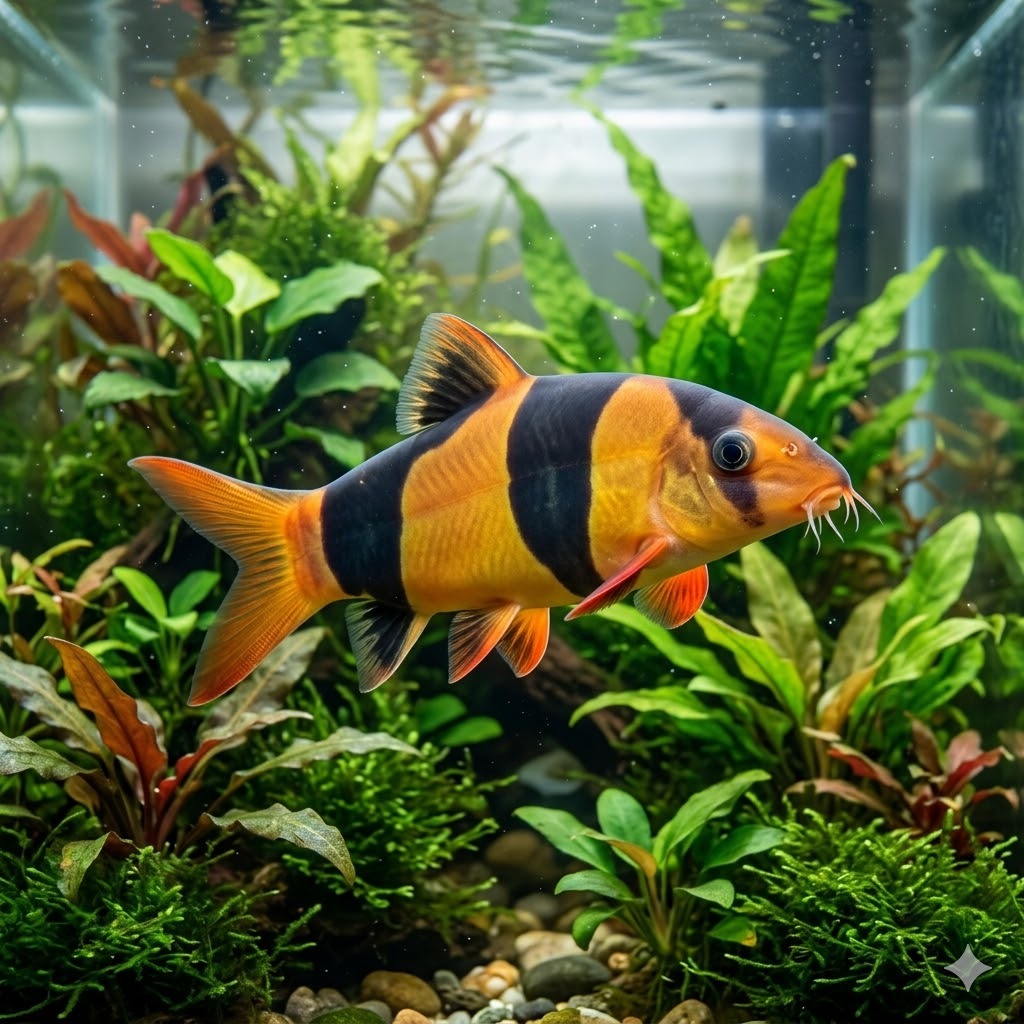
A striking, torpedo-shaped loach with a bright orange body crossed by three broad black bands, and reddish-pink fins that add to the bold colour scheme. Juveniles are the vivid, compact fish seen in shops, but with age they become much deeper-bodied and far larger, and the orange may soften or darken slightly. They possess a small, sharp spine beneath each eye - a defence mechanism that can flick out and catch painfully on nets and even on a careless hand, so they must be handled with care. The mouth is set low and surrounded by sensitive barbels for foraging. Adult size can reach around 30 cm in a suitable environment over many years, though this takes a long time to achieve.
Tank Size & Setup
- Small group of juveniles: minimum tank size around 300 litres to start.
- Adult group long-term: genuinely large aquariums, often 450 litres or much more.
Keep them in groups of at least five or six, as they suffer badly when kept singly or in pairs. Provide plenty of caves, driftwood, lengths of pipe and other hiding spots, along with open swimming space and a soft substrate that will not damage their bellies or barbels. Strong filtration, good oxygenation and a gentle to moderate current mimic their natural river home and keep the water they favour. A secure, tight-fitting lid is important because they can be surprisingly athletic, and always take great care when netting because of their eye spines, which can tangle in mesh. A dedicated container is often safer than a net for moving them.
Water Parameters
- Temperature: 25-30°C.
- pH: 6.0-7.5 - soft to neutral.
- Ammonia 0, nitrite 0, nitrate low.
Clown loaches appreciate warm, clean, well-oxygenated water and can be sensitive to poor conditions and to ich, so stable, high-quality water with regular changes is essential. As scaleless or fine-scaled fish, they are also more sensitive than many species to some medications, which is worth remembering when treating disease.
Diet
Omnivore with a fondness for meaty foods and, famously, snails - a group of clown loaches is a highly effective and entirely natural form of snail control. Offer sinking pellets and wafers as a staple, along with frozen and live foods such as bloodworm and brine shrimp, and include some vegetable matter and the occasional slice of blanched courgette or cucumber. A varied diet supports their slow, steady growth and long-term health. They feed with obvious enthusiasm and are entertaining to watch at mealtimes, but their food must sink, as they rarely take anything from the surface.
Health & Lifespan
Average lifespan is 15-20 years.
Common concerns:
- Ich (white spot) - clown loaches are notoriously prone to it and, being fine-scaled, are sensitive to some standard treatments, so medicate with care.
- Stress from being kept alone or in too-small groups, which suppresses their behaviour and health.
- Injury from eye spines during netting, both to the fish and to the keeper.
- Poor growth and health in undersized tanks, where they may stunt or decline.
Pros & Cons
Pros: playful, social and full of character, long-lived companion, natural snail eaters, beautiful bold striped pattern. Cons: grows very large and outgrows most home tanks, needs a big group and a very large aquarium, extremely long lifespan is a serious commitment, prone to ich and sensitive to poor conditions.
Clown Loach - frequently asked questions
How big do clown loaches get?
They can reach around 30 cm over many years - far larger than the juveniles sold in shops.
How long do they live?
A very long time - commonly 15-20 years, and sometimes considerably longer, so they are a decades-long commitment.
Can I keep just one?
No. Clown loaches are highly social and must be kept in groups of at least five or six, or they become stressed and unhealthy.
Do they really eat snails?
Yes - they are well known for hunting and crushing snails, and are often used as natural snail control.
Are they good for beginners?
Only for beginners who understand and can provide for their large adult size, big group needs, huge tank and long lifespan. Many buyers are caught out by how large they grow.
🧠 Test yourself: guess the fish
Three clues from our quiz bank, each about another of our fish. Can you name them?
Clue 1.Prized for vivid stripes and patterns, this disc-shaped fish is one of the most colorful freshwater species kept.
It's the Discus - read the full profile →
Clue 2.Males of this small, vividly colored labyrinth fish are so territorial that two cannot share a tank without fighting, giving rise to a fierce nickname.
It's the Betta (Siamese Fighting Fish) - read the full profile →
Clue 3.Diamond-shaped with long flowing dorsal and anal fins, this popular tank fish needs a tall aquarium to accommodate its towering body.
It's the Angelfish - read the full profile →