Ember Tetra
The ember tetra (Hyphessobrycon amandae) is a tiny, glowing-orange nano fish from Brazil, prized for the way a tight school lights up a planted tank like drifting embers.
🗓️ Last reviewed: July 2026
Overview
The ember tetra (Hyphessobrycon amandae) is a tiny, glowing-orange nano fish from Brazil, prized for the way a tight school lights up a planted tank like drifting embers. Adults reach only about 2 cm, and with good care they live 2-4 years. Peaceful and undemanding in temperament, they are still best suited to keepers who can provide soft, warm, stable water and a group of at least eight.
Natural History
Ember tetras come from the Araguaia River basin in central Brazil, where they live in slow-moving, heavily vegetated tributaries and floodplain pools. These waters are typically soft, slightly acidic, and stained brown with tannins from decaying leaves - the classic "blackwater" environment. In the wild they move in loose shoals through submerged roots and leaf litter, feeding on tiny invertebrates and picking at the water surface. Only formally described in 1987, the species was named in honour of Amanda Bleher, whose mother collected the fish. Although now widely captive-bred for the aquarium trade, ember tetras still show their best colour and behaviour when their tank echoes those dim, plant-filled origins.
Appearance
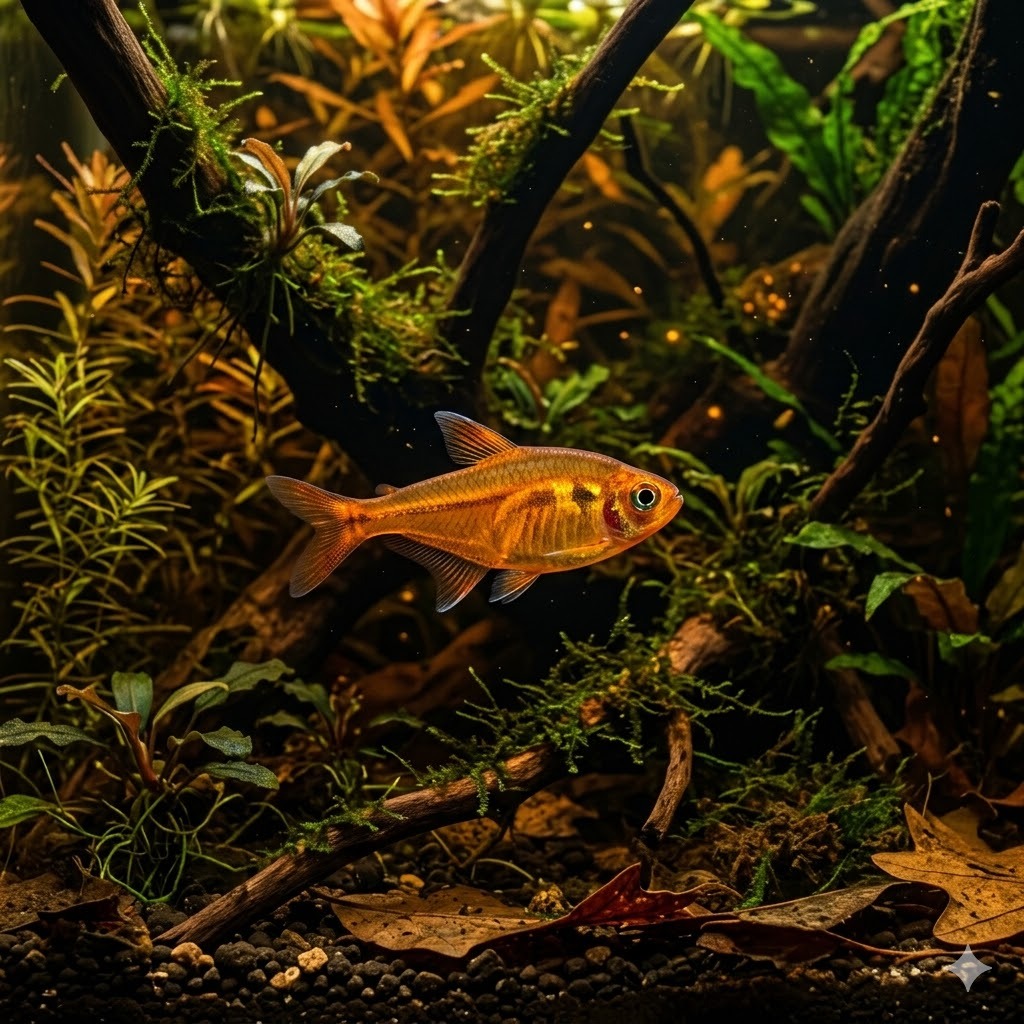
The ember tetra is one of the smallest commonly kept tetras, rarely exceeding 2 cm in length. The body is a warm translucent orange that deepens to fiery red-orange over the head and along the front half of the fish, fading toward the tail. The eyes are often ringed with the same glowing colour. Fins are small and semi-transparent with soft orange tints. Males tend to be slightly slimmer and more intensely coloured, while females are a little rounder, especially when carrying eggs. Colour intensity varies a great deal with mood, diet, and background - a stressed ember tetra in a bare, brightly lit tank can look washed-out and pale, while a settled school over dark substrate with plenty of plants can glow remarkably.
Tank Size & Setup
A group of ember tetras can be housed in a minimum of 40 litres, though a longer tank of 60 litres or more gives the school room to swim and shows them off far better. Because they are so small, floor space matters more than height. Aim to keep at least eight together - they are a schooling species and become shy, drab, and stressed in smaller numbers.
Recreate their blackwater home: dark substrate, plenty of live plants (both background stems and floating plants to dim the light), driftwood, and leaf litter such as dried oak or catappa leaves to release gentle tannins. Subdued lighting brings out their colour. Filtration should be gentle - a sponge filter or a filter with a baffled outflow is ideal, because these tiny fish are easily buffeted by strong currents. Always keep the tank well covered, and make sure any intake is fine enough not to trap such small fish.
Water Parameters
- Temperature: 23-28°C - they are a warm-water tropical species.
- pH: 5.5-7.0 - soft and slightly acidic is best.
- Hardness: soft, roughly 2-10 dGH.
- Ammonia 0, nitrite 0, nitrate low (under 20 ppm ideally).
Ember tetras are sensitive to poor water quality and to being added to an uncycled tank. Acclimatise them slowly and only add them once the aquarium is fully cycled and stable.
Diet
Ember tetras are micro-predators and omnivores. Because of their tiny mouths, food must be small. Offer high-quality micro-pellets or finely crushed flakes as a staple, and supplement regularly with small live or frozen foods such as micro-worms, baby brine shrimp, daphnia, and cyclops. A varied diet keeps their orange colour vivid and supports breeding condition. Feed small amounts once or twice a day, only as much as the school can finish in a minute or two, and take care not to let uneaten food foul such a small volume of water.
Health & Lifespan
Average lifespan is 2-4 years.
Ember tetras are generally hardy once established, but their small size and preference for stable, clean water mean problems usually trace back to husbandry. Common concerns:
- Stress and fading colour from being kept in too-small groups, bright bare tanks, or strong currents.
- Ich (white spot) - often triggered by chilling or poor acclimatisation.
- Fin issues and bacterial infections in tanks with poor water quality.
- Sensitivity to swings in temperature or pH; they do best with slow, stable conditions.
Quarantine new arrivals, keep nitrates low with regular small water changes, and avoid housing them with anything large or nippy.
Pros & Cons
Pros: stunning colour, tiny footprint, peaceful, suit nano and planted tanks, active and social when kept in a proper school. Cons: too small for boisterous community tanks; easily bullied or eaten by larger fish; need soft warm water and a group of eight or more; delicate during acclimatisation.
Ember Tetra - frequently asked questions
How many ember tetras should I keep together?
At least eight, and more is better. In larger groups they feel secure, colour up strongly, and school more tightly.
What can live with ember tetras?
Small, peaceful tankmates that share their warm, soft water - other small tetras, pygmy corydoras, otocinclus, small rasboras, and dwarf shrimp. Avoid anything large enough to eat them.
Are ember tetras good for beginners?
They are easy in temperament but need stable, soft, warm water and a mature tank, so they suit a careful beginner rather than a first-day-first-tank fish.
Why have my ember tetras lost their colour?
Usually stress - too few fish, too bright a tank, strong flow, or poor water quality. Dark substrate, plants, dim light, and a proper school restore the glow.
Can I keep ember tetras with shrimp?
Yes. They are too small to bother adult dwarf shrimp, though they may eat the tiniest shrimplets. Many keepers house them together successfully.
How big do ember tetras get?
Very small - about 2 cm as adults. They are one of the smallest tetras in the hobby.
🧠 Test yourself: guess the fish
Three clues from our quiz bank, each about another of our fish. Can you name them?
Clue 1.This tiny, hardy aquarium fish gives birth to live young rather than laying eggs, earning it the nickname 'rainbow fish.'
It's the Guppy - read the full profile →
Clue 2.Sporting two pairs of whiskers, this bottom-dweller is happiest kept in groups as it constantly sifts the substrate for food.
It's the Corydoras Catfish - read the full profile →
Clue 3.This category of hardy tropical fish includes the swordtail and platy and breeds readily in home tanks.
It's the Molly / Platy / Swordtail (Livebearers) - read the full profile →