Firemouth Cichlid
The firemouth cichlid (Thorichthys meeki) is a handsome, medium-sized Central American cichlid famous for the fiery red-orange colour that floods its throat and lower body when it displays.
🗓️ Last reviewed: July 2026
Overview
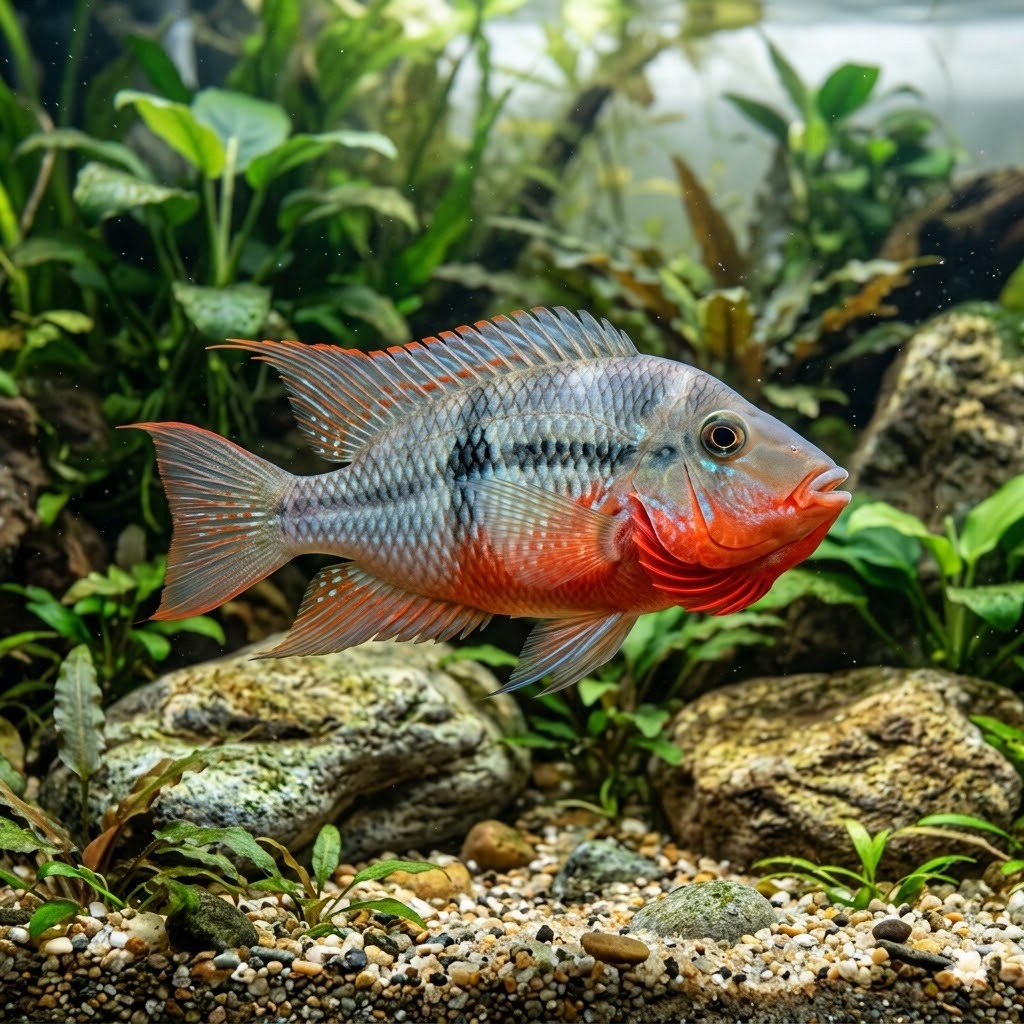
The firemouth cichlid (Thorichthys meeki) is a handsome, medium-sized Central American cichlid famous for the fiery red-orange colour that floods its throat and lower body when it displays. By flaring its gill covers and puffing out its brilliant throat, a firemouth can suddenly look far larger and more intimidating than it really is - a theatrical bluff it uses to defend territory, warn off rivals and win mates. Hardy, adaptable and full of character, it reaches around 15 cm and makes a rewarding centrepiece for the right tank. It sits in a useful middle ground for cichlid keepers: colourful and behaviourally interesting like the bigger New World species, yet more manageable in size and temperament than heavyweights such as convicts or larger Central Americans.
Natural History
Firemouths are native to the rivers, lakes and lagoons of Central America, particularly the Yucatan region of Mexico, Guatemala and Belize, where they inhabit slow, warm waters with soft substrates and plenty of submerged cover. They sift mouthfuls of sand for small invertebrates and dig pits in the bottom, a behaviour that becomes especially pronounced when they prepare a spawning site. Like most Central American cichlids they are substrate spawners and dedicated biparental guardians, with both parents defending a cleaned flat surface of eggs and then tending the wriggling fry in a pit. Their combination of hardiness, striking display and manageable size has kept them a firm favourite in the hobby for generations, and they were among the earliest cichlids to become widely available to home aquarists.
Appearance
An elegant, pearly grey-blue cichlid with rows of shimmering scales that catch the light, faint vertical bars along the flank, and long, flowing fin extensions on mature males. The signature feature is of course the vivid red-orange throat and belly, most intense during display and breeding, when the fish drops its gill covers and turns side-on to appear as broad as possible. Males grow larger with more extended, trailing finnage, while females are a little smaller and rounder, particularly when carrying eggs. Even at rest the fish is attractive, but a displaying firemouth in full colour is a genuine spectacle. Adult size is around 15 cm.
Tank Size & Setup
- Single fish or pair: minimum tank size around 110 litres.
- Community with a firemouth centrepiece: 150 litres or more.
Give them a soft sandy substrate for natural sifting, which they use constantly, along with rocks, driftwood and caves to establish territory and spawning sites. Firmly secure decor and use hardy or potted plants, as firemouths dig energetically, especially before spawning, and will happily rearrange a loose aquascape. Open swimming space at the front, set against a structured background of rock and wood, suits their behaviour and gives them room to perform their throat-flaring displays. Providing more than one potential territory helps if you keep them alongside other cichlids, so each can claim its own patch.
Water Parameters
- Temperature: 24-28°C.
- pH: 6.5-8.0 - adaptable, tolerates harder water well.
- Ammonia 0, nitrite 0, nitrate low to moderate.
Firemouths are forgiving of a wide range of conditions as long as the water is clean and stable, which contributes strongly to their reputation as a hardy, beginner-friendly cichlid. They do not need special water chemistry to look and behave their best, though like all cichlids they appreciate regular water changes and low nitrate.
Diet
Omnivore. Firemouths readily accept quality cichlid pellets and flakes and clearly appreciate frozen and live foods such as bloodworm, brine shrimp and daphnia, which they will hunt and pick from the substrate. Some vegetable matter, from spirulina-based foods or blanched greens, helps balance the diet and supports good digestion. Feeding a varied menu keeps their colours strong, especially the trademark red throat, and helps bring a pair into breeding condition. As always, several small feeds are kinder to water quality than one large one.
Health & Lifespan
Average lifespan is 8-10 years.
Common concerns:
- Semi-aggression - territorial disputes flare up, especially at breeding time, though much of the drama is bluff rather than real fighting.
- Ich (white spot) in stressed or newly added fish.
- Bloat from overfeeding rich foods.
- Poor water quality causing fin and skin problems in neglected tanks.
Pros & Cons
Pros: hardy, striking red-throat display, manageable adult size, interesting behaviour, generally less aggressive than many Central American cichlids. Cons: semi-aggressive and territorial when breeding, digs and rearranges the substrate, needs a reasonably large tank and careful choice of tank-mates.
Firemouth Cichlid - frequently asked questions
How big do firemouth cichlids get?
Around 15 cm at maturity.
Are they aggressive?
Semi-aggressive. Much of their aggression is bluff and display, but they defend territory firmly, especially when spawning.
Why is its throat red?
The bright red-orange throat is a display feature, flared during courtship and territorial standoffs to appear larger and more intimidating.
What tank-mates work?
Other robust, similarly sized fish that can hold their own. Avoid tiny, timid species and overly aggressive cichlids.
Are they good for beginners?
Yes - they are hardy, adaptable and less aggressive than many relatives, making them a good first Central American cichlid for keepers with an adequately sized tank.
Do they need a group?
No, they do not need to be kept in groups. A single fish or a bonded pair is ideal. Keeping several together in a small tank usually just leads to constant territorial squabbling.
Will they dig up my aquascape?
They dig, particularly when preparing to spawn, so anchor rocks and wood firmly and use potted or hardy plants. A settled firemouth outside breeding mode is generally more restrained.
🧠 Test yourself: guess the fish
Three clues from our quiz bank, each about another of our fish. Can you name them?
Clue 1.Some species of this small, brilliantly colored fish lay eggs that survive dried mud until rains return.
It's the Killifish - read the full profile →
Clue 2.Fancy varieties of this fish include bubble-eye and telescope-eye types bred for unusual looks.
It's the Goldfish - read the full profile →
Clue 3.Renowned for intelligence and complex breeding behavior, members of this freshwater group are a textbook example of explosive evolutionary radiation.
It's the Cichlid (Overview) - read the full profile →