Honey Gourami
The Honey Gourami (Trichogaster chuna) is a small, peaceful, beginner-friendly labyrinth fish from South Asia.
🗓️ Last reviewed: June 2026
Overview
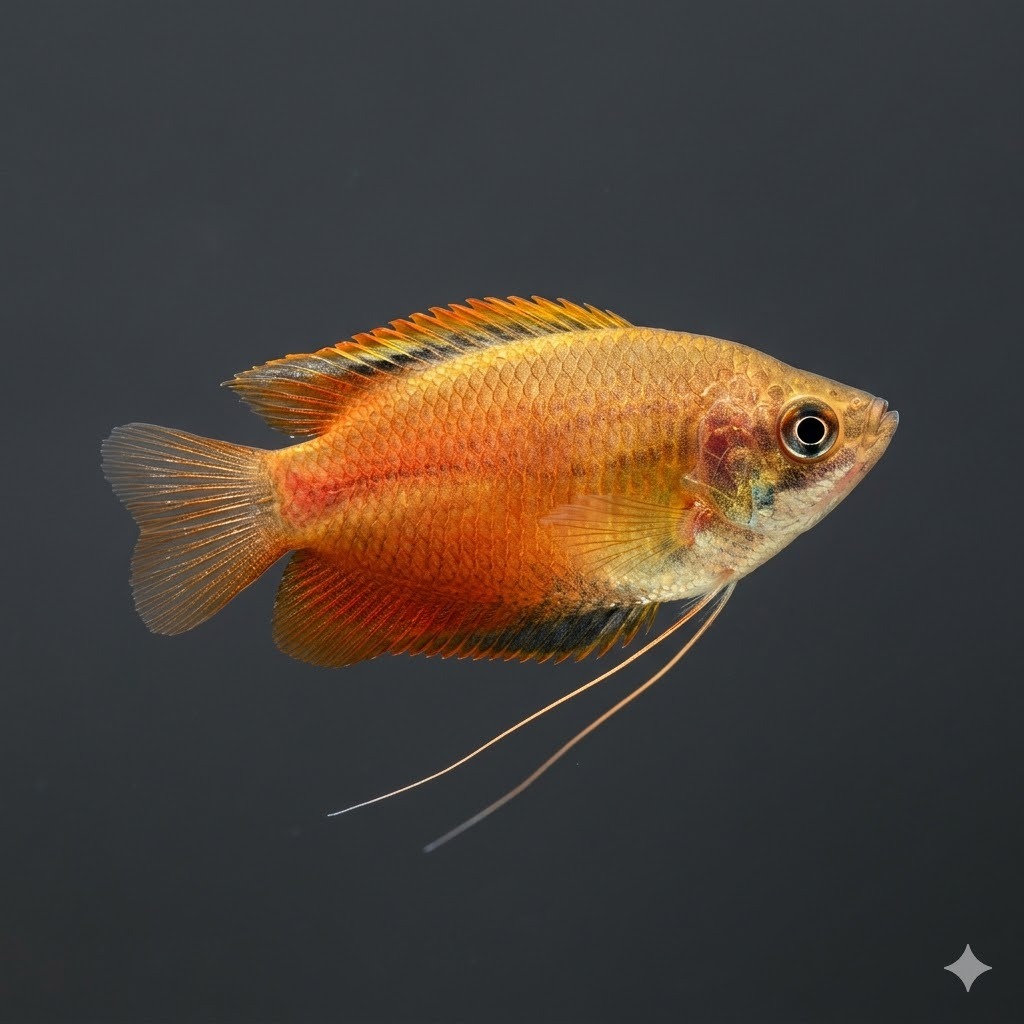
The Honey Gourami (Trichogaster chuna) is a small, peaceful, beginner-friendly labyrinth fish from South Asia. Mature males glow a warm honey-gold to deep reddish-orange, while females and young fish stay a soft silvery-tan with a faint horizontal stripe. Gentle, undemanding, and far calmer than its better-known relatives, it is one of the best choices for a quiet, planted community tank.
Natural History
Native to the slow, soft, often weedy waters of northern India, Bangladesh, and Nepal - ponds, ditches, flooded fields, and sluggish stretches of river. These shallow, warm, oxygen-poor habitats are why the honey gourami evolved a labyrinth organ, an accessory breathing structure that lets it gulp atmospheric air at the surface. It lives among dense vegetation and prefers calm water with little flow.
Appearance
Adults reach about 4-5 cm, smaller than most gouramis. Mature males develop a striking honey-gold to red-orange body, often with a darker blue-black throat and chest during display and breeding. Females and immature fish are a plainer silvery-tan with a faint brown stripe along the side. Like all gouramis, the pelvic fins are modified into long, thin, mobile feelers the fish uses to taste and explore its surroundings.
Temperament & Tankmates
Genuinely peaceful and rather shy, especially when newly added. Honey gouramis are not schooling fish, but they are sociable and do well kept singly, as a pair, or in a small group in a roomy planted tank. They appreciate plants and floating cover to retreat into, and they settle and colour up best in a calm, quiet environment.
They suit gentle community setups with other small, peaceful species such as rasboras, small tetras, corydoras, kuhli loaches, and dwarf shrimp. Avoid boisterous, fin-nipping, or aggressive tankmates, and avoid keeping them with the much pushier dwarf gourami, which can bully them.
Tank Size & Setup
Minimum: 60 L (15 gallon) for one or a pair.
A densely planted aquarium with calm water suits them perfectly: live plants, driftwood, and some floating plants to diffuse the light and provide cover. Keep filtration gentle - they dislike strong current. Because they breathe air at the surface, leave a small warm air gap under the lid and keep that lid on, both to retain humid surface air and to prevent jumping.
Water Parameters
- Temperature: 24-28°C.
- pH: 6.0-7.5 (soft to neutral preferred).
- Soft to moderately hard water.
- Ammonia 0, nitrite 0, nitrate <30 ppm.
Diet
Omnivore with a small mouth. Offer a quality small flake or micro-pellet staple, supplemented with frozen or live daphnia, baby brine shrimp, and small bloodworms. Variety brings out their colour. Feed small portions once or twice daily, and watch shy individuals get their share at first.
Health & Lifespan
4-6 years.
Common concerns:
- Ich (white spot).
- Fin rot from poor water quality.
- Stress and hiding in tanks with strong flow, harsh light, or pushy tankmates.
- Tank-cycle deaths from being added before the tank is established.
Unlike the closely related dwarf gourami, the honey gourami is not plagued by the well-known dwarf gourami iridovirus and bacterial issues, which makes it a hardier, more reliable choice.
Pros & Cons
Pros: peaceful, hardy, beautiful honey colour in males, beginner-friendly, free of the dwarf gourami's disease problems. Cons: shy at first and easily intimidated; needs calm water and gentle tankmates; colours best in a quiet planted tank.
Honey Gourami - frequently asked questions
Are honey gouramis good for beginners?
Yes - small, peaceful, hardy, and forgiving once the tank is cycled, and without the disease troubles that affect dwarf gouramis.
How are they different from dwarf gouramis?
Honey gouramis are smaller, gentler, and far less prone to the iridovirus and bacterial infections common in mass-bred dwarf gouramis. They are a calmer, more reliable fish.
Do I need to keep them in a group?
No - they are not a schooling fish. One, a pair, or a small group all work, as long as the tank is planted and the tankmates are peaceful.
Why does my honey gourami keep hiding?
They are naturally shy, especially when new or in a tank with strong flow, bright light, or boisterous fish. Plenty of plants, floating cover, and calm tankmates help them settle and come out.
🧠 Test yourself: guess the fish
Three clues from our quiz bank, each about another of our fish. Can you name them?
Clue 1.Prized for flowing, jewel-toned fins, the male of this species builds a floating nest of bubbles to cradle its eggs.
It's the Betta (Siamese Fighting Fish) - read the full profile →
Clue 2.This dazzling Amazonian schooling fish wears a full-length red stripe beneath its blue band, distinguishing it from a similar smaller cousin.
It's the Cardinal Tetra - read the full profile →
Clue 3.This tooth-carp's name comes from a Dutch word for a creek or ditch where it is often found.
It's the Killifish - read the full profile →