Rummynose Tetra
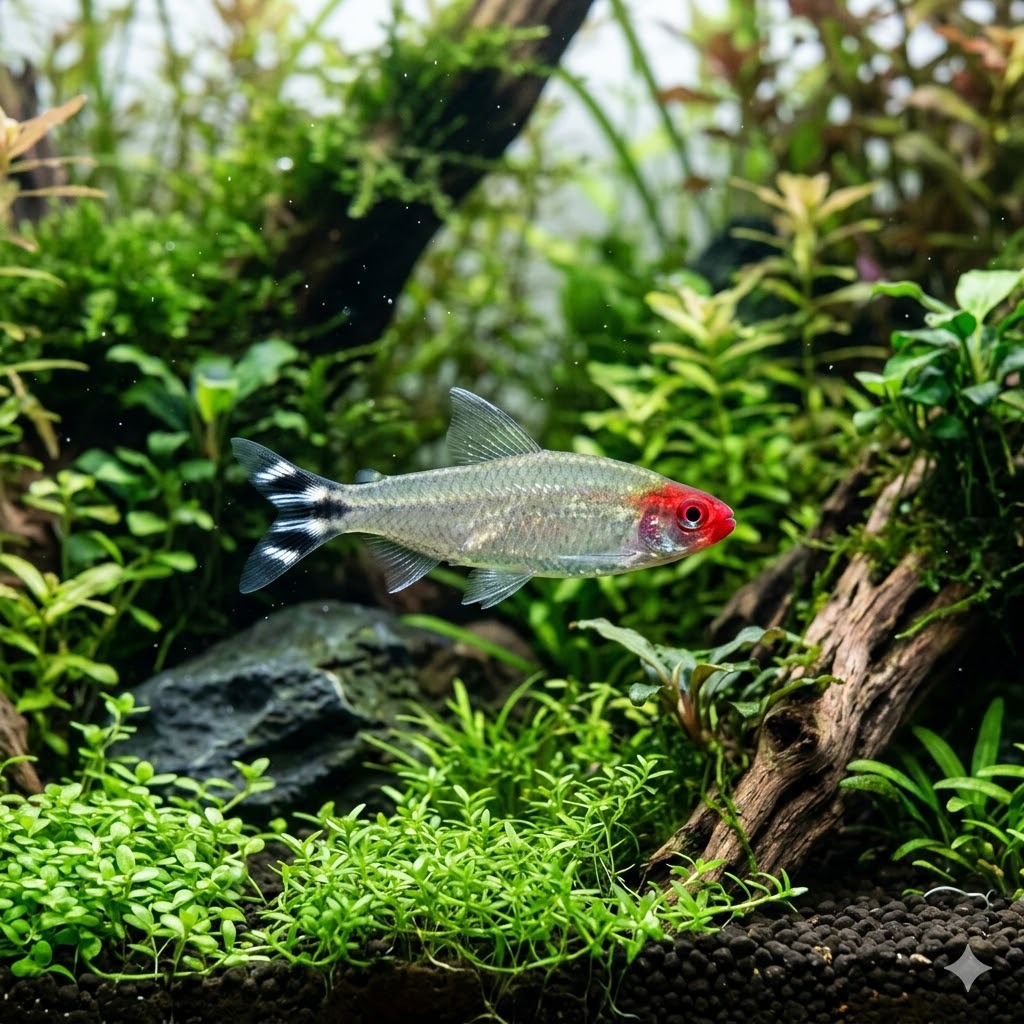
The rummynose tetra (Hemigrammus rhodostomus) is a striking schooling fish known for its bright red nose and the bold black-and-white striped tail that finishes off a silvery body.
🗓️ Last reviewed: July 2026
Overview
The rummynose tetra (Hemigrammus rhodostomus) is a striking schooling fish known for its bright red nose and the bold black-and-white striped tail that finishes off a silvery body. Adults reach about 5 cm and typically live 5-6 years. Famous for tight, coordinated schooling, it is also treated as a living water-quality "indicator," since its red nose fades quickly when conditions are poor.
Natural History
Rummynose tetras come from South America, associated with the soft, warm, tannin-stained blackwater of the lower Amazon basin. In these dark, slow rivers they move in dense, synchronised schools for safety, flashing their bright noses as a group. Their natural environment is warm, soft, and slightly acidic, and much of the fish available today is captive-bred, though they remain more demanding of good water than tougher community species. The name "rummynose" is also applied to a couple of very similar species, but care is broadly the same.
Appearance
The body is slim and translucent-silver, topped by a vivid red or crimson nose and face. The tail carries a distinctive pattern of black and white horizontal bars, so a school in motion looks like a line of red heads and striped tails. The red colouring is highly responsive to health and water quality - a strong, deep red nose signals a happy fish, while a pale or grey nose is an early warning that something is wrong.
Tank Size & Setup
- Minimum tank size: about 75 L for a proper school.
- Rummynose tetras are obligate schoolers and should be kept in groups of at least 6, and ideally 8-10 or more, to feel secure and school tightly.
Give them a well-planted tank with open swimming space in the middle and front, plus darker substrate and gentle lighting to bring out their colour. Rummynose tetras are active swimmers, so a longer tank that gives the school room to move from side to side is far better than a tall, narrow one. Driftwood, leaf litter, or botanicals that release tannins recreate their soft blackwater home and help them settle, and the slightly tinted water they produce shows off the red noses beautifully. A gentle to moderate current suits their active swimming, and a covered tank prevents jumps. Adding the whole school at once, rather than a few fish at a time, helps them settle and colour up faster.
Water Parameters
- Temperature: 24-27°C.
- pH: 5.5-7.0 (soft and slightly acidic preferred).
- Hardness: soft, roughly 2-8 dGH.
- Ammonia 0, nitrite 0, nitrate kept low with regular water changes.
This species is more sensitive than many community tetras and does best in soft, warm, stable, well-maintained water. Sudden changes or poor quality show up fast in a faded nose.
Diet
Omnivore with a preference for small foods. In the wild they eat tiny invertebrates and zooplankton. In the aquarium they thrive on a quality micro-pellet or flake staple, enriched with frozen and live foods such as daphnia, cyclops, brine shrimp, and finely chopped bloodworms. Small, frequent feedings suit their small mouths and keep colour strong. A varied diet directly supports the bright red nose that makes the species so appealing.
Health & Lifespan
Average lifespan is 5-6 years.
Rummynose tetras are hardy once established but demand good, stable water. Common concerns include:
- Faded or grey nose - the classic early sign of stress, poor water, or unstable parameters.
- Ich (white spot) - often following temperature swings or a rough acclimation.
- Fin rot and bacterial issues - linked to poor water quality.
- Acclimation stress - they can be touchy about being moved between very different water.
Because their colour reacts so quickly, a fading school is a useful cue to test the water and do a change before other fish show symptoms. Quarantining new stock and acclimating them slowly to your water chemistry also reduces the losses that can otherwise happen in the first weeks.
Pros & Cons
Pros: stunning tight schooling display, vivid red nose, peaceful, acts as a built-in water-quality indicator, excellent centrepiece for planted community tanks. Cons: more sensitive than many tetras; needs soft warm water, a real school, and stable conditions; can be delicate during acclimation; colour fades fast if care slips.
Rummynose Tetra - frequently asked questions
Why is my rummynose tetra's nose pale or grey?
A faded nose almost always means stress or water-quality problems - poor parameters, an uncycled tank, a recent move, or unstable conditions. Test the water and improve stability, and the red usually returns.
How many rummynose tetras should I keep?
At least 6, and ideally 8-10 or more. They are strong schoolers and look and behave best in a larger group.
Are rummynose tetras good for beginners?
They are better suited to someone with a stable, cycled, well-maintained tank. They are peaceful and rewarding, but less forgiving of mistakes than hardier community fish.
What water do rummynose tetras need?
Soft, warm, slightly acidic water, ideally with some tannins from driftwood or leaf litter to mimic their blackwater origins.
What can I keep with rummynose tetras?
Other peaceful, soft-water community fish - small tetras, rasboras, corydoras, otocinclus, and peaceful dwarf cichlids in a larger tank all pair well.
Why do people call them an "indicator" fish?
Their nose colour reacts quickly to water quality, so a school losing its red often warns you of a problem before less sensitive fish react.
🧠 Test yourself: guess the fish
Three clues from our quiz bank, each about another of our fish. Can you name them?
Clue 1.Prized for vivid stripes and patterns, this disc-shaped fish is one of the most colorful freshwater species kept.
It's the Discus - read the full profile →
Clue 2.Diamond-shaped with long flowing dorsal and anal fins, this popular tank fish needs a tall aquarium to accommodate its towering body.
It's the Angelfish - read the full profile →
Clue 3.Unlike most aquarium fish, this beginner-friendly group gives birth to free-swimming young instead of laying eggs.
It's the Molly / Platy / Swordtail (Livebearers) - read the full profile →