Chinese Water Dragon
The Chinese Water Dragon (Physignathus cocincinus) is a large, striking, emerald-green arboreal lizard that looks like a miniature dragon and behaves like an active, alert climber.
🗓️ Last reviewed: July 2026
Overview
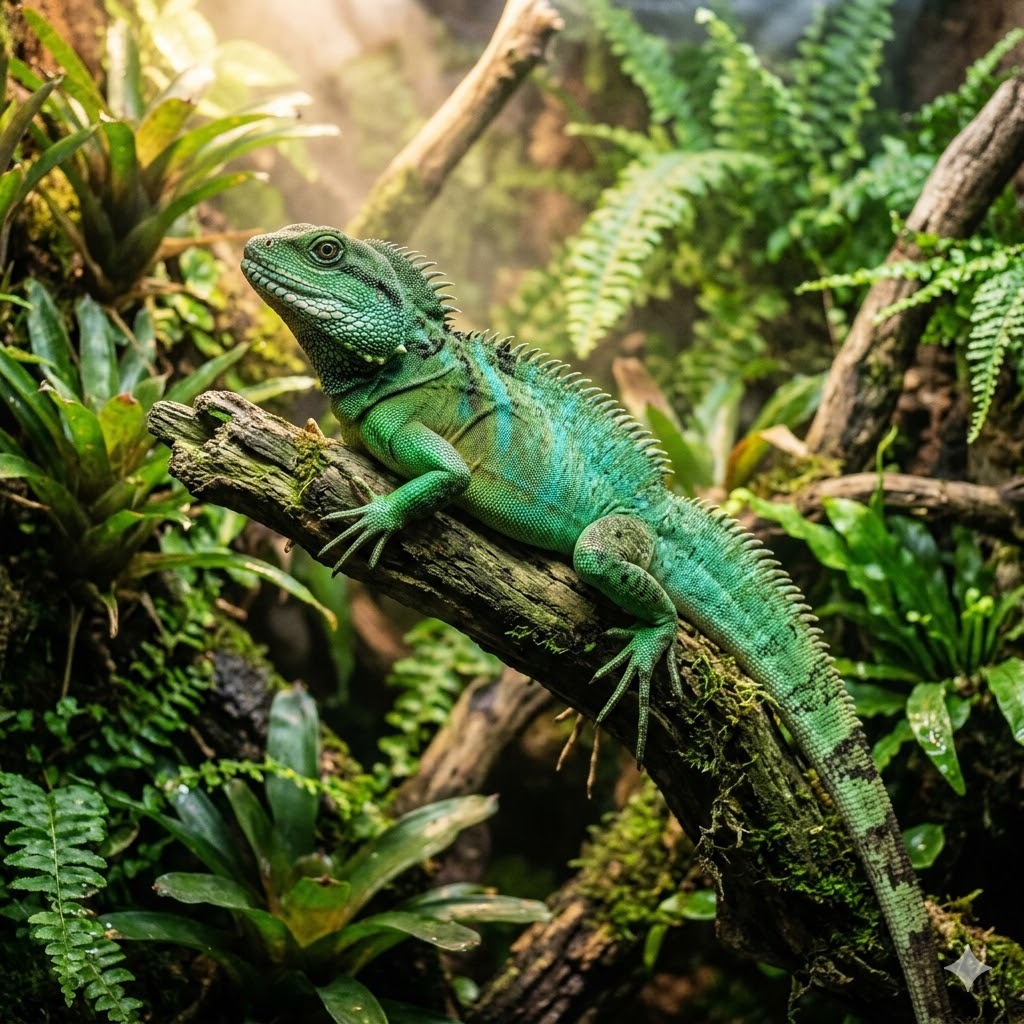
The Chinese Water Dragon (Physignathus cocincinus) is a large, striking, emerald-green arboreal lizard that looks like a miniature dragon and behaves like an active, alert climber. With its long whip tail, crested back, and bright colour, it is one of the most beautiful lizards in the hobby - but it is not a beginner's animal in the way a leopard gecko is. It needs height, humidity, water, and patient handling to settle, and it is prone to injuring its snout by rubbing against enclosure glass when stressed or under-housed. For a keeper ready to provide a large planted tropical vivarium and to invest time in taming, the reward is a spectacular, interactive display lizard.
Natural History
Chinese Water Dragons are native to the forests of southern China and mainland Southeast Asia, including Thailand, Vietnam, Cambodia, and Laos. They live along rivers, streams, and humid lowland forest, spending much of their time in trees and overhanging branches above water. Diurnal and semi-aquatic, they are strong swimmers that dive into water to escape threats and can stay submerged for extended periods. This arboreal, waterside lifestyle is the key to their care - they need to climb high and to soak, and a setup that ignores either will produce a stressed, unhealthy animal.
Appearance
Adults commonly reach 60-90 cm in total length, with males larger than females; the long tail makes up well over half of that length. Body colour is vivid green, often with diagonal bands of teal or turquoise along the flanks and a paler cream to yellow belly. A crest of enlarged spiny scales runs from the neck down the back, more pronounced in males, which also develop broader heads and larger jowls. The eyes are large and expressive, and a small pale "third eye" sensory spot sits on top of the head. Juveniles are brighter and slimmer, deepening in colour and bulk as they mature.
Temperament & Handling
Water Dragons are alert, active, and initially skittish. Wild-caught or unhandled animals may be flighty and can flee, thrash, or dash into the glass when frightened. With consistent, gentle, daily interaction most captive-raised dragons tame down well and become confident, even enjoying time out with their keeper. Support the body fully and let the lizard perch on the hand and arm rather than gripping it tightly. Never grab the tail. The single most important taming principle is space and patience - a dragon given room to climb and calm routines becomes far more trusting than one kept cramped and disturbed.
Enclosure
Minimum: a tall, arboreal vivarium at least 120 × 60 × 120-180 cm for one adult, prioritising height for climbing. Bigger is strongly preferred.
Provide:
- Plenty of sturdy climbing branches, cork bark, and vines arranged at varying heights.
- Dense planting, live or artificial, for cover and to reduce stress and glass-rubbing.
- A large water area big enough for the dragon to submerge and soak, kept clean and filtered.
- A background or planting against the glass, and screening of clear panels, to prevent snout rubbing - dragons that see through glass may repeatedly bump it and injure the snout (rostral abrasions).
- A moisture-holding substrate such as soil, coir, and leaf litter that supports humidity.
- Secure, ventilated screen or vivarium construction that holds warmth and moisture.
Heating & Lighting
- Basking spot: 32-35°C at a high perch under the lamp.
- Warm ambient: 28-30°C.
- Cool end: 24-26°C.
- Night: can fall to around 22-24°C.
- UVB: essential. A strong UVB source positioned at basking height drives vitamin D3 and calcium metabolism for this large, fast-growing lizard.
Because the animal climbs, the basking heat and UVB must be placed high where the dragon actually perches, not just at floor level.
Humidity
This is a tropical, humidity-loving species. Maintain ambient humidity around 60-80%, achieved through misting once or twice daily, a large water feature, live plants, and a moisture-retaining substrate. A humid, well-planted environment supports clean sheds, hydration, and respiratory health, while chronic dryness leads to shedding problems and stress. Good ventilation alongside the moisture is important to avoid stagnant, mouldy conditions.
Diet
Insectivore-leaning omnivore. Chinese Water Dragons eat mainly live prey with some plant matter:
- Staple: crickets, dubia roaches, locusts, and other gut-loaded insects.
- Protein variety: earthworms, silkworms, hornworms, and occasional pinkie mice for adults as a treat.
- Occasional: small amounts of leafy greens, vegetables, and fruit.
- Avoid: wild-caught insects, fatty feeders in excess, and toxic plants.
Gut-load feeders and dust with calcium plus vitamin D3 supplements on a regular schedule. Juveniles eat daily; adults every one to two days in appropriate portions. Fresh clean water must always be available, and because these dragons often drink and defecate in their water feature, it should be filtered and refreshed frequently to protect both hydration and water quality.
Health & Lifespan
10-15 years with good care, sometimes longer - a substantial long-term commitment for a large, demanding lizard.
Common concerns:
- Snout and facial abrasions from rubbing on glass (rostral trauma) - a hallmark problem of this species.
- Metabolic bone disease from inadequate UVB or calcium.
- Respiratory infections from cold or poor conditions.
- Skin and shedding problems from low humidity.
- Stress and injury from cramped or exposed housing.
- Parasites, especially in wild-caught imports.
Pros & Cons
Pros:
- Spectacular, dragon-like appearance.
- Active, diurnal, and interactive when tamed.
- Can become confident and enjoy handling.
- Rewarding for keepers who like large, engaging lizards.
- Strong swimmer with fascinating natural behaviour.
Cons:
- Needs a large, tall, humid, planted vivarium.
- Prone to snout injuries from glass rubbing.
- Skittish and needs patient taming.
- Higher setup and space demands than beginner reptiles.
- 10-15 year commitment.
Best Suited For
- Intermediate keepers ready for a large arboreal setup.
- Owners wanting an active, showy, interactive lizard.
- People able to maintain height, humidity, and water features.
Not suited for first-time reptile owners, those short on vertical space, or anyone unable to keep tropical humidity and prevent glass-rubbing stress.
Chinese Water Dragon - frequently asked questions
Why does my dragon rub its nose on the glass?
Snout rubbing usually signals stress, wanting to escape, or seeing through clear panels. Add dense planting, cover the lower glass with backgrounds, and give more space and height to reduce it and prevent rostral injuries.
How big do they get?
Adults reach 60-90 cm total length, with the long tail making up most of that. They need a tall enclosure to match.
Are they good for beginners?
Not really. They are beautiful but demanding, needing large humid arboreal setups and patient handling to tame. They suit intermediate keepers.
Do they need water to swim in?
Yes. As a semi-aquatic species they need a large water area to soak and submerge, kept clean and filtered.
How long do they live?
Typically 10-15 years, sometimes longer with excellent care. Plan for a long-term commitment.
🧠 Test yourself: guess the reptile
Three clues from our quiz bank, each about another of our reptiles. Can you name them?
Clue 1.Lacking sticky toe pads, this ground-dwelling gecko stores fat in a thick tail as an energy reserve.
It's the Leopard Gecko - read the full profile →
Clue 2.This docile orange-and-red North American constrictor is the most popular pet snake, named perhaps for the maize-like belly pattern.
It's the Corn Snake - read the full profile →
Clue 3.A calm, easily tamed reptile that basks under heat lamps, it is one of the most beginner-friendly lizards kept as a pet.
It's the Bearded Dragon - read the full profile →