Roborovski Hamster
The Roborovski hamster is the smallest and fastest of all pet hamsters - a tiny, energetic desert dwarf that measures barely 4-5 cm as an adult and moves like quicksilver.
🗓️ Last reviewed: July 2026
Overview
The Roborovski hamster is the smallest and fastest of all pet hamsters - a tiny, energetic desert dwarf that measures barely 4-5 cm as an adult and moves like quicksilver. Often called the "Robo," this species is a watch-not-cuddle pet. It is far too quick, skittish, and easily startled to be handled the way many people picture a hamster. Owners who want an animal to hold constantly will be disappointed, but those who enjoy observing a fascinating, busy little creature going about its natural behaviours will find the Robo endlessly entertaining. It is best suited to patient, hands-off keepers rather than young children hoping for a snuggly pet.
Natural History & Origin
The Roborovski hamster (Phodopus roborovskii) is native to the deserts and semi-arid steppes of Mongolia, northern China, and parts of Kazakhstan. It lives in sandy, sparsely vegetated terrain where it digs deep burrows to escape the extreme heat of the day and the cold of desert nights. The species is named after Lt. Vsevolod Roborovski, a Russian explorer who first collected specimens in the late nineteenth century.
In the wild, Robos are nocturnal and crepuscular, emerging at dusk and dawn to forage across surprisingly large territories. Their speed and constant motion are survival adaptations - a small desert animal must cover ground quickly and dive for cover to avoid predators. These instincts remain fully intact in captive animals, which is exactly why they resist handling.
Appearance
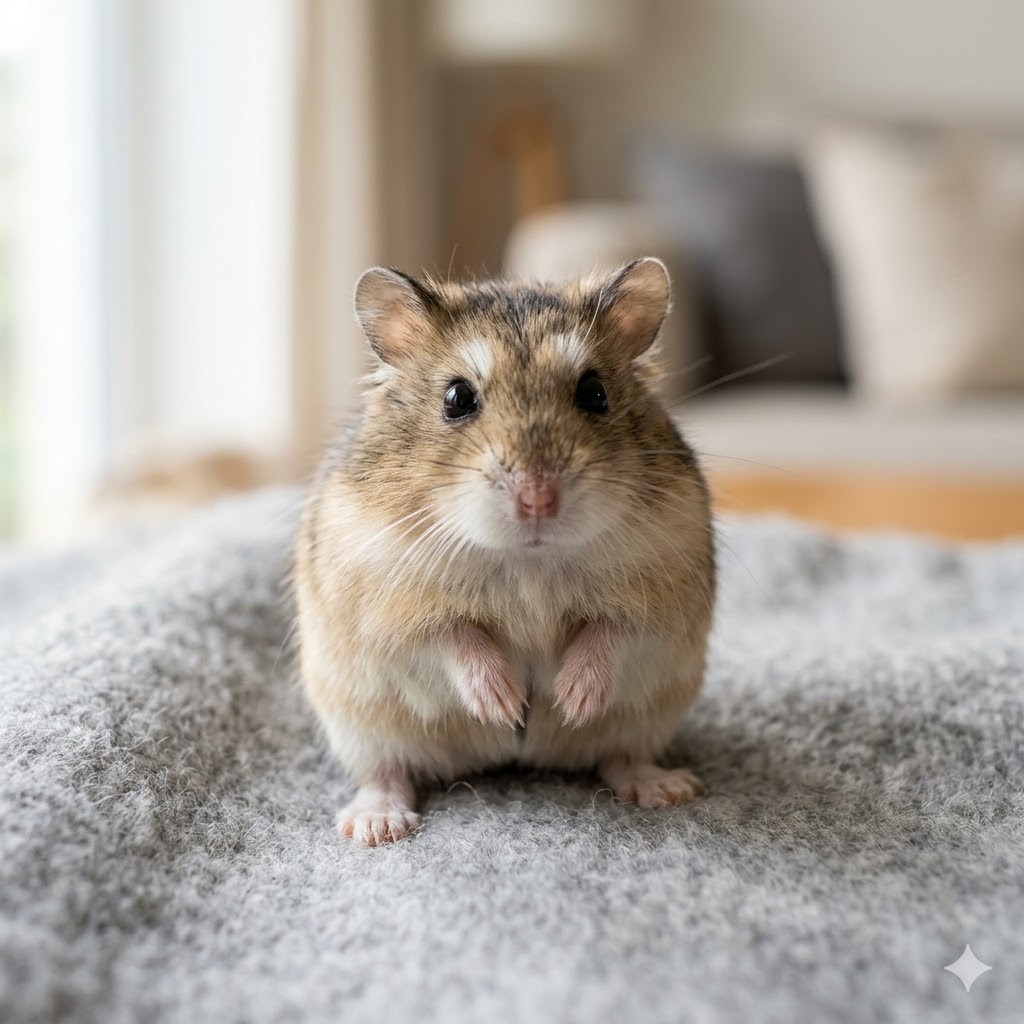
The Roborovski is unmistakably the tiniest hamster kept as a pet. Adults measure roughly 4-5 cm in body length and weigh only 20-25 grams - small enough to sit comfortably on a thumb. The classic wild-type coat is a warm sandy-brown on top with a clean white belly, and the species has two distinctive white "eyebrow" spots above the eyes and no dark dorsal stripe, which distinguishes it from other dwarf hamsters.
Selective breeding has produced a few colour variations, including "white-faced" and lighter "husky" patterns, but the sandy agouti remains the most common. The face is rounded, the eyes are large and dark, and the whole animal has a soft, feathery-furred appearance. Their tiny size combined with blazing speed makes them genuinely difficult to catch once loose.
Temperament & Handling
Robos are gentle and rarely bite, but they are extremely skittish and almost impossible to hold still. They are not aggressive - they simply do not want to be caught. A startled Robo will bolt, leap from the hand, and can injure itself in a fall. For this reason, taming is a slow, patient process built around hand-feeding and letting the hamster choose to approach, never grabbing.
The realistic expectation is a watch-not-cuddle pet. You can enjoy them scurrying, digging, foraging, and sprinting on a wheel, and over time some individuals will take treats from your fingers. But regular cuddling and lap-time are not part of the deal. Children who need a hamster to carry around will be frustrated, and the hamster will be stressed.
Housing
Because Robos are so active and love to dig, they need a large, deep-bedding enclosure - far bigger than the tiny cages often marketed for dwarf hamsters. A minimum floor area of around 4,000 cm² is a good target, and larger is better. A glass or acrylic tank with a secure mesh lid works best, both to contain the deep substrate and to prevent escapes through bars they can squeeze through.
Provide:
- A deep bedding layer (at least 20-25 cm) of paper-based or aspen substrate for burrowing.
- A large solid-surface exercise wheel - at least 20 cm across - since a wheel too small forces a painful arched back.
- A sand bath in a small dish for grooming (they are desert animals and love to roll in sand).
- Hides, tunnels, and chew items for enrichment.
- A water bottle or shallow dish and a food dish.
Avoid wire-floored cages, cedar or pine shavings, and cramped store-bought cages. Robos are escape artists, so lids and gaps must be secure.
Diet
Robos eat a hamster-appropriate diet built around a quality dry mix of seeds, grains, and dried vegetables formulated for dwarf hamsters. Because they are desert animals, they thrive on a varied but modest diet:
- A staple dry seed-and-grain mix as the daily base.
- Occasional small amounts of fresh vegetables such as cucumber, carrot, or leafy greens.
- Small amounts of animal protein a couple of times a week - a mealworm or a little cooked egg - which supports their busy metabolism.
Fresh water must always be available. Avoid sugary treats, citrus, onion, garlic, chocolate, and sticky or processed human foods. Robos naturally hoard food, so a little scattered in the bedding encourages healthy foraging behaviour.
Health & Lifespan
Roborovski hamsters typically live 3-3.5 years, which is longer than most other pet hamsters - a welcome trade-off for their hands-off nature.
Common health concerns include:
- Wet tail and other digestive upsets, often stress-related.
- Diabetes and obesity if the diet is too sugary.
- Overgrown teeth without adequate chewing material.
- Injuries from falls when startled during attempted handling.
- Bumblefoot from wire flooring or dirty bedding.
Because they are so small and fast, illness can be hard to spot early, so watch for changes in activity, appetite, coat condition, and droppings. Find an exotic-savvy vet before problems arise, as not all small-animal vets are experienced with tiny rodents.
Pros & Cons
Pros:
- The smallest, most charming dwarf hamster.
- Fascinating to watch - constantly active and busy.
- Rarely bites; gentle by nature.
- Longer-lived than most hamsters.
- Can sometimes be kept in cautious same-sex pairs.
Cons:
- Too fast and skittish to handle much.
- Not suitable for young children wanting to cuddle.
- Needs a large deep-bedding tank, not a small cage.
- Escape artist if housing is not secure.
- Hard to catch and easily injured if it falls.
Best Suited For
- Patient, hands-off keepers who enjoy observing.
- Adults and older children who understand it is a watch-not-cuddle pet.
- Those with room for a large deep-bedding tank.
- People wanting a fascinating, low-handling small pet.
Not suited for young children expecting a hamster to carry around, keepers wanting frequent handling, or anyone who cannot provide a large, secure, deep-substrate enclosure.
Roborovski Hamster - frequently asked questions
Can I hold a Roborovski hamster?
Only briefly and with great care. They are too fast and skittish for regular handling and are best enjoyed as a watch-not-cuddle pet. Some will take treats from your hand over time.
How big do they get?
They are the smallest pet hamster at just 4-5 cm and 20-25 grams as adults.
How long do they live?
Usually 3-3.5 years, longer than most other hamster species.
Can I keep two together?
Sometimes, in cautious same-sex pairs introduced young in a large enclosure, but fighting can happen suddenly. Solo housing is the safe default.
Do they need a big cage?
Yes. They need a large tank with deep bedding for burrowing and a large wheel - small store cages are inadequate.
🧠 Test yourself: guess the small mammal
Three clues from our quiz bank, each about another of our small mammals. Can you name them?
Clue 1.A strictly solitary nocturnal rodent that hoards food in cheek pouches reaching back to its shoulders.
It's the Syrian Hamster - read the full profile →
Clue 2.This big-eared Andean rodent has the densest fur of any land mammal and must bathe in volcanic dust, never water.
It's the Chinchilla - read the full profile →
Clue 3.This intelligent pet laughs with ultrasonic chirps when tickled and grooms its human companions affectionately.
It's the Fancy Rat - read the full profile →
Social Needs
Unlike Syrian hamsters, Robos are relatively social and can sometimes be kept in same-sex pairs or small groups, but this must be done cautiously. Success depends on introducing young littermates early, providing an enclosure large enough to prevent territorial disputes, and watching closely for fighting. Even bonded groups can suddenly turn on one another, so a keeper must be prepared to separate them permanently at the first sign of aggression.
Many keepers house Robos singly and find they do perfectly well alone. If you attempt a pair, never mix males and females - they breed prolifically and quickly. Solo housing is always the safe default if you are unsure.