Eastern Newt
The Eastern Newt (Notophthalmus viridescens) is a small, hardy North American amphibian best known for its dramatic three-stage life cycle, including a bright orange terrestrial juvenile phase called the "red eft." Adults are semi-aquatic, olive-green with red spots, and like many newts their skin carries mild toxins as a defence.
🗓️ Last reviewed: June 2026
Overview
The Eastern Newt (Notophthalmus viridescens) is a small, hardy North American amphibian best known for its dramatic three-stage life cycle, including a bright orange terrestrial juvenile phase called the "red eft." Adults are semi-aquatic, olive-green with red spots, and like many newts their skin carries mild toxins as a defence. They are a charming, long-lived, hands-off display species for a cool aquatic or paludarium setup.
Natural History
Native to eastern North America, from Canada down through the eastern United States, in and around ponds, marshes, and slow woodland streams. The life cycle runs from aquatic larva, to a terrestrial red eft that may wander the forest floor for years, to a semi-aquatic adult that returns to water. The vivid orange of the eft is a warning of its toxic skin.
Appearance
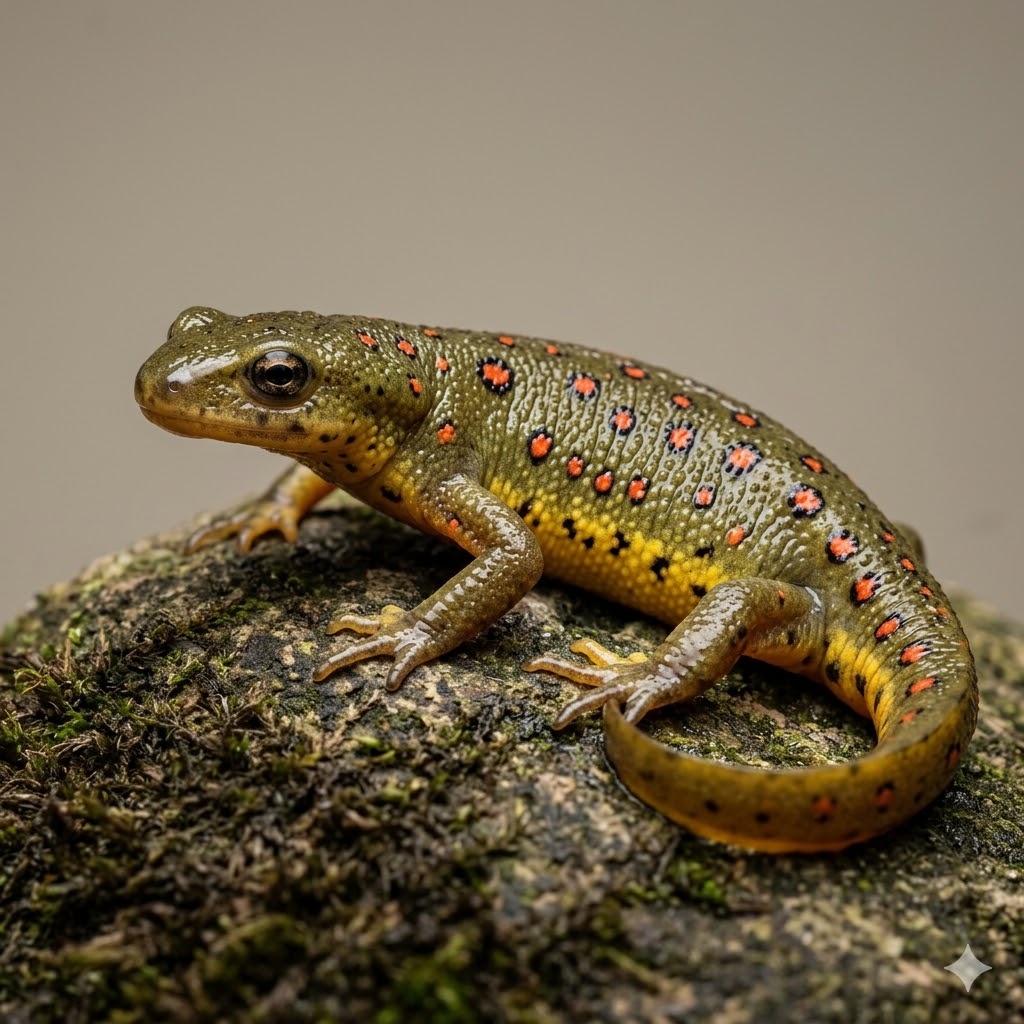
Adults reach about 7-12 cm. Aquatic adults are olive to yellowish-brown above with a yellow belly and a row of black-bordered red spots along each side, plus a finned, paddle-like tail. The red eft stage is bright orange with the same red spots and a rougher skin. Sexes are similar, though breeding males develop a higher tail fin.
Temperament & Handling
Active, curious, hands-off display animal. Their skin secretes mild toxins, so handling should be minimal and always with clean wet hands, washing thoroughly afterward and keeping hands away from the face. They are confident and interesting to watch, foraging through water and decor.
Enclosure
Minimum: a 40-75 L (10-20 gallon) aquatic or paludarium setup for 1-2 adults; larger for groups.
Provide:
- For aquatic adults: a planted aquatic section with gentle filtration and an easy exit point such as a cork or land ledge, since they breathe air and like to haul out.
- For red efts: a moist terrestrial setup with damp substrate, leaf litter, and hides.
- Smooth decor, live or artificial plants, and plenty of cover.
- A secure, ventilated lid - newts climb and can escape.
Heating, Lighting, Humidity
- Temperature: cool, ideally 16-22°C. Sustained warmth above the low 20s is stressful.
- For terrestrial efts: maintain humidity of 70-90% with a damp substrate and misting.
- Lighting: dim to moderate, no basking lamp; a planted-tank light on a day/night cycle is fine. No heater is needed in most homes, and cooling may be required in summer.
Diet
Carnivore.
- Frozen or live bloodworms and blackworms.
- Daphnia and brine shrimp (aquatic adults).
- Small earthworms, and appropriately sized insects (efts and adults).
Dust terrestrial feeders with calcium and a multivitamin. Feed small amounts every 1-2 days for growing animals and every 2-3 days for adults, removing uneaten food to protect water quality.
Avoid: oversized prey and wild-caught food that may carry pesticides or parasites.
Health & Lifespan
10-15 years, sometimes longer in excellent care.
Common concerns:
- Heat stress - keep them cool.
- Ammonia/nitrite poisoning in aquatic setups with inadequate filtration or water changes.
- Chytrid fungus.
- Bacterial and fungal skin infections from poor hygiene.
- Chemical poisoning - sensitive to chlorine and chloramine; always use dechlorinated water.
Pros & Cons
Pros:
- Fascinating multi-stage life cycle.
- Hardy and long-lived.
- Active and watchable.
- Quiet, low-noise pet.
Cons:
- Cool temperatures required (cooling in many homes).
- Mild skin toxins; not for handling.
- Aquatic adults need clean, well-maintained water.
- Skilled escape artists.
Best Suited For
- Cool-climate or air-conditioned homes.
- Keepers interested in amphibian life cycles.
- Older children and adults (for observation).
Not suited for warm homes without cooling, keepers wanting to handle their pet, or anyone unwilling to maintain clean aquatic conditions.
Eastern Newt - frequently asked questions
What is a red eft?
It is the bright orange terrestrial juvenile stage of the eastern newt. After the aquatic larval stage, efts roam the forest floor for one or more years before maturing into semi-aquatic adults.
Are eastern newts toxic?
Their skin secretes mild toxins as a defence, signalled by the eft's bright orange colour. They are not dangerous to observe, but handle minimally and wash your hands afterward.
Do they live in water or on land?
Both, depending on stage. Efts are terrestrial; adults are semi-aquatic and spend most of their time in water with access to haul out and breathe air.
How long do they live?
Commonly 10-15 years, and longer with excellent care.
🧠 Test yourself: guess the amphibian
Three clues from our quiz bank, each about another of our amphibians. Can you name them?
Clue 1.This rotund South American amphibian is named for a video-game character because its enormous gaping mouth spans nearly half its body.
It's the Pacman Frog (Horned Frog) - read the full profile →
Clue 2.Famous for its permanent smile and frilly pink gill stalks, this underwater creature is a popular exotic pet and a marvel of regeneration.
It's the Axolotl - read the full profile →
Clue 3.Despite its name, this semi-aquatic creature has a slightly bumpy skin and bright belly that warns predators of its toxic secretions.
It's the Fire-Bellied Toad - read the full profile →