Spotted Salamander
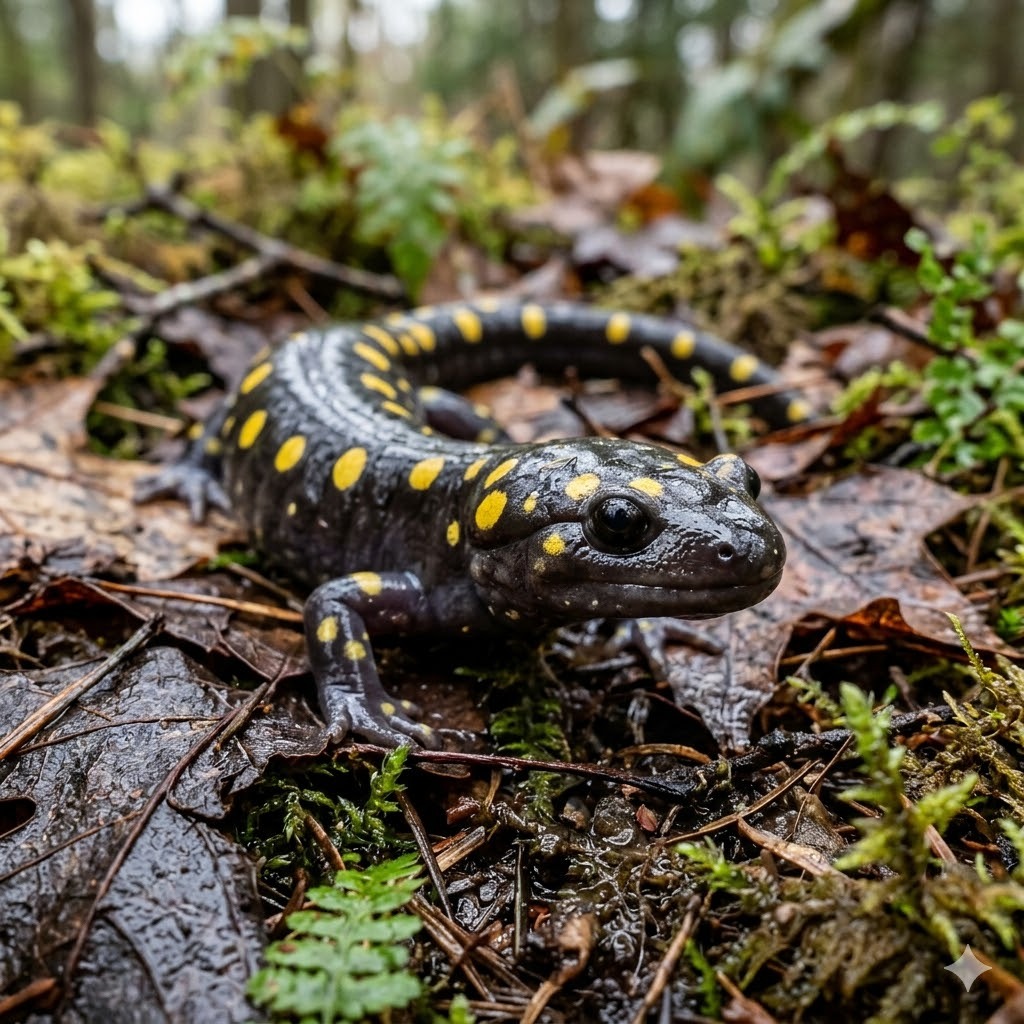
The Spotted Salamander (Ambystoma maculatum) is a stout, secretive "mole salamander" from the woodlands of eastern North America, instantly recognisable by its glossy black body dotted with two irregular rows of bright yellow spots.
🗓️ Last reviewed: July 2026
Overview
The Spotted Salamander (Ambystoma maculatum) is a stout, secretive "mole salamander" from the woodlands of eastern North America, instantly recognisable by its glossy black body dotted with two irregular rows of bright yellow spots. Despite its striking looks it is a shy burrower that spends almost the entire day hidden underground and comes out only in cool, damp darkness. Kept correctly in a cool, moist woodland terrarium it is one of the most long-lived amphibians available, but it is very much a look-don't-handle animal.
Natural History
Spotted Salamanders live across the deciduous and mixed forests of the eastern and central United States and southeastern Canada, from the Great Lakes down to the Appalachians. For most of the year they are almost never seen, living in burrows and under logs where the soil stays cool and humid.
Their most famous behaviour is the spring "big night": on the first warm rains of late winter or early spring, huge numbers migrate together to breed in temporary vernal pools. The females lay large gelatinous egg masses in these fishless pools, and the larvae develop through an aquatic gilled stage before crawling onto land and returning underground. This species is not endangered globally, but local populations are fragile and easily wiped out by road traffic and habitat loss, so wild animals should never be collected. Only captive-bred specimens should ever be kept as pets, both to protect wild populations and because captive-bred animals adapt far better to life in a terrarium.
Appearance
Adults reach roughly 15-25 cm in total length, making them one of the larger terrestrial salamanders you can keep. The body is thick and rounded with a broad head and a fairly stout tail.
The base colour is a deep glossy black to slate grey, marked by two uneven rows of rounded yellow to orange spots running from behind the eyes to the tail tip. The belly is slate grey. The skin is smooth and always looks slightly wet.
Temperament & Handling
This is a calm, slow-moving, secretive animal - and a look-don't-handle pet. Their skin is delicate, permeable, and absorbs oils, salts, and residues from human hands, which can harm them. Handle only when strictly necessary (for example a health check or enclosure move), and then only briefly with clean, wet, unpowdered hands or by gently scooping them.
Expect to see very little of your salamander during daylight. It will spend the day burrowed and become active in the cool of night. This is normal and healthy behaviour, not distress. Sudden bright light or frequent disturbance stresses them, so the best way to enjoy this animal is to observe quietly in the evening, perhaps with dim indirect light, rather than digging it out or reaching in to touch it. Over months a settled salamander often becomes a little bolder about surfacing to feed, but it will always be a watch-and-wait pet.
Enclosure
Minimum: a 40-60 litre (10-15 gallon) terrarium for one adult, with more floor space always better than height. This is a terrestrial, burrowing species, so ground area matters most.
Provide:
- A deep, moist substrate they can dig into - coconut fibre, a soil-and-leaf-litter mix, or sphagnum-based bedding at least 8-10 cm deep.
- A generous layer of leaf litter and several hides (cork bark, half logs, hide caves) so the animal always feels covered.
- A shallow, easily exited water dish of dechlorinated water.
- A secure, ventilated lid - they are surprisingly good at pushing out of gaps.
Keep the substrate damp but never waterlogged, and spot-clean waste and uneaten food regularly. A fully naturalistic, bioactive setup with live plants, a clean-up crew of isopods and springtails, and a stable moist microclimate suits this species very well and cuts down on maintenance.
Heating, Lighting, Humidity
- Temperature: cool. Aim for around 15-20°C, and keep it below the low 20s. Warmth is a serious danger for this woodland species. Above the mid-20s°C is stressful and can be fatal, so many homes need a cool room or basement rather than any heating device.
- Lighting: dim, low, indirect light. No UVB is required. A natural day-night cycle is enough, and bright lights should be avoided.
- Humidity: high. Keep the substrate and leaf litter consistently moist and mist lightly as needed. The enclosure should feel like damp forest floor, not a swamp.
Diet
Carnivore / insectivore.
- Earthworms (an excellent staple).
- Gut-loaded crickets.
- Nightcrawlers, cut to size for smaller animals.
- Occasional isopods, small roaches, waxworms, or slugs.
Dust feeder insects with a calcium supplement. Feed adults roughly every 2-3 days and offer prey in the evening when the animal is active. Remove uneaten live insects, which can nibble a resting salamander. Because they hunt slowly and mostly by scent and touch, place food near their hide or feed by tongs.
Health & Lifespan
Spotted Salamanders are famously long-lived, commonly reaching 15-20 years and sometimes longer in good care.
Common concerns:
- Heat stress - the most serious risk. Keep the enclosure cool.
- Dehydration or dryness from substrate that is allowed to dry out.
- Chemical poisoning - their permeable skin is very sensitive to chlorine and chloramine, so always use dechlorinated water.
- Impaction from swallowing loose coarse substrate while feeding.
- Skin (fungal or bacterial) infections from poor hygiene or stagnant, waterlogged bedding.
- Obesity from overfeeding rich prey.
Find an exotics vet experienced with amphibians before problems arise.
Pros & Cons
Pros:
- Striking black-and-yellow looks.
- Extremely long-lived - a 15-20 year companion.
- Quiet, low-noise, low-space observation pet.
- Hardy when kept cool and moist.
Cons:
- Cool temperatures required - hard in warm homes.
- Secretive and nocturnal - rarely seen by day.
- Cannot be handled routinely.
- Sensitive to water and air quality.
Best Suited For
- Patient keepers who enjoy watching rather than handling.
- Cool-climate homes or naturally cool rooms.
- Older children and adults.
Not suited for anyone wanting an interactive, handleable pet, warm households without a cool room, or keepers unwilling to maintain steady humidity.
Spotted Salamander - frequently asked questions
Why do I never see my salamander?
It is a nocturnal burrower. It hides underground all day and comes out in the cool, dark evening. Seeing little of it during the day is completely normal.
Can I take one from the woods near me?
No. Wild collection harms fragile local populations, and many areas protect them. Always start with a captive-bred animal.
Can I hold it?
Only when strictly necessary, briefly, with clean wet hands. Their permeable skin absorbs oils and residues, so this is a look-don't-handle species.
How long do they live?
Often 15-20 years, sometimes longer - a serious long-term commitment.
Do they need a heat lamp?
No. They need cool conditions, not heat. In most homes the challenge is keeping them cool enough, not warm.
🧠 Test yourself: guess the amphibian
Three clues from our quiz bank, each about another of our amphibians. Can you name them?
Clue 1.A popular beginner amphibian, this little green-and-black hopper spends much of its time floating in shallow water.
It's the Fire-Bellied Toad - read the full profile →
Clue 2.Critically endangered in the wild, this Mexican amphibian is native to just a single lake system near a major capital city.
It's the Axolotl - read the full profile →
Clue 3.This stocky, burrowing amphibian is one of the largest land-dwelling salamanders, marked with yellowish bars or blotches on dark skin.
It's the Tiger Salamander - read the full profile →