Alexandrine Parakeet
The Alexandrine parakeet is a large, long-tailed Asian parakeet named after Alexander the Great, whose armies are said to have carried the birds westward from India in ancient times.
🗓️ Last reviewed: July 2026
Overview
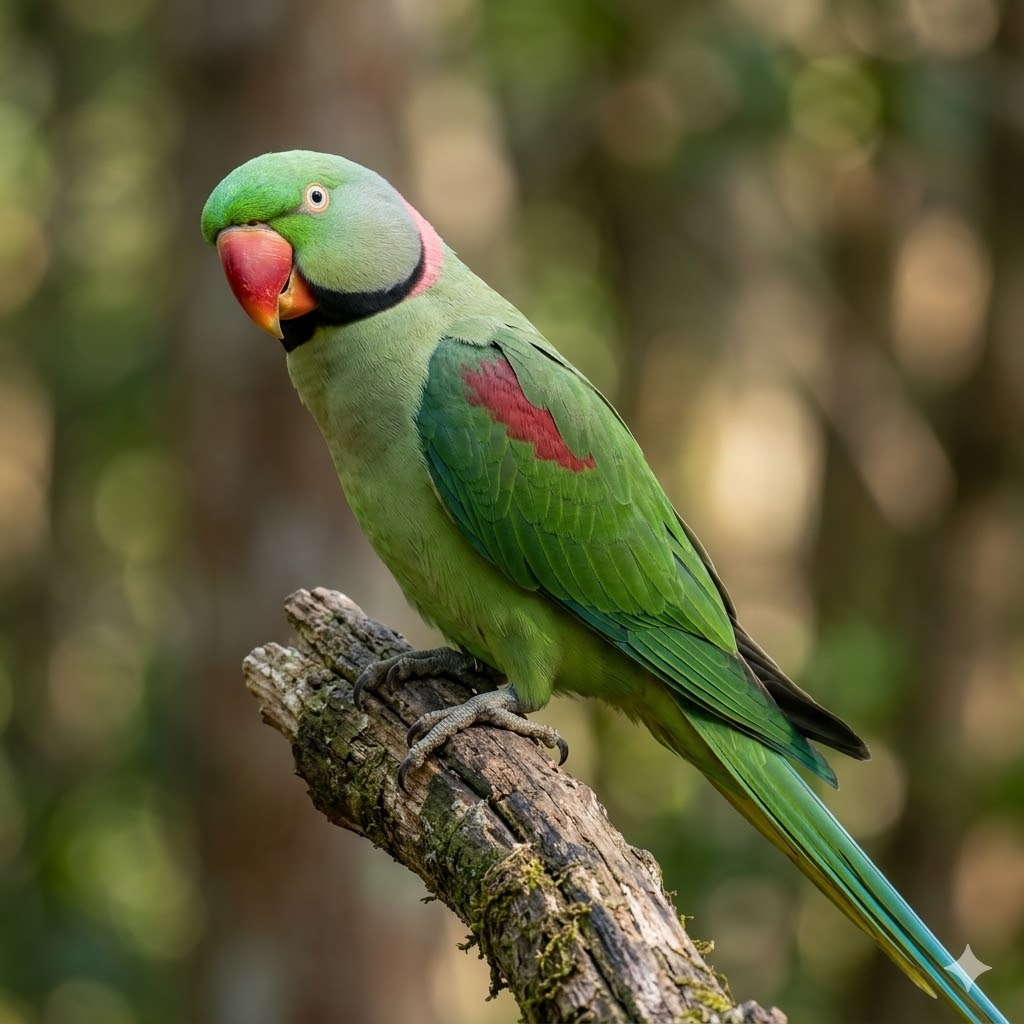
The Alexandrine parakeet is a large, long-tailed Asian parakeet named after Alexander the Great, whose armies are said to have carried the birds westward from India in ancient times. Think of it as the bigger, calmer, more talkative cousin of the familiar Indian ringneck. With its elegant proportions, distinctive rose collar, and gentle disposition once tamed, the Alexandrine has become a favourite among keepers who want the presence of a big parrot without the noise and neediness of a cockatoo or macaw. It is intelligent, capable of an impressive vocabulary, and forms a deep bond with a patient owner. This is a bird that rewards commitment - it lives for decades and has a strong beak that demands serious chew toys and a spacious home. Owners describe the Alexandrine as dignified and observant, a bird that watches the household closely and slowly decides to trust. Given consistent, respectful handling from a young age, it settles into a steady, affectionate companion that is neither as clingy as a cockatoo nor as flighty as many smaller parakeets, which is a large part of its lasting appeal.
Natural History & Origin
The Alexandrine parakeet (Psittacula eupatria) ranges naturally across the Indian subcontinent and Southeast Asia, including India, Sri Lanka, Myanmar, Thailand, and neighbouring regions. It inhabits forests, woodland, mangroves, and cultivated areas, often gathering in noisy flocks and roosting communally in large trees. Escaped and released birds have established feral populations in several European cities. The species has been kept by people for well over two thousand years, making it one of the oldest parrots in human care. Several subspecies exist across its wide range, differing slightly in size and colour intensity.
Appearance
A large parakeet: length 56-62 cm including the long tapering tail, with the tail alone making up more than half that measurement. Weight is typically 200-300 g. The body is mostly rich green, paler on the underparts, with a large red patch on each wing shoulder that instantly separates it from the smaller ringneck. Adult males develop a striking neck ring - a black band across the throat blending into a rose-pink collar around the nape. Females and immature birds lack the ring or show only a faint shadow of it. The massive red-orange beak is a defining feature and a reminder of the powerful bite this species is capable of.
Temperament & Noise
Alexandrines are intelligent, curious, and generally gentle once they trust their people. Hand-raised birds can be affectionate and steady, less prone to the sudden nippiness some smaller parakeets show. They are among the better talkers in the parakeet group, learning words, short phrases, and household sounds with a surprisingly clear voice. Noise-wise they are moderate to loud - not constant screamers, but capable of piercing contact calls, especially at dawn and dusk. They are usually too loud for thin-walled apartments but manageable in a house. A bored or lonely Alexandrine can become noisy and destructive, so engagement matters.
Housing & Flight
This is a big, active bird that needs room. Minimum cage: 90 x 60 x 120 cm for a single bird, and bigger is genuinely better - an aviary is ideal. Bar spacing should be around 2 cm, and the cage must be sturdy metal, because a determined Alexandrine will destroy flimsy construction with that powerful beak.
Provide:
- Several thick natural-wood perches of varying diameter.
- Robust chew toys and destructible wood - this species must chew.
- Foraging toys and puzzles to occupy the mind.
- A cuttlebone or mineral block for calcium.
- Daily out-of-cage time in a bird-safe room for exercise and flight.
Diet
- Quality pellets as the dietary base (around 50-60%).
- Fresh vegetables and leafy greens daily - broccoli, carrot, capsicum, dark greens.
- Fruit in moderation - apple, berries, papaya, a few times weekly.
- A modest seed and nut mix as a supplement and training treat, not the main diet.
- Cuttlebone or mineral block for calcium.
- Fresh water changed daily.
Avoid: avocado (toxic to all birds), chocolate, caffeine, alcohol, onion, garlic, and salty foods.
Health & Lifespan
Alexandrine parakeets are long-lived, commonly reaching 25-30 years and sometimes beyond 40 with excellent care. This is a multi-decade commitment comparable to a large parrot.
Common concerns:
- Psittacosis (a bacterial infection that can spread to people).
- Feather-plucking and boredom-related behaviour in under-stimulated birds.
- Respiratory illness - sensitive to fumes from non-stick cookware, aerosols, and smoke.
- Fatty liver disease from seed-heavy diets.
- Aspergillosis (a fungal infection).
- Vitamin A deficiency from poor diet.
Establish care with an avian vet before bringing the bird home.
Training & Enrichment
Highly intelligent and very trainable with patience. They learn step-up, recall, target training, and a range of tricks, and are among the more capable talkers of the parakeets. Enrichment is essential: rotate toys, offer foraging challenges, and provide plenty of destructible wood to satisfy the chewing drive. Consistent, gentle, reward-based training prevents the nipping and screaming that come from frustration.
Pros & Cons
Pros:
- Elegant, impressive large parakeet.
- Gentle and steady when hand-raised.
- One of the better-talking parakeets.
- Long lifespan - a companion for decades.
- Intelligent and highly trainable.
Cons:
- Needs a very large cage or aviary.
- Powerful beak destroys cheap toys and cages.
- Loud contact calls unsuitable for apartments.
- 25-40 year commitment.
- Can become noisy or destructive if neglected.
Best Suited For
- Experienced or dedicated intermediate bird owners.
- Households in a house rather than a thin-walled flat.
- People wanting a talking parrot without cockatoo-level neediness.
- Owners able to commit for decades.
Not suited for first-time bird keepers unsure about a long commitment, apartment dwellers sensitive to noise, or homes with non-stick cookware in active use.
Alexandrine Parakeet - frequently asked questions
How is an Alexandrine different from an Indian ringneck?
It is noticeably larger, has red wing-shoulder patches, tends to be calmer and steadier, and often talks a little more clearly.
Can they talk?
Yes - they are among the better talkers of the parakeets, learning words, phrases, and household sounds.
How long do they live?
Commonly 25-30 years, sometimes over 40 with excellent care.
Are they loud?
Moderately to loud. Not constant screamers, but their contact calls can be piercing, especially at dawn and dusk.
Are they good for beginners?
Better for dedicated intermediate keepers. Their size, strong beak, and long lifespan make them a serious commitment.
🧠 Test yourself: guess the bird
Three clues from our quiz bank, each about another of our birds. Can you name them?
Clue 1.Among the tiniest parrots kept as pets, this short-tailed bird is bold and feisty despite its affectionate name.
It's the Lovebird - read the full profile →
Clue 2.Hardy enough to form feral city colonies in cold climates, this small talkative parrot constructs apartment-like twig nests.
It's the Quaker (Monk) Parakeet - read the full profile →
Clue 3.This silver-feathered parrot with a bright red tail is widely regarded as one of the most intelligent birds, able to learn hundreds of words and use them in context.
It's the African Grey Parrot - read the full profile →
Social Needs
Alexandrines are flock birds and need genuine social contact. A single bird will bond intensely with its owner and requires daily interaction to stay content. If you cannot commit several hours a day, consider keeping a compatible pair, though a bonded pair may focus on each other rather than on you. They can be territorial and occasionally jealous, so introductions to other birds and to family members should be gradual and supervised. Hormonal seasons can make a normally gentle bird moody or cage-protective for a few weeks, and understanding this cycle helps owners respond with patience rather than punishment. A well-socialised Alexandrine that is included in daily household life tends to be far more balanced than one left alone in its cage for long stretches.