Green-Cheek Conure
The green-cheek conure is often described as a "big personality in a small body." Playful, curious, and endlessly entertaining, this small South American parrot packs the charm and intelligence of the larger conures into a package that suits homes with limited space.
🗓️ Last reviewed: July 2026
Overview
The green-cheek conure is often described as a "big personality in a small body." Playful, curious, and endlessly entertaining, this small South American parrot packs the charm and intelligence of the larger conures into a package that suits homes with limited space. Crucially for many keepers, the green-cheek is noticeably quieter than its flashier cousins like the sun conure - it still makes noise, but it rarely reaches the ear-piercing volumes that make some conures apartment nightmares. Cuddly, mischievous, and deeply bonded to their people, green-cheeks have earned a reputation as one of the best small parrots for interactive companionship.
Natural History & Origin
Green-cheek conures (Pyrrhura molinae) come from the forests and woodlands of central South America - Brazil, Bolivia, Argentina, and Paraguay. In the wild they live in noisy flocks, foraging through the canopy for seeds, fruits, and berries. They are cavity nesters, raising their young in tree hollows. Their flock lifestyle explains the pet green-cheek's intense social drive: these birds are wired to stay in near-constant contact with their group, which in a home becomes the human family. Because they are a Pyrrhura conure rather than one of the larger Aratinga species, their calls evolved to be softer and more clipped - a natural quietness that is a big part of why they have become such a popular apartment parrot. Captive breeding is now widespread and well established, so most pet green-cheeks are hand-raised and well adapted to life alongside people.
Appearance
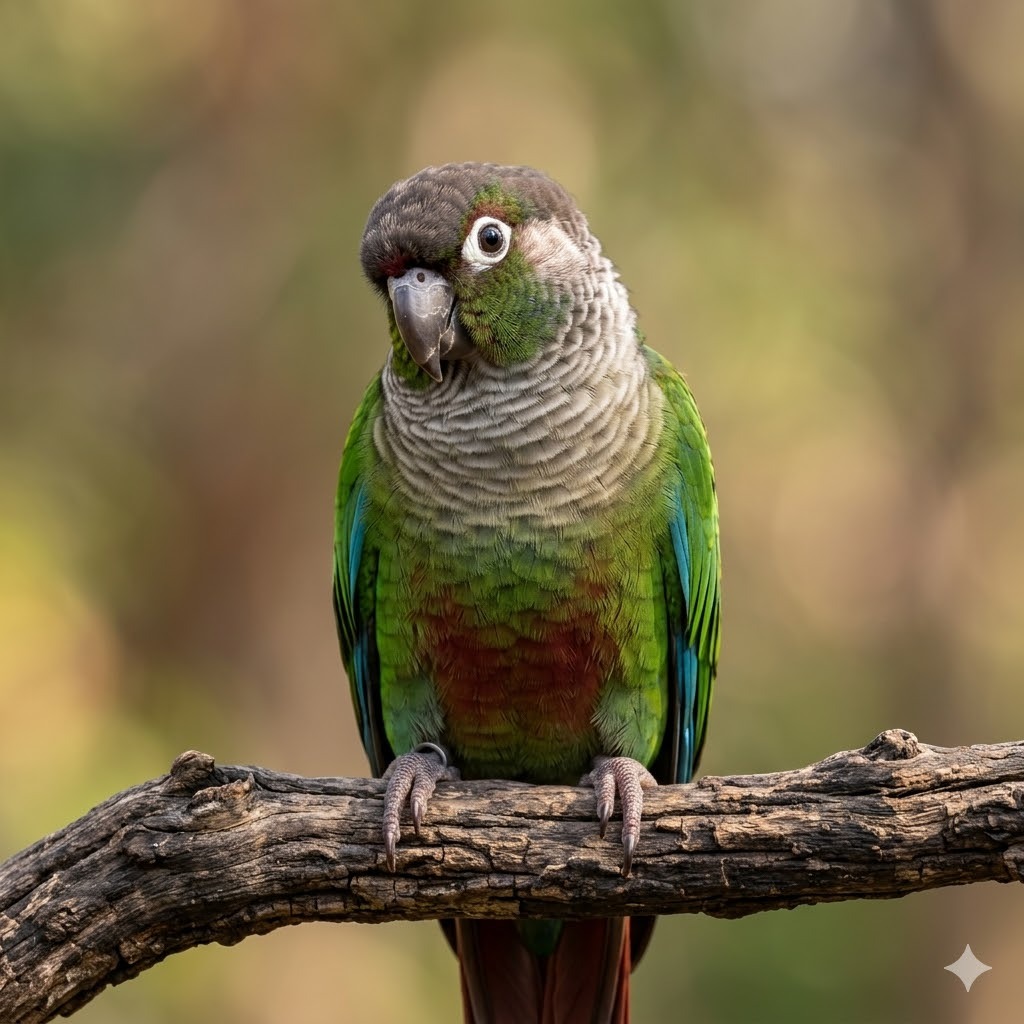
Small parrots, roughly 26 cm long including the tail, and weighing 60-80 g. The wild ("normal") type has a green body, a grey-scalloped chest, maroon tail, dull red belly patch, and the dark cap and green cheeks that give the species its name. Selective breeding has produced several color mutations, including yellow-sided, cinnamon, pineapple, and turquoise, which soften or shift the natural coloring. Despite the variety, all remain the same compact, slender-tailed bird underneath.
Temperament & Noise
Green-cheeks are affectionate, comical, and famously fond of physical contact - many enjoy being cradled on their backs, tucked into shirts, and gently scratched. They are also little clowns, hanging upside down, wrestling with toys, and inventing games. Expect a mischievous streak: they explore with their beaks and can be nippy, especially during hormonal phases or if under-socialized.
On noise, honesty matters. Green-cheeks are among the quieter conures, which is a major selling point, but "quieter" does not mean silent. They chatter, make contact calls, and can produce a surprisingly loud screech when excited, alarmed, or seeking attention. This screeching is usually short-lived and situational rather than the relentless screaming of a sun conure, but it can still be sharp enough to carry. For an apartment they are generally realistic, unlike a sun conure, but no conure is a truly quiet bird, and prospective owners should visit one in person to hear the volume before committing.
Housing & Flight
Minimum cage: around 60 x 60 x 90 cm, taller and wider being better. Bar spacing of about 1.5 cm prevents heads getting stuck. Green-cheeks are active and need room to climb, flap, and play.
Provide:
- Multiple perches of varied natural-wood diameters to keep feet healthy.
- Plenty of toys - foraging puzzles, shreddable wood, and things to chew, rotated regularly to fight boredom.
- A cozy area, since many green-cheeks like to snuggle into tents or huddles (monitor for hormonal or over-attachment issues).
- Daily out-of-cage time. This is non-negotiable - a green-cheek confined to its cage becomes frustrated and can develop behavioral problems.
Diet
- Quality pellets as the base of the diet (roughly 60-70%).
- Fresh vegetables and leafy greens daily.
- Some fruit in moderation as a treat.
- A small amount of seed and nuts as occasional treats and training rewards, never as the staple.
Avoid entirely: avocado, chocolate, caffeine, alcohol, onion, garlic, and salty or sugary human foods. An all-seed diet leads to obesity and nutritional deficiency and shortens life.
Health & Lifespan
With good care, green-cheek conures typically live 20-30 years, a long commitment for such a small bird.
Common concerns:
- Feather-destructive behavior (plucking) driven by boredom, stress, or loneliness.
- Obesity and fatty liver disease from seed-heavy diets.
- Proventricular dilatation disease (PDD), a serious viral condition seen in conures.
- Respiratory illness and sensitivity to airborne toxins (non-stick cookware fumes, aerosols, smoke).
- Psittacosis (a bacterial infection).
Locate an avian vet before bringing a bird home, and schedule regular wellness checks.
Training & Enrichment
Intelligent and food-motivated, green-cheeks take readily to training. Many learn step-up, recall, and simple tricks, and some pick up a handful of words (though they are not strong talkers - their voice tends to be gravelly and quiet). Foraging toys and puzzle feeders channel their curiosity and prevent boredom-driven misbehavior. Consistent, gentle handling from a young age produces the sweet, confident pet the species is known for. Short, frequent training sessions work best, since these busy birds lose focus quickly but respond eagerly to praise and food rewards. Teaching a reliable step-up and gentle beak pressure early on also helps curb the nippiness that green-cheeks can otherwise develop as they mature.
Pros & Cons
Pros:
- Big-parrot personality in a small, manageable size.
- Quieter than most conures.
- Affectionate and cuddly.
- Playful, clever, and entertaining.
- Long lifespan for a small bird.
Cons:
- Not silent - can screech when excited.
- Needs significant daily out-of-cage time and interaction.
- Can be nippy, especially when hormonal.
- Prone to plucking if bored or lonely.
- 20-30 year commitment.
Best Suited For
- Owners wanting an interactive, cuddly small parrot.
- Apartment dwellers who can tolerate moderate noise.
- People able to commit daily time and decades of care.
- Patient keepers willing to work through the nippy phase.
Not suited for households seeking a low-interaction "background" pet, homes with non-stick cookware in active use, or anyone unable to provide daily out-of-cage attention.
Green-Cheek Conure - frequently asked questions
Are green-cheek conures loud?
They are among the quietest conures, but they still chatter and can screech loudly when excited or seeking attention. Realistic for most apartments, but not a silent bird.
Do they talk?
Some learn a few words, but their voice is gravelly and quiet. They are valued for personality, not talking.
Can I keep just one?
Yes, provided you give daily attention and out-of-cage time. A lonely, neglected green-cheek suffers.
How long do they live?
Typically 20-30 years with good care.
Are they good for beginners?
They are a good step-up bird for committed first-time owners who research thoroughly, but they are more demanding than a budgie or cockatiel.
🧠 Test yourself: guess the bird
Three clues from our quiz bank, each about another of our birds. Can you name them?
Clue 1.Playful and clownish, these long-tailed Central and South American parrots love to cuddle and may sleep on their backs.
It's the Conure - read the full profile →
Clue 2.This small grey Australian parrot, the smallest member of its crested family, sports orange cheek patches and a jaunty head crest.
It's the Cockatiel - read the full profile →
Clue 3.Native to American rainforests, this brilliantly colored bird can live 50 years or more in captivity.
It's the Macaw - read the full profile →
Social Needs
Green-cheeks are flock animals that crave interaction. A single green-cheek can thrive as a devoted companion, but only if the owner provides daily attention and out-of-cage time. Neglected birds become depressed, noisy, or prone to plucking. They can be kept in pairs or small groups, though a bonded pair may focus on each other rather than on people.