Indian Ringneck Parakeet (Psittacula krameri)
The Indian Ringneck Parakeet (Psittacula krameri) is a striking, long-tailed parrot famous for its clear talking ability and bold, intelligent personality.
🗓️ Last reviewed: June 2026
Overview
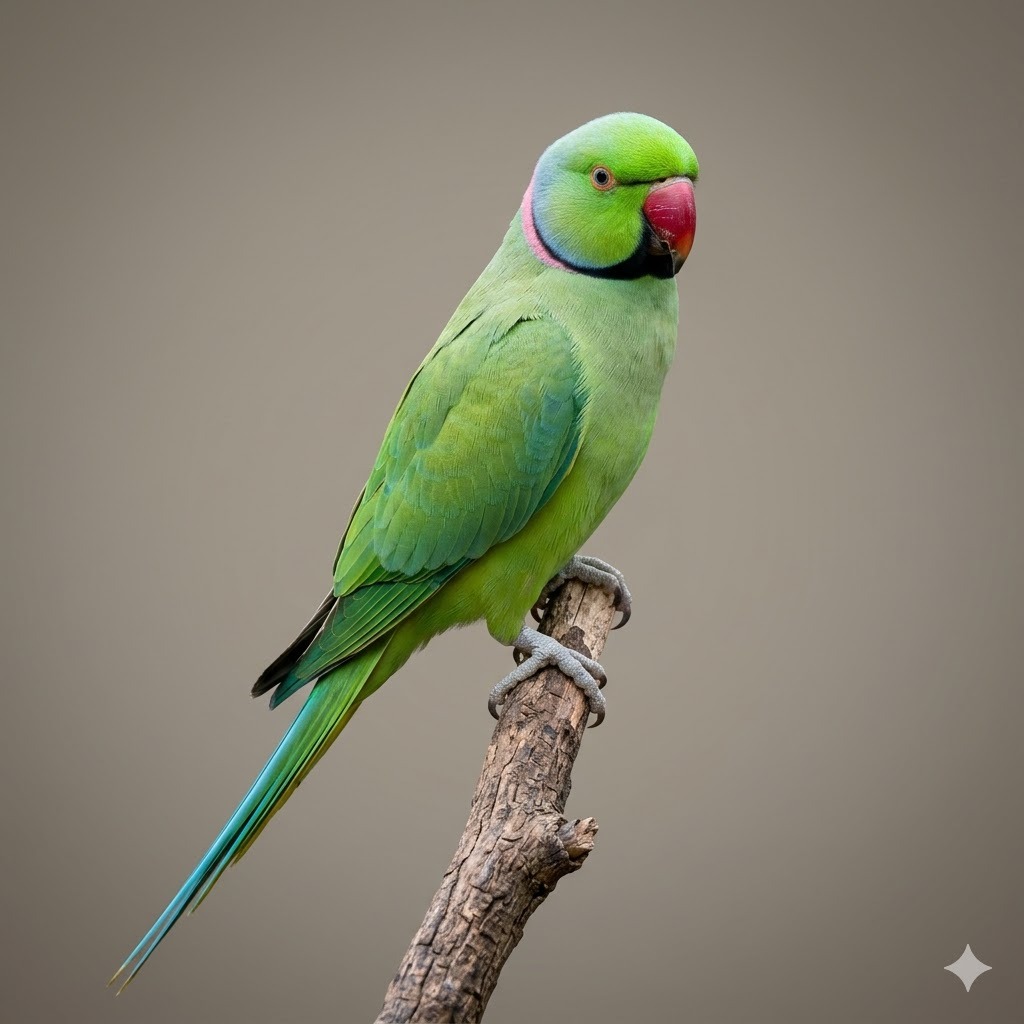
The Indian Ringneck Parakeet (Psittacula krameri) is a striking, long-tailed parrot famous for its clear talking ability and bold, intelligent personality. Mature males wear a black-and-rose neck ring that gives the species its name. Ringnecks are beautiful, smart, and rewarding, but they are not a low-effort beginner bird: they need a large flight cage, hours of out-of-cage time, consistent daily handling, and patience through a demanding adolescent phase. For an owner who can commit the time and structure, a well-socialised ringneck is an engaging companion for decades.
Natural History & Origin
Indian ringnecks are native to a broad band of Asia and Africa, including the Indian subcontinent, and have established large feral populations in many cities worldwide thanks to their adaptability. In the wild they live in flocks, foraging on seeds, fruit, blossoms, and crops, and roosting communally in noisy groups. They have been kept by people for a very long time and are bred in aviculture in a wide range of colour mutations.
Appearance
Adults weigh roughly 100-130 g, length around 37-43 cm including the very long, tapered tail, which makes up much of that measurement.
Colour varieties: the wild type is bright apple-green with a red beak and a long tail tipped in blue. Mature males show a black chin stripe and a rose-and-black ring around the neck; females and young males lack the defined ring or show only a faint shadow. Captive mutations include blue, lutino (yellow), grey, cinnamon, albino, and many combinations.
Temperament & Noise
Intelligent, curious, and confident, with a strong independent streak. Ringnecks are quick learners and can become excellent, very clear talkers. They are not loud all day like some larger parrots, but they have a piercing natural call and tend to be vocal at dawn and dusk, which is loud enough to matter in an apartment.
Hand-raised ringnecks can be affectionate and closely bonded, but many go through a hormonal adolescent stage, often called "bluffing," where a previously sweet bird suddenly becomes nippy, moody, or standoffish for a period. This phase passes with calm, consistent handling and is a normal part of the species, not a sign the bird is ruined. Birds that are not handled regularly can become distant or cage-territorial, so daily interaction matters throughout their life.
Housing & Flight
Minimum cage: a large flight cage of at least about 90 cm or more in width for a single bird, and bigger is always better given the long tail and active nature - the tail alone needs room so it does not rub or bend against the bars. An aviary or a dedicated bird room is ideal.
Provide:
- Plenty of out-of-cage time every day in a safe, bird-proofed space - several hours is appropriate for this active flier.
- Varied perches of different diameters, plus chewable wood, foraging toys, and puzzles to occupy a busy mind.
- A sturdy cage with secure latches, as ringnecks are clever and can learn to open simple doors.
- A cuttlebone and mineral block for calcium.
- A bathing dish or gentle spray, which most ringnecks enjoy.
Diet
- A quality pelleted diet as the foundation, which gives more complete nutrition than seed alone.
- Daily fresh vegetables and leafy greens, plus some fruit in moderation.
- Seed and nuts in limited amounts as treats and for training, not as the main diet.
- Sprouted seed and soaked legumes for variety.
- Cuttlebone and a mineral block for calcium.
- Fresh water daily, plus a bath.
Avoid: avocado (toxic to all birds), chocolate, caffeine, alcohol, onion, salt, and fruit pits and apple seeds.
Health & Lifespan
25-30 years (sometimes longer with excellent care), so this is a multi-decade commitment.
Common concerns:
- Psittacosis (parrot fever) - a bacterial infection that can also affect people; suspected birds need veterinary testing.
- Polyomavirus and PBFD (psittacine beak and feather disease) - viral diseases seen in parrots.
- Aspergillosis - a fungal respiratory infection linked to poor air quality and stress.
- Feather-damaging behaviour - plucking can develop from boredom, stress, or hormones in an under-stimulated bird.
- Nutritional deficiency and obesity from an all-seed or high-fat diet.
- Respiratory illness - very sensitive to fumes (non-stick cookware, aerosols, smoke).
Find an avian or exotics vet experienced with parrots before acquisition, and schedule routine wellness checks. None of the above is a do-it-yourself diagnosis; any sick or off-colour bird should be seen by an avian vet promptly.
Training & Enrichment
Ringnecks are intelligent and respond well to short, positive, reward-based training sessions. They can learn step-up, recall, simple tricks, and an impressive talking vocabulary, and consistent gentle training is the best way to work through the bluffing phase rather than punishing it. Enrichment is essential: rotate foraging toys, provide destructible wood to chew, hide food to make them work for it, and give daily out-of-cage flight and social time. A bored ringneck is a screaming or plucking ringneck, so mental stimulation is not optional.
Pros & Cons
Pros:
- Strikingly beautiful with a long elegant tail.
- Highly intelligent and can be a very clear talker.
- Trainable and engaging for a committed owner.
- Long-lived companion of 25-30 years.
Cons:
- Not a beginner or low-effort bird.
- Goes through a demanding hormonal "bluffing" phase.
- Loud piercing calls, especially morning and evening.
- Needs a large cage and hours of daily out-of-cage time.
Best Suited For
- Experienced or dedicated bird owners.
- People home enough to give daily interaction and flight time.
- Keepers who enjoy training and a talking parrot.
Not suited for households with non-stick cookware in active use (fumes can kill birds quickly), smokers in the same room, people wanting a quiet apartment bird, anyone away from home most of the day, or those unprepared for a 25-30 year commitment and a moody adolescent stage.
Indian Ringneck Parakeet (Psittacula krameri) - frequently asked questions
Are Indian ringnecks loud?
They are not noisy all day like some big parrots, but they have a piercing call and are vocal at dawn and dusk, which can be loud for an apartment.
Are they good for beginners?
Not really. They are intelligent and rewarding but need experienced, consistent handling, plenty of time, and patience through the bluffing phase.
How long do they live?
Around 25-30 years, sometimes longer with excellent care, so they are a long-term commitment.
What is "bluffing"?
A hormonal adolescent phase when a previously friendly ringneck becomes nippy or moody for a period. It is normal and passes with calm, consistent handling, not punishment.
Can they really talk?
Yes. Ringnecks are among the clearer talking parrots and many learn a sizeable vocabulary, though not every individual will choose to talk.
🧠 Test yourself: guess the bird
Three clues from our quiz bank, each about another of our birds. Can you name them?
Clue 1.Among the tiniest parrots kept as pets, this short-tailed bird is bold and feisty despite its affectionate name.
It's the Lovebird - read the full profile →
Clue 2.This small Australian grass parakeet, wild-colored green and yellow with black scalloping, is the world's most popular pet bird.
It's the Budgerigar (Budgie) - read the full profile →
Clue 3.This is the largest type of parrot kept as a pet, with a long sweeping tail and a huge nut-cracking beak.
It's the Macaw - read the full profile →
Social Needs
Highly social flock birds that need meaningful daily interaction, whether from a human family that spends real time with them or from another bird. A single ringneck can be a wonderful pet but only if it receives consistent attention; left alone too much it can become withdrawn, frustrated, or develop problem behaviours.
They can be kept with their own kind in a large aviary, but ringnecks can be assertive toward other birds, so introductions need space and supervision and they are not always reliable mixers with smaller, gentler species.