Zebra Finch (Taeniopygia guttata)
The Zebra Finch (Taeniopygia guttata) is one of the smallest, hardiest, and most popular pet finches in the world - a busy, cheerful little aviary bird with a soft beeping call and constant activity.
🗓️ Last reviewed: June 2026
Overview
The Zebra Finch (Taeniopygia guttata) is one of the smallest, hardiest, and most popular pet finches in the world - a busy, cheerful little aviary bird with a soft beeping call and constant activity. Named for the fine black-and-white barring across the male's throat and chest, this tiny Australian finch is sociable, easy to feed, and endlessly entertaining to watch. It is an excellent first bird for keepers who want lively company to observe rather than a parrot to handle or teach to talk. Zebra finches must always be kept in pairs or groups; they are flock birds and should never be housed alone.
Natural History & Origin
Zebra finches are native to the dry grasslands and open country of mainland Australia, where they live in large, restless flocks, foraging on the ground for grass seeds and rarely straying far from water. They are one of the most numerous birds on the continent and are superbly adapted to arid conditions. Kept and bred in aviculture for well over a century, they are among the most domesticated of all cage birds and exist today in many colour mutations.
Appearance
Adults weigh about 10-16 g, length around 10-11 cm including the tail - a genuinely tiny bird.
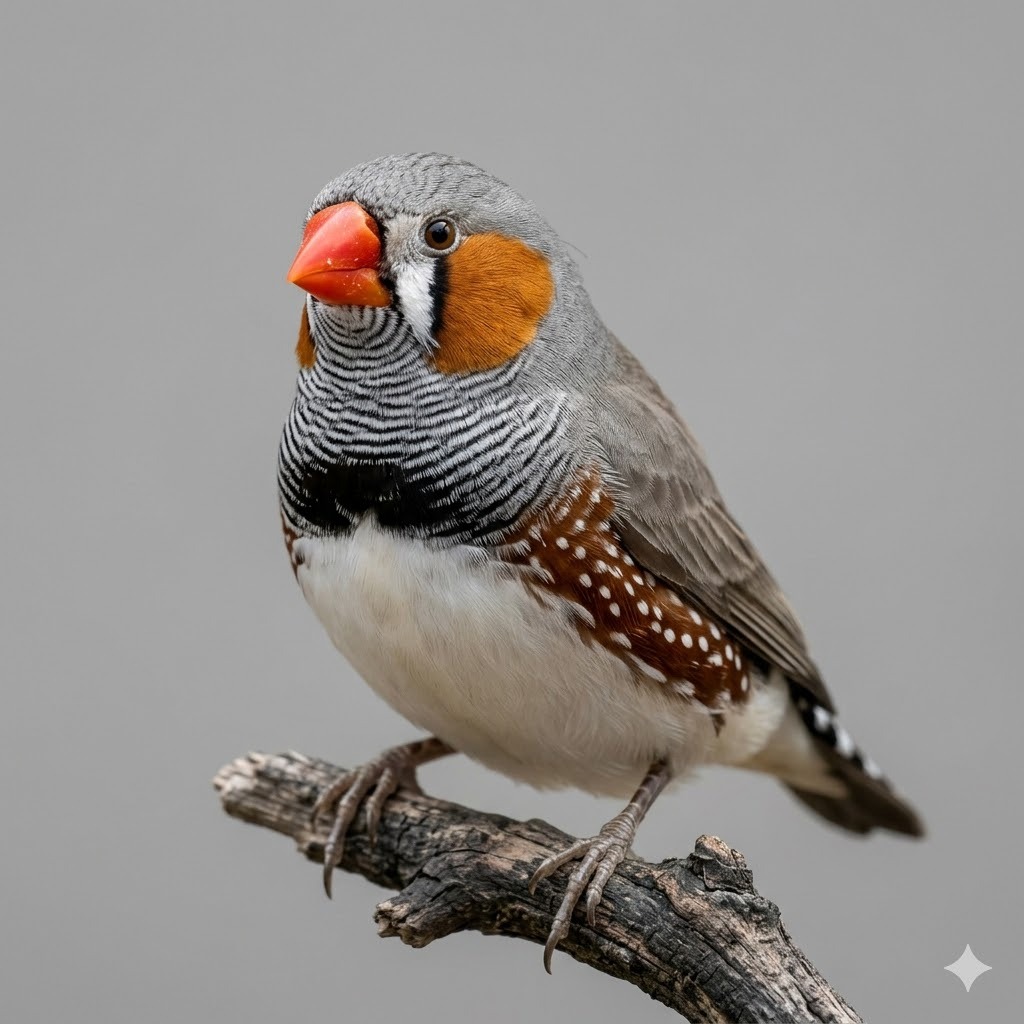
Colour varieties: the wild ("grey") type has a grey back, a pale grey breast, and a bright red-orange beak. Males show vivid chestnut-orange cheek patches, fine black-and-white barring across the throat and upper chest ("zebra" markings), and chestnut flanks dotted with white spots. Females are plainer grey with a paler beak and no cheek patches or chest barring, which makes sexing easy in the wild type. Captive mutations include fawn, white, pied, chestnut-flanked white, and crested forms, though colour can mask the usual sex differences.
Temperament & Noise
Busy, social, and cheerful. Zebra finches are active little birds, hopping and flitting almost constantly and keeping up a steady chatter of soft beeps and trills. The male sings a quiet, buzzy, beeping song that many people find pleasant; the overall volume is low and apartment-friendly, with none of the screaming of parrots.
Zebra finches are watching pets, not handling pets. They generally do not become tame and dislike being held, so they are best enjoyed for their lively behaviour rather than for interaction. They are easily startled, so calm surroundings and slow, quiet movements keep them relaxed.
Housing & Flight
Minimum cage: a long flight cage of about 75-90 cm or more in width for a pair - horizontal space matters far more than height, because finches fly in fast, level dashes rather than climbing. Tall, narrow cages are unsuitable. An aviary is ideal, especially for a group.
Provide:
- Several perches placed at the ends to leave a clear open flight path across the middle of the cage.
- A cuttlebone and fine grit for calcium and digestion.
- A shallow bathing dish, which finches use enthusiastically and often.
- Calm companions of their own kind; keep them away from pushy or much larger birds.
Diet
- Quality finch seed mix as a base, rich in various millets and canary seed.
- Egg food for protein, especially during moulting and breeding.
- Daily fresh greens in small amounts, such as spinach, chickweed, or dandelion, plus sprouted seed.
- Cuttlebone and fine grit for calcium and digestion.
- Fresh water daily, plus a bathing dish.
Avoid: avocado (toxic to all birds), chocolate, caffeine, alcohol, onion, salt.
Health & Lifespan
About 5-7 years (some live longer with excellent care).
Common concerns:
- Air-sac mites - a respiratory parasite that causes clicking, wheezing, and open-mouth breathing.
- Egg binding in females, especially with frequent laying or low calcium.
- Scaly leg and face (mites) - crusty growths on the legs or around the beak.
- Injury from panic (night fright) - startled finches may flush and hit cage bars in the dark.
- Respiratory infections - sensitive to fumes (non-stick cookware, aerosols, smoking).
- Nutritional deficiencies from an all-seed diet with no egg food, greens, or calcium.
Find an avian or exotics vet experienced with small birds before acquisition.
Training & Enrichment
Zebra finches are not trained in the way parrots are, and they do not learn tricks or speech. Enrichment instead comes from a spacious horizontal flight, the company of their own kind, natural foraging on millet sprays and greens, regular bathing, and a varied, planted aviary or well-furnished cage. A small night light can help prevent panic flushing in the dark.
Pros & Cons
Pros:
- Tiny, hardy, and easy to feed.
- Low volume - cheerful soft beeping suits apartments.
- Lively and entertaining to watch.
- Sociable and content in a simple pair.
Cons:
- Not a hands-on or handling pet.
- Must be kept in pairs or groups, never alone.
- Flighty and prone to night fright.
- Needs a long horizontal flight cage, not a tall one.
Best Suited For
- First-time bird owners wanting easy, lively company.
- Apartment dwellers needing a quiet, low-volume bird.
- Keepers who enjoy watching busy birds rather than handling them.
Not suited for households with non-stick cookware in active use (fumes can kill birds quickly), smokers in the same room, cold or drafty homes, or anyone wanting an interactive, tameable, or talking companion.
Zebra Finch (Taeniopygia guttata) - frequently asked questions
Are zebra finches loud?
No. The male's beeping song and the flock's soft chatter are low in volume and among the more apartment-friendly of any pet bird.
Should I get one or two?
Never just one. Zebra finches are flock birds and must be kept at least as a pair, or in a small group; a lone bird becomes stressed and unhappy.
How long do they live?
About 5-7 years on average, sometimes longer with excellent care.
Can they be handled?
Not really. Zebra finches generally stay wild to the hand and dislike being held. They are watching pets, enjoyed for their lively behaviour rather than for cuddling.
What is night fright?
A sudden panic in the dark that makes finches flush and hit the cage. A small night light and a calm location help prevent it.
🧠 Test yourself: guess the bird
Three clues from our quiz bank, each about another of our birds. Can you name them?
Clue 1.This is the largest type of parrot kept as a pet, with a long sweeping tail and a huge nut-cracking beak.
It's the Macaw - read the full profile →
Clue 2.Selective breeding turned this little parrot into blues, whites, and a larger 'English' show type, though wild ones are always green.
It's the Budgerigar (Budgie) - read the full profile →
Clue 3.One brilliant orange-and-yellow species in this group is now endangered in the wild despite being common in captivity.
It's the Conure - read the full profile →
Social Needs
Highly social and must be kept at least in pairs - zebra finches are flock birds and should never be housed alone. A pair or small group is content and shows constant natural behaviour, singing, preening, and foraging together. Lone zebra finches become stressed and unhappy.
They are gentle and easily intimidated, so house them only with calm species of similar size, never with assertive birds that will bully them. In a group, give plenty of space and enough feeding stations to avoid squabbling.