Colorpoint Shorthair
The Colorpoint Shorthair is a slender, elegant, Siamese-type cat that comes in point colours beyond the four traditional Siamese shades, such as red, cream, and a range of tortie and lynx points.
🗓️ Last reviewed: July 2026
Overview
The Colorpoint Shorthair is a slender, elegant, Siamese-type cat that comes in point colours beyond the four traditional Siamese shades, such as red, cream, and a range of tortie and lynx points. Sharing the Siamese's sleek build, striking blue eyes, and highly vocal, people-focused nature, it is often considered a first cousin of the Siamese. Adults typically weigh 4-6 kg and have an average lifespan of 12-16 years.
History & Origins
The Colorpoint Shorthair began in the mid-20th century when breeders in Britain and the United States set out to expand the colour range of the pointed Siamese cat. Traditional Siamese are recognised only in seal, chocolate, blue, and lilac points. To achieve new point colours, breeders crossed Siamese with other shorthaired cats, including red and tabby domestic shorthairs, then bred back to Siamese for many generations to preserve the classic Siamese type.
The result was a cat with the Siamese's body, temperament, and voice but in additional point colours, including red point, cream point, and the various tortie and lynx (tabby) points. Because of the outcrossing in its background, some registries treat the Colorpoint Shorthair as a distinct breed, while others consider it a colour division of the Siamese. It was recognised as its own breed by the Cat Fanciers' Association in 1964.
The breed's exact classification still varies by organisation, but everywhere it is prized as a Siamese in a broader palette.
Appearance
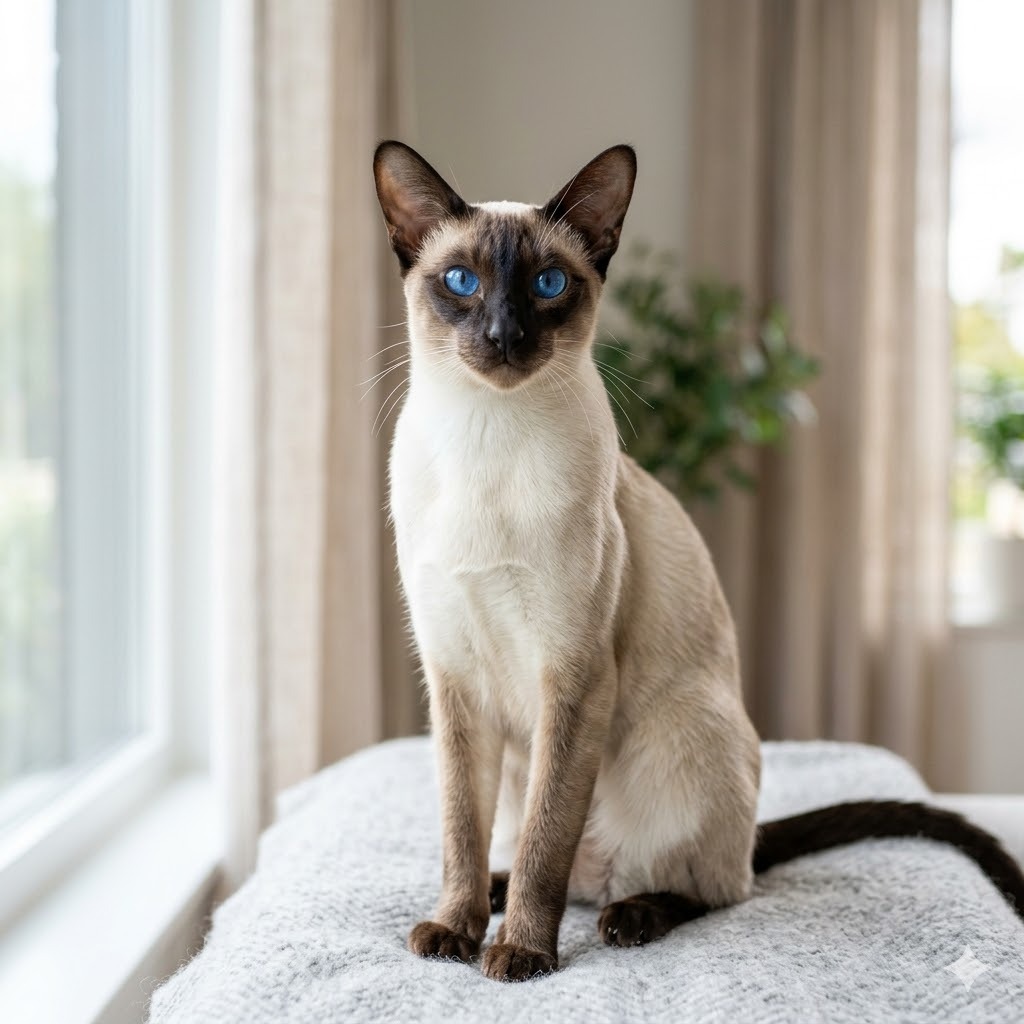
Sleek, refined, and athletic, the Colorpoint Shorthair mirrors the modern Siamese in every structural detail apart from colour. It is a medium-sized cat with a deceptively heavy, muscular body beneath a fine coat. Males typically weigh 4-6 kg; females 4-5 kg.
Key features:
- Coat: short, fine, glossy, and close-lying, requiring very little grooming.
- Colour: the defining trait - point colours beyond the traditional four, including red point, cream point, and seal, chocolate, blue, and lilac in tortie and lynx (tabby) variations, for a large family of point colours.
- Points: the mask, ears, legs, feet, and tail carry the darker colour, contrasting with a paler body.
- Head: long, tapering wedge from the nose to the tips of the ears.
- Ears: large, wide at the base, and pointed, continuing the lines of the wedge.
- Eyes: almond-shaped and a vivid, deep blue - a hallmark of the pointed pattern.
- Body: long, tubular, and svelte, with fine bone, firm muscle, and long slim legs, giving a graceful, elongated silhouette.
Temperament & Character
The Colorpoint Shorthair is intensely social, affectionate, and demanding of attention. Like the Siamese, it bonds closely with its people and does not like to be left alone for long stretches. It wants to be involved in everything, supervising chores, sitting on laps, and sleeping under the covers.
This breed is famously vocal. It has a loud, distinctive voice and will use it freely to comment on the day, ask for attention, or hold a conversation with you. Owners who want a quiet cat should look elsewhere; owners who want a chatty companion will be delighted.
Intelligent, active, and playful, the Colorpoint Shorthair stays kitten-like for years. It is agile and curious, loves to climb and explore, and can learn tricks, fetch, and harness walking. Its emotional sensitivity means it thrives on routine, company, and interaction, and can become stressed or clingy if neglected.
Care
Coat & Grooming
Grooming is minimal. The short, fine, close-lying coat needs only a weekly once-over with a soft brush or a grooming glove to remove loose hair and keep it glossy. The breed sheds relatively little.
An occasional bath is rarely necessary. Round out the routine with regular nail trims, ear checks, and several teeth-brushing sessions each week to support dental health.
Exercise & Enrichment
This is an active, intelligent breed that needs daily physical and mental stimulation. Provide tall cat trees, climbing shelves, puzzle feeders, and interactive wand toys, and schedule play sessions every day. The breed's cleverness makes it well suited to clicker training, fetch, and harness walks.
Because it is so people-focused, a Colorpoint Shorthair does best with company and interaction; consider a second compatible cat if the household is away often, and always leave engaging toys to prevent boredom-driven mischief.
Health & Lifespan
Average lifespan is 12-16 years.
As a Siamese-type breed, the Colorpoint Shorthair shares similar health considerations:
- Progressive retinal atrophy (PRA) - an inherited eye condition; responsible breeders test for it.
- Amyloidosis - a condition affecting the liver and other organs seen in some Siamese lines.
- Dental disease - the breed can be prone to periodontal issues, so dental care is important.
- Respiratory sensitivity and crossed eyes or kinked tails - occasionally seen, though less common in modern lines.
- Standard feline concerns - heart and kidney conditions that affect cats generally.
Choose a breeder who screens breeding cats for known Siamese-line issues and raises kittens in a clean, well-socialised home.
Feeding & Nutrition
Adults typically eat 50-70 g of quality cat food per day, adjusted for size and activity. This active, lean breed generally maintains a good figure, but measured meals are still wise to prevent overeating.
A high-protein diet suits the breed's athletic build. Fresh water should always be available, and a mix of wet and dry food supports hydration and urinary health. Because the breed is intelligent and food-motivated, puzzle feeders are a good way to combine feeding with enrichment.
Living With
Litter
Provide one box per cat plus one extra, scooped daily. The breed is not fussy about box size given its slender build, but most prefer low-dust, unscented litter and a clean, quiet location.
Multi-cat households
The Colorpoint Shorthair is sociable and usually thrives with feline companionship, particularly another active, playful cat or a fellow Siamese-type. Because it hates being alone, a compatible companion can be a real benefit. It also tends to do well with cat-friendly dogs.
Indoor vs outdoor
Indoor living is strongly recommended. The breed is people-focused, trusting, and valuable, which makes free roaming risky. Satisfy its curiosity and energy with vertical space, enrichment, and, if desired, a secure catio or supervised harness walks.
Pros & Cons
Pros
- Affectionate, devoted, and highly interactive.
- Available in a wide, beautiful range of point colours.
- Very low grooming needs.
- Intelligent and trainable.
- Excellent with families and other sociable pets.
Cons
- Extremely vocal and talkative.
- Dislikes being left alone; prone to separation stress.
- Demands attention and interaction daily.
- Some inherited health issues in the Siamese line.
- Can be clingy and sensitive to change.
Best Suited For
- People who are home often and want a chatty, involved cat.
- Families and multi-pet households.
- Owners wanting an interactive, trainable cat.
- Those who love the Siamese personality in more colours.
- Homes that can offer plenty of company and stimulation.
Not suited for owners wanting a quiet, independent cat, households empty for long hours, or anyone unable to give consistent daily attention.
Colorpoint Shorthair - frequently asked questions
How is a Colorpoint Shorthair different from a Siamese?
Structurally they are the same Siamese-type cat. The difference is colour: the Colorpoint Shorthair comes in point colours beyond the four traditional Siamese shades, such as red, cream, tortie, and lynx points.
Are they really that vocal?
Yes. Like the Siamese, this is one of the most talkative cat breeds, with a loud, distinctive voice it uses often.
Do they get along with other pets?
Generally very well. They are sociable and often happiest with a feline companion, and they tend to accept cat-friendly dogs.
Can they be left alone during the workday?
Not ideally. The breed craves company and can become stressed or lonely if left alone for long periods; a companion animal and enrichment help.
Do they need a lot of grooming?
No. The short, fine coat needs only a quick weekly brushing, making this a low-maintenance breed for coat care.
What colours do they come in?
A wide range of points, including red, cream, and the tortie and lynx (tabby) variations of seal, chocolate, blue, and lilac.
🧠 Test yourself: guess the cat
Three clues from our quiz bank, each about another of our cats. Can you name them?
Clue 1.The color-restricting gene in this Thai breed is a form of partial albinism that also gives every individual its characteristic blue eyes.
It's the Siamese - read the full profile →
Clue 2.Often sitting upright in a so-called Buddha pose, this owl-faced cat carries a folded-ear mutation first found in Scotland.
It's the Scottish Fold - read the full profile →
Clue 3.This slender, athletic cat has a warm ruddy coat where every hair is banded with several colors, giving a shimmering, wild-rabbit-like appearance.
It's the Abyssinian - read the full profile →
💛 Adoptable Colorpoint Shorthairs near you
Real cats of this breed (and close mixes) waiting in shelters and rescues right now, live from Petfinder. We have no affiliation and earn nothing - if someone catches your eye, the link goes straight to their shelter. New to adopting? Start with our adoption guide.
Widget not loading (some ad-blockers hide it)? Search directly on petfinder.com.