European Shorthair
The European Shorthair - also known as the Celtic Shorthair - is the hardy, everyday domestic cat of Europe, standardised as a recognised breed.
🗓️ Last reviewed: July 2026
Overview
The European Shorthair - also known as the Celtic Shorthair - is the hardy, everyday domestic cat of Europe, standardised as a recognised breed. For thousands of years these robust, moderate cats have lived alongside Europeans as farm and household mousers, and the breed simply formalises that natural, healthy type rather than exaggerating it. Medium to large, muscular, and even-tempered, the European Shorthair typically weighs 4-7 kg. It is one of the most balanced, low-maintenance, and genetically sound of all breeds. Friendly, adaptable, and undemanding, it makes an excellent family cat and first pet, offering all the charm of a classic domestic cat with the consistency of a recognised standard.
History & Origins
The European Shorthair's ancestors arrived with the Romans, who spread domestic cats across Europe to control rodents in granaries and settlements. Over roughly two thousand years, these cats naturally adapted to European climates and lifestyles as the common working and household cat of the continent.
For most of history this was simply "the cat" - unbred, hardy, and everywhere. In the twentieth century, Scandinavian breeders in particular worked to preserve and standardise the natural European type as a distinct breed, rather than letting it be absorbed into the British Shorthair. FIFe recognised the European Shorthair as its own breed in 1982, defining a cat that closely reflects the healthy, moderate domestic cat of Europe.
Because it derives from a vast, naturally robust population, the breed enjoys one of the broadest and healthiest gene pools of any cat. It remains especially popular in the Nordic countries and across continental Europe.
Appearance
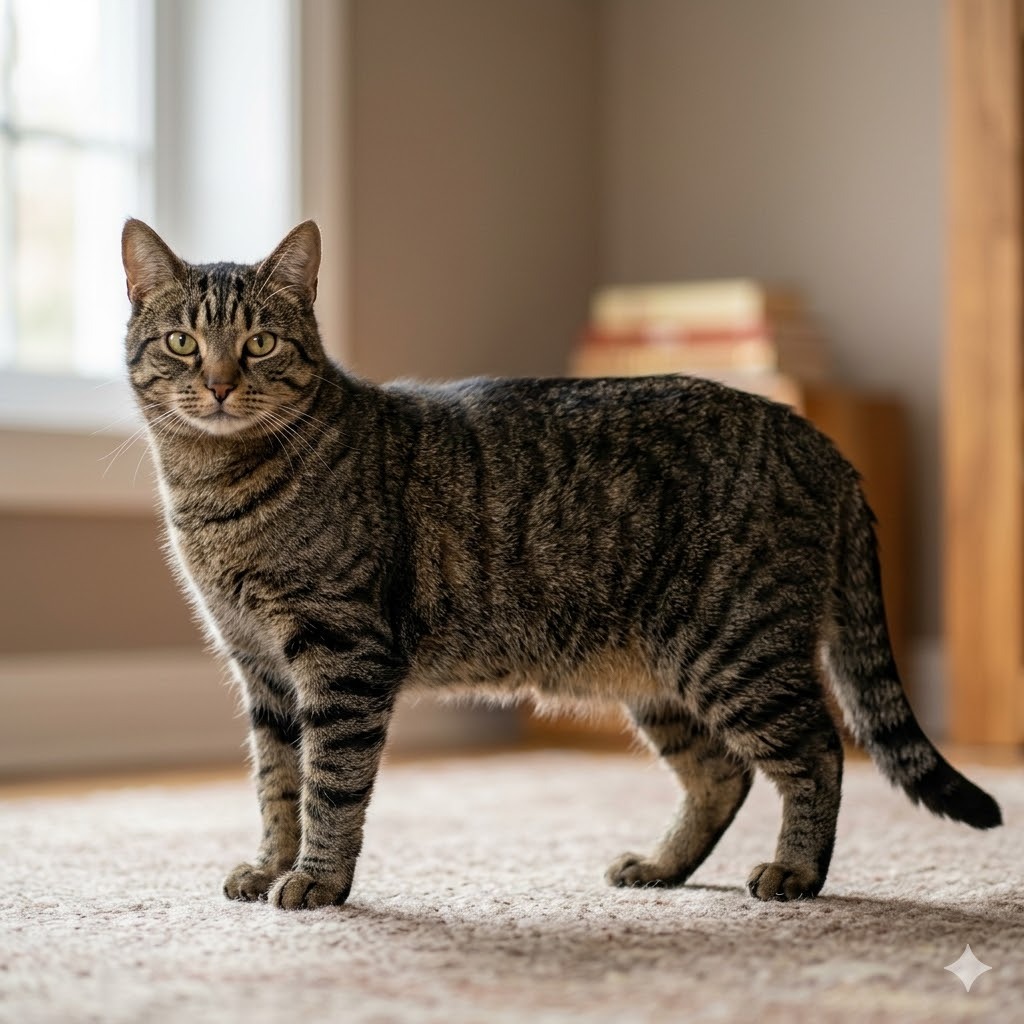
Medium to large, muscular, and well-balanced, the European Shorthair is the picture of a sturdy, natural domestic cat with no exaggerated features. Weight is typically 4-7 kg, with males larger than females.
Key features:
- Coat: short, dense, glossy, and close-lying, with a firm texture that provides good weather protection.
- Colour: a very wide range of colours and patterns, including tabby (classic and mackerel), solid, bicolour, tortoiseshell, and white; pointed patterns are not part of the breed.
- Head: rounded but slightly longer than wide, with full cheeks and a firm chin.
- Ears: medium, set well apart, with rounded tips.
- Eyes: large, round, and expressive, in colours that harmonise with the coat.
- Body: medium to large, muscular, and sturdy, powerful without being cobby.
- Legs: medium, strong, and well-proportioned, ending in firm rounded paws.
- Tail: medium length, thick at the base, tapering to a rounded tip.
Temperament & Character
The European Shorthair is friendly, calm, and adaptable - the easygoing companion its centuries of domestic life have produced. It is affectionate with its family without being clingy, happy to share a lap or simply keep its people company nearby.
These cats are intelligent and retain strong natural hunting instincts, making them alert and playful, but they are also content and undemanding. They tend to be confident and balanced, rarely nervous or high-strung.
European Shorthairs generally get along well with children, other cats, and dogs, adapting smoothly to family life. Independent enough to entertain themselves yet sociable enough to enjoy company, they strike an ideal middle ground that suits a wide range of households.
Care
Coat & Grooming
The short, dense coat is very low maintenance. A weekly brush removes loose hair and keeps the coat glossy, with a little extra brushing during seasonal shedding.
Bathing is rarely needed. Clean ears as required, trim claws every couple of weeks, and brush teeth regularly to maintain dental health.
Exercise & Enrichment
Active and playful, the European Shorthair enjoys regular play and appreciates outlets for its hunting instincts. Provide scratching posts, cat trees, wand toys, and puzzle feeders.
Daily play sessions keep this athletic cat fit and mentally engaged. While adaptable and fairly independent, it still benefits from interactive games and enrichment to prevent boredom and weight gain.
Health & Lifespan
Average lifespan is 15-20 years.
Common concerns:
- Exceptionally healthy - thanks to its vast, natural gene pool, the breed has no widespread breed-specific genetic diseases and is among the most robust of cats.
- Standard feline issues - routine risks such as dental disease and, in older cats, kidney disease apply as to any cat.
- Obesity - the main practical concern; keep this hearty eater lean with measured feeding.
- Parasites and injury if allowed to roam freely outdoors.
Choose a breeder who maintains the breed's health and diversity; breed-specific genetic testing needs are minimal.
Feeding & Nutrition
Feed a high-quality, protein-rich diet suited to an active, sturdy cat. Because the breed is hardy and food-motivated, measured meals rather than free-feeding help prevent obesity.
A mix of wet and dry food supports hydration and dental health. Keep fresh water available, and adjust portions to activity level and life stage.
Living With
Litter
Standard provisions: 1 + 1 box per cat, scooped daily. A medium-large box suits this sturdy breed. Low-dust, unscented litter is generally preferred.
Multi-cat households
European Shorthairs are typically sociable and adaptable, mixing well with other cats when introduced gradually. Their balanced, confident nature makes them easy companions in multi-pet homes.
Indoor vs outdoor
The breed adapts well to both indoor life and supervised outdoor access. Its hardy, streetwise heritage makes it a capable outdoor cat, but indoor-only living (with a catio or garden access) is safest, protecting it from traffic, disease, and injury.
Pros & Cons
Pros
- Exceptionally healthy with a broad gene pool.
- Friendly, calm, and highly adaptable.
- Excellent with children and other pets.
- Low-maintenance short coat.
- Long-lived and easy to keep.
Cons
- Common looking - not exotic or unusual.
- Strong hunting instinct if allowed outdoors.
- Food-motivated, so prone to weight gain if overfed.
- Can be confused with ordinary domestic shorthairs.
- Less available as a pedigree outside continental Europe.
Best Suited For
- First-time cat owners.
- Families with children of any age.
- Multi-pet households.
- Owners wanting a healthy, long-lived, easy breed.
- Homes seeking a balanced, adaptable companion.
Not suited for owners wanting an exotic or unusual-looking cat, or anyone unwilling to manage feeding to prevent obesity.
European Shorthair - frequently asked questions
Is the European Shorthair just a regular domestic cat?
It descends from Europe's common domestic cats but is a recognised breed with a defined standard, bred to preserve that healthy, natural type consistently.
Are they healthy?
Exceptionally so - thanks to a vast natural gene pool, they have no widespread breed-specific diseases and often live well into their late teens or beyond.
Are they good with families?
Very. They are friendly, calm, and adaptable, typically excellent with children, other cats, and dogs.
How much grooming do they need?
Very little - a weekly brush keeps the short, dense coat glossy and healthy.
How is it different from a British Shorthair?
The European Shorthair is more moderate and athletic, without the very round, cobby build and dense plush coat of the British Shorthair; it reflects the natural European domestic cat.
🧠 Test yourself: guess the cat
Three clues from our quiz bank, each about another of our cats. Can you name them?
Clue 1.This muscular, surprisingly heavy cat, said to feel 'like a brick wrapped in silk', traces to a single brown female imported from Asia.
It's the Burmese - read the full profile →
Clue 2.This long-haired cat blends a flat-faced body type with the blue eyes and dark color points of a Siamese.
It's the Himalayan - read the full profile →
Clue 3.Weighing among the least of any pedigreed cat, this big-eyed breed traces to street cats of a tropical port nation.
It's the Singapura - read the full profile →
💛 Adoptable European Shorthairs near you
Real cats of this breed (and close mixes) waiting in shelters and rescues right now, live from Petfinder. We have no affiliation and earn nothing - if someone catches your eye, the link goes straight to their shelter. New to adopting? Start with our adoption guide.
Widget not loading (some ad-blockers hide it)? Search directly on petfinder.com.