Khao Manee (Felis catus)
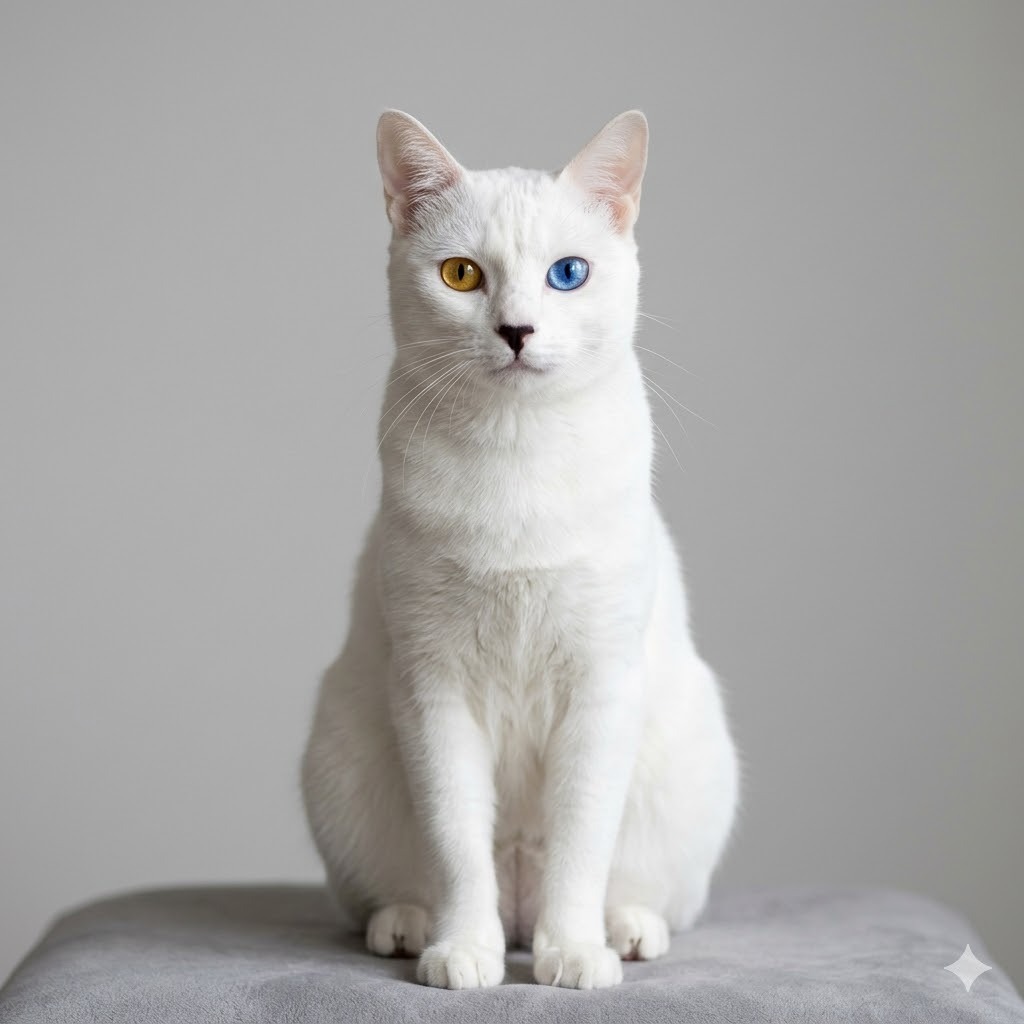
The Khao Manee is an ancient, pure-white short-haired cat from Thailand, where its name means "White Gem." Sleek, muscular, and athletic in build, the breed is best known for its luminous, jewel-like eyes, which are frequently odd-colored - one blue and one gold or green.
🗓️ Last reviewed: June 2026
Overview
The Khao Manee is an ancient, pure-white short-haired cat from Thailand, where its name means "White Gem." Sleek, muscular, and athletic in build, the breed is best known for its luminous, jewel-like eyes, which are frequently odd-colored - one blue and one gold or green. Affectionate, active, and highly social, the Khao Manee is a people-oriented cat that bonds closely with its family and wants to be part of daily life. It is a rare breed with a long history, treasured in its homeland for centuries.
History & Origins
The Khao Manee is a genuinely ancient breed, native to Thailand, where pure-white cats with gem-like eyes have been documented for hundreds of years. The breed is sometimes linked to the Tamra Maew, the old Thai "cat poems" that describe several prized native cats, and white cats were long associated with status and good fortune. For generations the Khao Manee was kept by Thai families and, by tradition, regarded as a cat of high regard.
The name reflects this heritage: "Khao" meaning white and "Manee" meaning gem or jewel - together, "White Gem." The breed was kept relatively isolated within Thailand for much of its history, which helped preserve its distinct, naturally pure-white short coat.
Western interest came much later. The Khao Manee was introduced to breeders in the United States and Europe in the 1990s and 2000s, and careful breeding programs worked to establish the cat outside Thailand while keeping its natural type. The breed was accepted by TICA, gaining championship recognition in the mid-2010s, and remains uncommon worldwide. Unlike many modern breeds, the Khao Manee was not engineered from crosses - it is a natural, long-established Thai cat now being preserved beyond its country of origin.
Appearance
Medium-sized, muscular, and athletic with a smooth, well-balanced body - a moderate, foreign-type cat without extremes. Males weigh 3.5-5.5 kg (8-12 lb); females 3-4.5 kg (6-10 lb).
Key features:
- Coat: short, smooth, and close-lying with little undercoat, always pure, solid white with no other colour or markings - the defining trait of the breed.
- Skin: healthy pink skin beneath the white coat, with pink nose leather and paw pads.
- Colour: white only. Kittens may show a small smudge of colour on the head that usually fades with maturity; an adult Khao Manee is solid white.
- Head: a gently rounded, slightly wedge-shaped head with a strong chin and a moderate muzzle.
- Eyes: the breed's most celebrated feature - large, luminous, and jewel-like. Eyes may be blue, gold, green, or, most prized, odd-colored (one blue and one gold or green).
- Ears: medium to large, set fairly high and wide, alert and expressive.
- Body: medium-length, muscular, and firm with an elegant, athletic outline, moderate legs, and a smooth tapering tail.
Temperament & Character
The Khao Manee is affectionate, social, and people-oriented - a cat that genuinely seeks out human company and bonds closely with its family. It greets its people, follows them around, and likes to be involved in whatever is going on, often supervising household activity from the best vantage point in the room.
This is an active, intelligent, and curious breed with real energy. Khao Manees are playful and athletic, enjoy climbing and exploring, and stay engaged with interactive toys and games well into adulthood. Many are talkative, communicating with their owners in a clear, expressive voice.
The breed thrives on interaction and company and does not love being ignored or left alone for long stretches. Khao Manees tend to attach to the whole household rather than a single person, and they are generally confident, outgoing, and quick to make friends with visitors.
Friendly and adaptable, the Khao Manee usually gets on well with children, other cats, and cat-friendly dogs, and it suits lively, sociable homes where there is plenty of attention and activity to share.
Care
Coat & Grooming
The Khao Manee is wonderfully low-maintenance to groom. The short, close-lying coat needs only a weekly brush or a quick wipe to remove loose hair and keep the white coat bright; it sheds modestly and rarely mats.
Because the coat is pure white, occasional bathing helps keep it looking clean, especially before shows, and any tear-staining around the eyes is easily wiped. The pink skin can be sensitive to strong sun, so limit prolonged direct sun exposure, particularly through windows.
Routine care covers the rest: check and clean ears as needed, trim claws every couple of weeks, and brush teeth several times weekly to support dental health.
Exercise & Enrichment
The Khao Manee is athletic, agile, and intelligent and needs daily activity and mental stimulation. Provide tall cat trees, climbing shelves, scratching posts, puzzle feeders, and interactive wand-toy sessions, and rotate toys to keep this curious breed interested.
Because the breed is active and clever, games that reward problem-solving are especially satisfying, and many Khao Manees enjoy fetch and clicker training. A social cat like this is happiest when play is interactive and shared with its family, so daily one-on-one play time matters as much as toys.
Health & Lifespan
Average lifespan is 12-15 years - the Khao Manee is generally a healthy, robust natural breed with no large burden of breed-specific disease.
The most important honest caveat concerns hearing. Like many pure-white cats - and especially those with one or two blue eyes - the Khao Manee carries an elevated risk of congenital deafness, which is linked to the genetics of the white coat. Deafness may affect one ear or both, and a blue-eyed cat is at higher risk than a gold- or green-eyed one. A deaf cat can live a full, happy life as a contented indoor pet, but it is something owners should know about and have checked.
Common concerns:
- Congenital deafness - an elevated risk in white cats, particularly blue-eyed ones; may be unilateral or bilateral. Responsible breeders BAER-test where possible.
- Sun sensitivity - pink skin under white fur can sunburn with prolonged direct sun exposure.
- Routine feline cardiac concerns - worth normal veterinary monitoring, as in any cat.
- General dental and weight monitoring - standard preventive care.
Choose a breeder who is transparent about health and hearing, tests where they can, and is honest about a kitten's hearing status.
Feeding & Nutrition
Adults typically eat 50-70 g of quality cat food per day, adjusted for the cat's size, age, and activity level - this is an active, muscular breed that does well on good nutrition.
A high-protein, balanced diet supports the breed's lean, athletic build. Feed measured meals rather than free-feeding, and monitor body condition to keep this energetic cat trim and well-muscled.
Fresh water should always be available; a mix of wet and dry food supports hydration and urinary health.
Living With
Litter
Standard provisions: 1 + 1 box per cat, scooped daily. Low-dust unscented litter is generally preferred and keeps a white-coated, indoor cat clean and comfortable.
Multi-cat households
The sociable Khao Manee usually loves company and does very well with other cats and cat-friendly dogs, especially a companion to keep it engaged while the family is out. Its confident, friendly nature makes introductions relatively easy when done gradually.
Indoor vs outdoor
Indoor-only, or a secure catio, is strongly recommended. A pure-white cat is highly visible to predators and traffic, can sunburn outdoors, and a deaf or partly deaf cat cannot hear approaching danger - all reasons to keep this rare, valuable breed safely indoors with enriching sunny, UV-safe perches.
Pros & Cons
Pros
- Affectionate, social, and strongly people-oriented.
- Striking pure-white coat and luminous, often odd-colored eyes.
- Active, intelligent, playful, and trainable.
- Easy-care short coat with minimal grooming.
- Good with children, cats, and cat-friendly dogs.
Cons
- Elevated risk of congenital deafness, especially in blue-eyed cats.
- White coat and pink skin are sun-sensitive.
- Dislikes being left alone for long.
- Rare and often expensive, with limited availability.
- Active and social - needs daily interaction and play.
Best Suited For
- Owners wanting an affectionate, interactive, people-oriented companion.
- Households where someone is home much of the day, or a second pet is present.
- People happy to keep an active cat enriched and indoors.
- Families with children and cat-friendly pets.
- Owners comfortable with the breed's deafness risk and ready to care for a deaf cat if needed.
Not suited for people away long hours with no companion pet, owners set on letting a cat roam outdoors, or those unwilling to accept and manage the breed's elevated deafness risk.
Khao Manee (Felis catus) - frequently asked questions
Why do Khao Manee cats often have two different colored eyes?
Odd-colored eyes (one blue, one gold or green) are a celebrated and prized trait in the breed, linked to the genetics of the pure-white coat. Khao Manees can also have matched blue, gold, or green eyes.
Are Khao Manee cats deaf?
Not all are, but the breed carries an elevated risk of congenital deafness, like many white cats - especially those with blue eyes. It can affect one or both ears. Responsible breeders test hearing where they can, and a deaf cat can still live a happy, full life indoors.
Is the Khao Manee a natural breed?
Yes - it is an ancient, naturally occurring Thai cat documented for centuries, not a modern hybrid created from crosses. Western breeding programs work to preserve its natural type.
Are Khao Manees affectionate?
Very - they are social, people-oriented cats that bond closely with the whole family, follow their owners around, and enjoy being involved in daily life.
Are they hypoallergenic?
No - the Khao Manee produces dander and the Fel d 1 protein in saliva and skin, so no cat is truly hypoallergenic.
🧠 Test yourself: guess the cat
Three clues from our quiz bank, each about another of our cats. Can you name them?
Clue 1.This tiny, large-eared cat has a sepia-toned ticked coat and is named after the Malay word for its country of origin.
It's the Singapura - read the full profile →
Clue 2.With huge upright ears and long legs, this exotic breed can leap roughly eight feet into the air.
It's the Savannah - read the full profile →
Clue 3.This pointed cat is prized for the distinctive white feet that inspired its wintry name, plus a white inverted-V on the face.
It's the Snowshoe - read the full profile →
💛 Adoptable Khao Manee (Felis catus)s near you
Real cats of this breed (and close mixes) waiting in shelters and rescues right now, live from Petfinder. We have no affiliation and earn nothing - if someone catches your eye, the link goes straight to their shelter. New to adopting? Start with our adoption guide.
Widget not loading (some ad-blockers hide it)? Search directly on petfinder.com.