Boesemani Rainbowfish
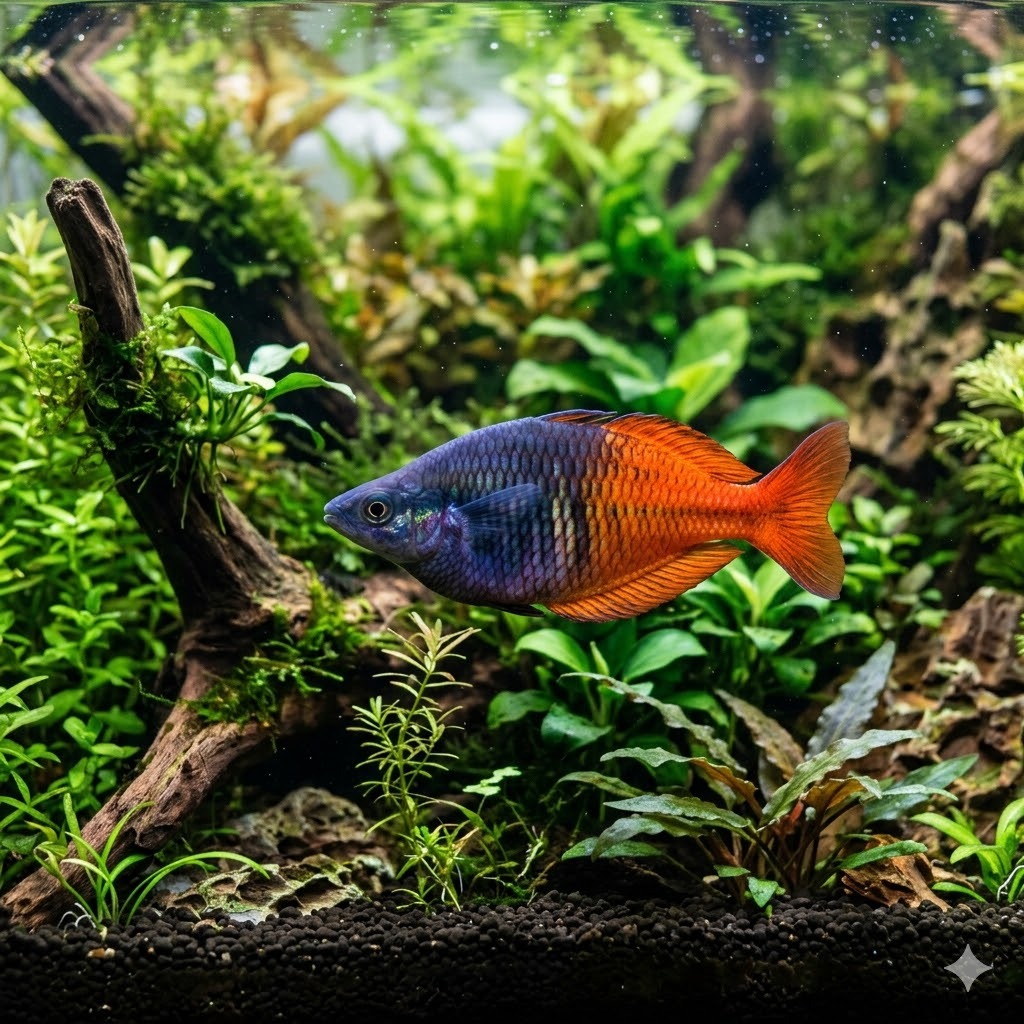
The Boesemani rainbowfish (Melanotaenia boesemani) is one of the most spectacular freshwater fish in the hobby, famous for its striking two-tone body: a deep blue-purple front half melting into a fiery orange-red rear.
🗓️ Last reviewed: July 2026
Overview
The Boesemani rainbowfish (Melanotaenia boesemani) is one of the most spectacular freshwater fish in the hobby, famous for its striking two-tone body: a deep blue-purple front half melting into a fiery orange-red rear. Reaching around 10 cm, it is a peaceful, active schooling species that rewards patience, as its full colour only develops as the fish matures. Native to a small region of Indonesia, the Boesemani needs space, a proper group and hard alkaline water to look and behave at its best. Kept well, a shoal of mature males in a planted tank is an unforgettable sight.
Natural History
The Boesemani rainbowfish comes from a very limited natural range - the Ayamaru Lakes and connected waters of the Vogelkop Peninsula in West Papua, Indonesia. These are warm, shallow, hard and alkaline lakes with clear water and abundant vegetation. Because the species is confined to such a small area, it is especially vulnerable to local changes in its environment. In the wild it has faced pressure from over-collection and habitat change, giving added importance to captive breeding, which now supplies most fish in the trade and takes pressure off the natural population. Rainbowfish are strong, tireless swimmers adapted to open, sunlit waters, which explains their need for room and their active shoaling behaviour in the aquarium. Understanding this lake origin is the key to keeping them well, since it dictates both the hard alkaline water and the generous swimming space they require.
Appearance
The Boesemani is instantly recognisable. Mature males show a dramatic split of colour - the head and front third a rich blue to purple-grey, the back two-thirds glowing orange to red, sometimes with fine barring. In peak condition the males can even shift the intensity of their colour through the day, flaring brightest when displaying to rivals or females. Females and young fish are more silvery and subdued, which is why buyers should expect juveniles to be plain and colour up over months rather than arriving in full glory. Both sexes have the deep, laterally compressed rainbowfish body and the characteristic forked, double dorsal fins that give the group its name. Adults reach around 10 cm, with males typically larger and deeper-bodied than females, and it is the mature males kept in a group that produce the classic rainbowfish spectacle.
Tank Size & Setup
As larger, energetic swimmers kept in groups, Boesemani rainbowfish need substantial space. A shoal of six or more should have a minimum tank size of 200 litres, with length prioritised to give them room to cruise. Provide open swimming areas framed by robust planting and some driftwood, plus a bit of gentle current to mimic their lake habitat. Good filtration and strong oxygenation suit these active fish. A secure lid is important, as rainbowfish are capable jumpers.
Water Parameters
- Temperature: 24-28°C.
- pH: 7.0-8.5 - they need hard, alkaline water.
- Hardness: moderately hard to hard.
- Ammonia 0, nitrite 0, nitrate kept low with regular water changes.
Boesemani rainbowfish specifically require harder, alkaline conditions and will not thrive long-term in soft, acidic water. Stable parameters bring out their strongest colour.
Diet
Omnivore with a good appetite. Offer a quality flake or small pellet as a staple, supplemented generously with live and frozen foods such as bloodworms, daphnia and brine shrimp, plus vegetable and colour-enhancing foods. Their slightly upturned mouths are suited to feeding at the surface and in mid-water, so floating and slow-sinking foods work well. A varied, protein-rich diet supports steady growth and intensifies the males' vivid orange and blue, while foods containing natural colour enhancers such as spirulina help sustain that colour over time. Feed two or three small meals daily, offering only as much as the shoal clears in a couple of minutes to keep the water clean in what should be a larger, well-stocked tank.
Health & Lifespan
Average lifespan is 5-8 years. Boesemani rainbowfish are robust when their needs are met, but poor water chemistry or cramped housing undermines their health and colour.
Common concerns:
- Ich (white spot) - stress- or chill-related.
- Fungal and bacterial infections from poor water quality.
- Stunted colour and stress in tanks that are too small or under-schooled.
- Wasting and poor condition if kept in unsuitable soft, acidic water.
A large tank, a proper group of six or more, hard alkaline water and a rich diet keep them healthy and let their colours peak.
Pros & Cons
Pros: stunning two-tone colour, peaceful, active and social, long-lived, safe with most community fish. Cons: needs a large tank and a group; requires hard alkaline water; juveniles look plain and take months to colour up.
Boesemani Rainbowfish - frequently asked questions
How big do Boesemani rainbowfish get?
Around 10 cm as adults, larger than many community fish.
Why is my Boesemani not colourful?
They colour up slowly with maturity. Juveniles are naturally plain; give them time, space and good water.
Do they need to be in a group?
Yes. Keep six or more. They shoal and show their best behaviour and colour in numbers.
What water do they need?
Hard, alkaline water around pH 7.0-8.5. They do poorly in soft, acidic conditions.
Are they peaceful?
Yes, they are peaceful and suit spacious community tanks with other active, similarly sized fish.
🧠 Test yourself: guess the fish
Three clues from our quiz bank, each about another of our fish. Can you name them?
Clue 1.This stout algae-eating catfish has bony armor plates and males that grow fleshy tentacle-like growths on the snout.
It's the Bristlenose Pleco - read the full profile →
Clue 2.Nicknamed the 'king of the aquarium,' this round, flat Amazonian cichlid feeds its fry on mucus from its own skin.
It's the Discus - read the full profile →
Clue 3.Almost all of these tiny blue-and-red beauties sold in stores are still wild-caught from blackwater rivers of South America.
It's the Cardinal Tetra - read the full profile →