Pea Puffer
The pea puffer (Carinotetraodon travancoricus), also called the dwarf or Indian pufferfish, is the world's smallest pufferfish - adults reach only about 2.5 cm.
🗓️ Last reviewed: July 2026
Overview
The pea puffer (Carinotetraodon travancoricus), also called the dwarf or Indian pufferfish, is the world's smallest pufferfish - adults reach only about 2.5 cm. Despite the tiny size it has the full personality of a puffer: intelligent, endlessly curious, and bold enough to swim up and watch its keeper through the glass. That charm comes with a catch - they are feisty, nippy and demand a diet of live and frozen foods, so they are usually kept in a species-only tank rather than a mixed community.
Natural History
Native to slow-moving, heavily vegetated freshwater rivers, lakes and backwaters of the Western Ghats in southern India, particularly Kerala. Unlike most puffers they are a true freshwater species and do not need brackish or salt water at any life stage. Their densely planted home shaped their hunting style - they hover and dart among leaves, picking off tiny snails, insect larvae and crustaceans with keen eyesight. Wild populations face pressure from over-collection, so responsibly captive-bred stock is preferred where available. That hunting background matters for the keeper: these are ambush micro-predators wired to stalk small prey all day, and an aquarium that gives them real objects to investigate and hunt keeps them mentally engaged and far less likely to turn their attention to picking on tank-mates.
They are one of very few puffers small enough for a nano tank, which has made them enormously popular, but their intelligence and attitude mean they are a fish to keep for their behaviour, not as an easy beginner community fish. Owners quickly learn to recognise individual personalities, and a settled pea puffer will often greet its keeper and beg at feeding time in a way few small fish do, which is a large part of their appeal despite the extra care they demand.
Appearance
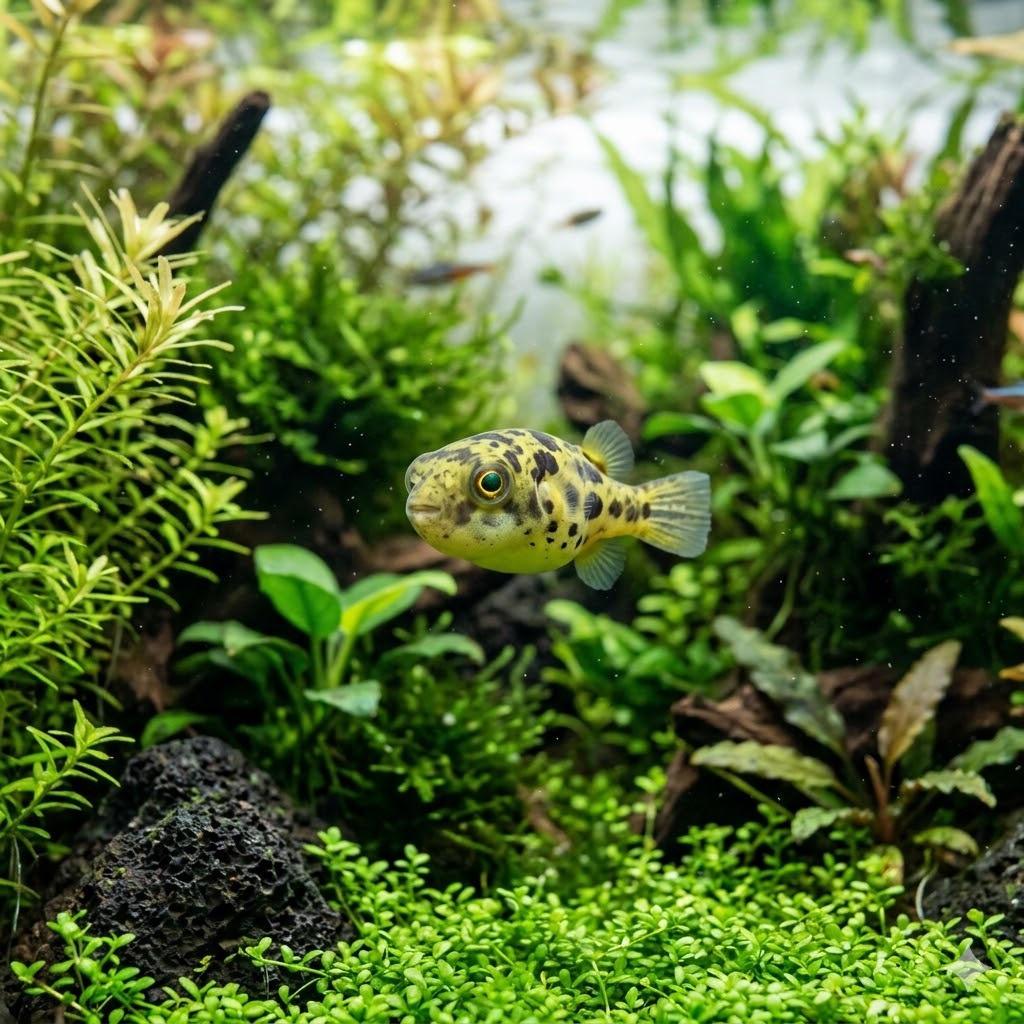
Round-bodied and tiny, with a yellow to olive-green base colour marked by dark green to black blotches along the back and sides, and a pale to white belly. They have large, independently swivelling eyes that give them an alert, expressive look. Males often show a dark line down the belly and a distinct wrinkle behind the eye, and tend to be more vividly coloured, while females are rounder and more spotted. Like all puffers they can inflate with water when badly stressed, though a well-kept fish should rarely if ever need to, and repeatedly triggering this in the aquarium is harmful rather than a party trick.
Tank Size & Setup
Minimum tank size is around 20 litres for a single fish, with roughly 20-25 litres more per additional puffer in a small group. Heavy planting is essential - use dense live plants, driftwood and rockwork to break up sightlines, because clear line of sight fuels aggression and hiding places let subordinate fish escape. Gentle filtration and gentle flow suit them, and clean, stable water is important. If keeping more than one, provide extra space and cover and watch closely for bullying; many keepers ultimately keep a single pea puffer for a peaceful tank.
Water Parameters
- Temperature: 24-28°C.
- pH: 6.5-7.5.
- Soft to moderately hard water.
- Ammonia 0, nitrite 0, nitrate low - they are sensitive to poor water.
Diet
Strict micro-predator - they will not thrive on dry pellets or flakes. Feed live and frozen meaty foods such as bloodworm, daphnia, brine shrimp and blackworm. Small pest snails are excellent, both as food and to help wear down their continuously growing beak-like teeth. A supply of tiny snails is genuinely useful for dental health. Feed small amounts regularly and remove uneaten food to protect water quality. Many keepers set up a small, separate snail-breeding container so there is always a supply of appropriately sized snails on hand, since a puffer that cannot gnaw regularly is at real risk of its teeth overgrowing. Their reliance on live and frozen food is the single biggest reason they are not a casual community purchase.
Health & Lifespan
Average lifespan is 4-5 years.
Sensitive to water quality and diet-related problems. Common concerns:
- Overgrown teeth if the diet lacks hard-shelled snails to gnaw on.
- Internal parasites - common in wild-caught stock; deworming may be needed.
- Constipation or bloating from overfeeding.
- Stress and aggression in bare tanks or when overcrowded.
- Nitrate sensitivity in under-maintained tanks.
Pros & Cons
Pros: tiny, intelligent and full of personality; interactive and rewarding to watch; true freshwater and suited to a planted nano tank. Cons: aggressive and fin-nippy, so usually species-only; needs live or frozen food and snails; not a hands-off beginner fish.
Pea Puffer - frequently asked questions
How big do they get?
About 2.5 cm - the smallest pufferfish in the world.
Can I keep them in a community tank?
Generally no. They are nippy and will harass slow or long-finned fish, so they are usually kept species-only or with very careful, well-researched tank-mates.
What do they eat?
Live and frozen meaty foods - bloodworm, daphnia, brine shrimp - plus small snails, which also help keep their teeth worn down. They will not thrive on dry food.
Do they need salt or brackish water?
No. Unlike many puffers, the pea puffer is a true freshwater fish for its whole life.
How many can I keep together?
A single fish is easiest. If keeping several, provide a larger, heavily planted tank, allow extra space per fish, and be ready to separate bullies.
🧠 Test yourself: guess the fish
Three clues from our quiz bank, each about another of our fish. Can you name them?
Clue 1.Famous for multiplying fast, these fish carry developing fry internally until the babies emerge swimming.
It's the Molly / Platy / Swordtail (Livebearers) - read the full profile →
Clue 2.This tiny, hardy aquarium fish gives birth to live young rather than laying eggs, earning it the nickname 'rainbow fish.'
It's the Guppy - read the full profile →
Clue 3.Males of this small, vividly colored labyrinth fish are so territorial that two cannot share a tank without fighting, giving rise to a fierce nickname.
It's the Betta (Siamese Fighting Fish) - read the full profile →