Pearl Gourami
The pearl gourami (Trichopodus leerii) is a graceful labyrinth fish covered in a delicate, pearl-like spotted pattern, widely regarded as one of the most beautiful and peaceful gouramis.
🗓️ Last reviewed: July 2026
Overview
The pearl gourami (Trichopodus leerii) is a graceful labyrinth fish covered in a delicate, pearl-like spotted pattern, widely regarded as one of the most beautiful and peaceful gouramis. Adults reach around 11-12 cm, and with good care they live 4-5 years. As a labyrinth fish, it can breathe air at the surface, so it needs calm, quiet water and gentle tankmates to truly settle and show its best colours.
Natural History
Pearl gouramis are native to Southeast Asia, occurring across the Malay Peninsula, Sumatra, and Borneo, with introduced populations elsewhere. They inhabit slow-moving, densely vegetated lowland waters - swamps, ponds, and sluggish streams that are often soft, acidic, and low in oxygen. To cope with these oxygen-poor conditions they evolved a labyrinth organ, an accessory breathing structure that lets them gulp air directly from the surface. This is why access to a calm, undisturbed water surface matters so much. Long a favourite in the aquarium hobby, pearl gouramis are now widely captive-bred, but they retain their preference for still, warm, plant-filled water.
Appearance
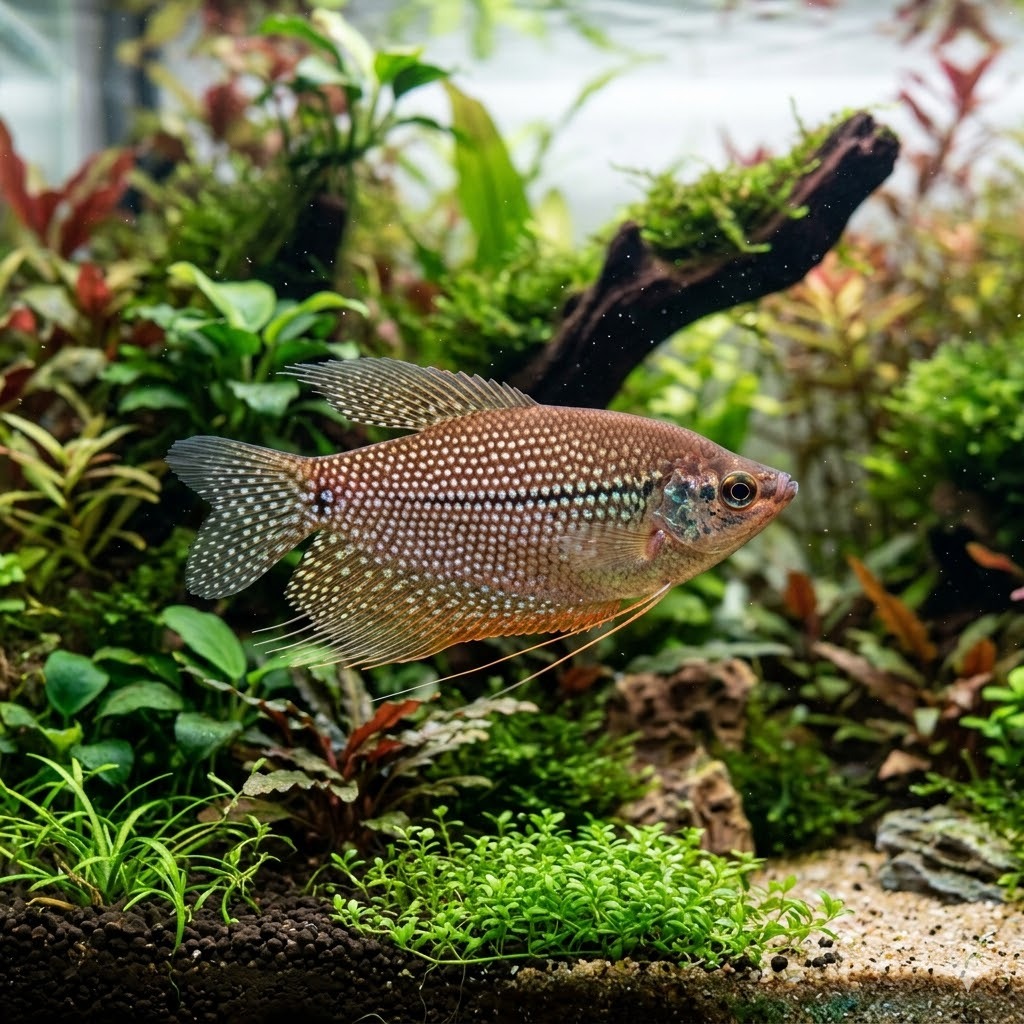
The pearl gourami is named for the fine network of pearly white spots scattered across its brownish-silver body and fins, giving it a shimmering, jewelled appearance. A dark horizontal line runs from the snout through the eye to the base of the tail. During breeding and display, mature males develop a striking deep orange-red throat and chest, along with more pointed, extended dorsal and anal fins. Females are plainer, rounder-bodied, and have shorter, more rounded fins. Like other members of its group, the pearl gourami has long, thread-like pelvic fins that it uses almost like feelers to explore its surroundings. Adults reach roughly 11-12 cm in length.
Tank Size & Setup
Because of their size and need for calm surface access, pearl gouramis should be kept in a minimum of 100 litres, with more space appreciated - especially if kept in a small group or community. A longer tank with a stable, undisturbed surface suits them far better than a tall, turbulent one.
Aim for a well-planted layout with tall stems, floating plants, and driftwood to provide cover and diffuse the light, which helps these sometimes-shy fish feel secure. Leave calm open areas at the surface for breathing and, if breeding, for the male to build his bubble nest. Keep filtration flow gentle - strong currents disturb both the fish and the surface they rely on. A tight-fitting lid is important, and because they breathe air, it helps to keep the air layer above the water warm and humid so they do not chill their labyrinth organ.
Water Parameters
- Temperature: 24-28°C.
- pH: 6.0-7.5 - soft, slightly acidic to neutral water is ideal.
- Hardness: soft to moderate, roughly 5-15 dGH.
- Ammonia 0, nitrite 0, nitrate under 30 ppm.
Pearl gouramis are fairly adaptable but show their best colour and behaviour in warm, soft, calm water that echoes their natural swamp habitat.
Diet
Pearl gouramis are omnivores and accept a wide range of foods. Offer a quality flake or pellet as a staple, and supplement with live or frozen foods such as bloodworms, brine shrimp, and daphnia, plus some vegetable matter and algae-based food. They are natural micro-predators and will appreciate small live foods, which also help bring them into breeding condition. Interestingly, pearl gouramis are among the fish reputed to eat hydra and small pest organisms. Feed modest amounts once or twice a day, only what they can finish comfortably, and vary the diet to keep them healthy and colourful.
Health & Lifespan
Average lifespan is 4-5 years.
Pearl gouramis are generally hardy and long-lived when their need for calm, warm, clean water is respected. Common concerns:
- Chilling of the labyrinth organ from cold air above the tank - keep the lid on and the room warm.
- Ich (white spot) and other stress-related parasites.
- Bacterial infections and fin problems in poor water quality or turbulent tanks.
- Stress and hiding when housed with boisterous, fin-nipping, or aggressive tankmates.
- Shyness in bare, brightly lit tanks with too little cover.
Provide gentle flow, plenty of planted cover, a warm and covered tank, and peaceful companions to keep them thriving.
Pros & Cons
Pros: beautiful pearlescent pattern, peaceful and graceful, hardy and long-lived, can breathe air so tolerant of lower-oxygen water, interesting labyrinth behaviour. Cons: can be shy and easily stressed; need a larger, calm tank with gentle flow; males may show some territoriality during breeding; not suited to boisterous or nippy tankmates.
Pearl Gourami - frequently asked questions
Can I keep just one pearl gourami?
Yes, a single pearl gourami does fine, but they show more natural behaviour in a small group. If keeping several, avoid housing multiple males in too small a space to reduce breeding-season squabbles.
Are pearl gouramis aggressive?
No, they are among the most peaceful gouramis. Males can become mildly territorial when breeding, but generally they are gentle and even a little timid.
What tankmates suit pearl gouramis?
Calm, non-nippy community fish that share their warm, soft water - larger tetras, rasboras, corydoras, peaceful barbs, and similar. Avoid fin-nippers and aggressive or very active fish.
Why does my pearl gourami keep going to the surface?
That is normal. As a labyrinth fish it breathes air from the surface, so regular trips up to gulp air are healthy behaviour, not a sign of distress.
How do I tell males from females?
Males have a deep orange-red throat and chest (especially when displaying) and longer, more pointed dorsal and anal fins; females are plainer, rounder, and have shorter fins.
Do pearl gouramis need a heater and a lid?
Yes to both. They are tropical fish needing 24-28°C, and a lid keeps the air above the water warm and humid so they do not chill their labyrinth organ, as well as reducing evaporation.
🧠 Test yourself: guess the fish
Three clues from our quiz bank, each about another of our fish. Can you name them?
Clue 1.Fancy varieties of this fish include bubble-eye and telescope-eye types bred for unusual looks.
It's the Goldfish - read the full profile →
Clue 2.This tiny schooling fish glows with an iridescent blue stripe and a red streak along its rear half.
It's the Neon Tetra - read the full profile →
Clue 3.A laterally compressed cichlid with vertical dark stripes, it forms monogamous pairs and guards its eggs on a flat leaf or surface.
It's the Angelfish - read the full profile →