California Kingsnake
The California Kingsnake (Lampropeltis californiae) is one of the hardiest, most forgiving, and most popular pet snakes in the world - an excellent beginner colubrid.
🗓️ Last reviewed: July 2026
Overview
The California Kingsnake (Lampropeltis californiae) is one of the hardiest, most forgiving, and most popular pet snakes in the world - an excellent beginner colubrid. Tough, adaptable, and generally easy to handle, it comes in a huge variety of banded and striped morphs, from classic black-and-white bands to chocolate, striped, and high-contrast designer patterns. It earns the name "king" honestly: it is a powerful feeder that readily eats other snakes, including venomous ones, in the wild. That single fact drives the golden rule of keeping one - always house it alone. Adults typically reach 90-120 cm in length.
Natural History
Wild range: California and the southwestern United States into northern Mexico, across deserts, grasslands, chaparral, farmland, and rocky hillsides. This adaptability is exactly why it thrives in captivity. California Kingsnakes are diurnal to crepuscular, active ground-dwelling hunters with a bold appetite. In the wild they prey on rodents, lizards, birds, amphibians, and notably other snakes - their resistance to rattlesnake venom lets them hunt and eat pit vipers, which is part of how they earned "king" status.
Their broad natural range and tolerance of a variety of climates translate directly into a captive animal that forgives minor husbandry mistakes better than most reptiles, which is a large part of why the species is so widely recommended for beginners. Wild California Kingsnakes shelter in rodent burrows, rock crevices, and under debris, emerging to hunt when temperatures suit them. This burrowing, hiding lifestyle is worth remembering when setting up an enclosure: a snake with good hides and a loose substrate to tunnel through will feel secure and behave naturally, whereas one with nowhere to hide may become stressed. Decades of captive breeding have made most animals in the hobby captive-bred, healthy, and well-adapted to life in a vivarium, and have produced the remarkable range of colours and patterns available today.
Appearance
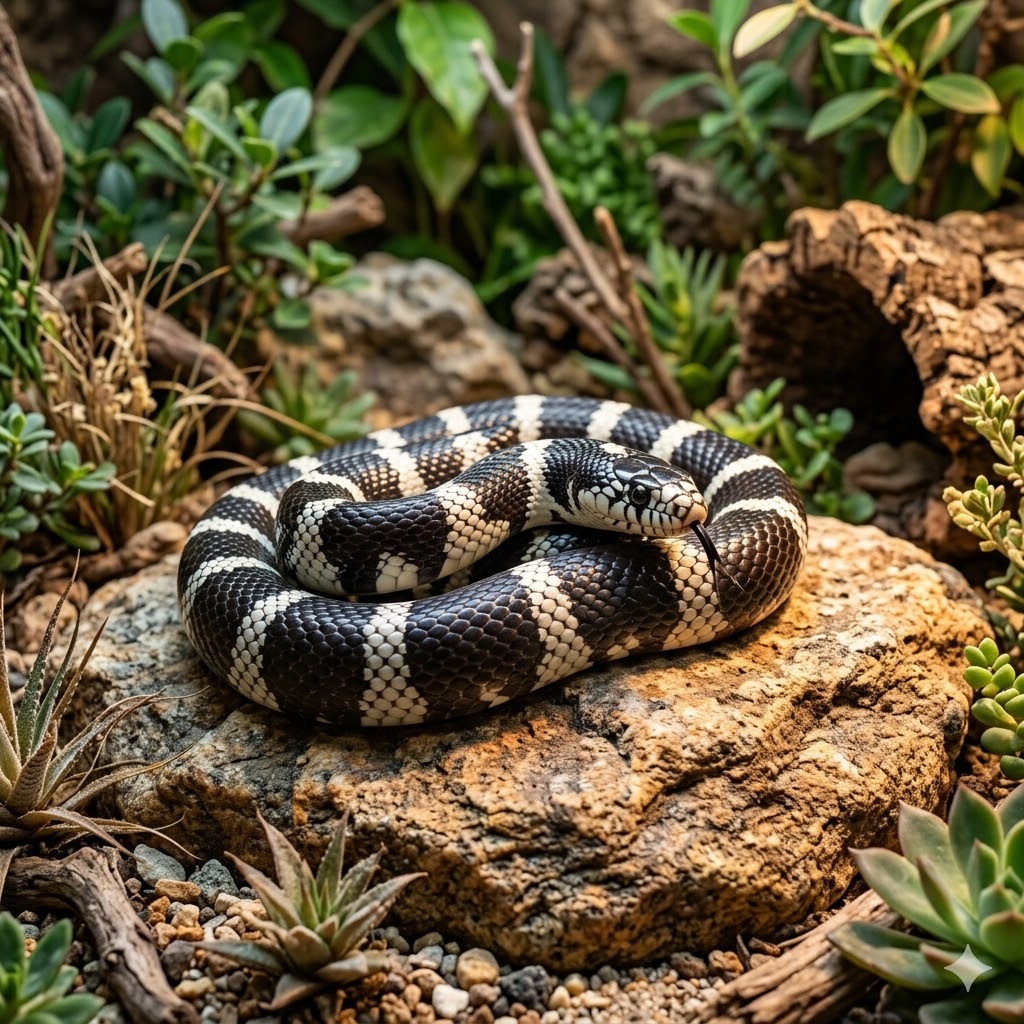
Adults commonly 90-120 cm in length, occasionally larger, with a lean, muscular, powerful body. The classic wild pattern is bold alternating bands of black or brown and white or cream, but the species shows enormous variation: banded, striped, aberrant, chocolate, high-white, and many selectively bred morphs. Their smooth scales have a glossy, polished appearance that gives the genus its name (Lampropeltis means "shiny shields"). Males and females are similar in appearance.
Temperament & Handling
Generally docile and tolerant, and among the easiest snakes to handle. Hatchlings can be feisty, quick, and prone to musking or nipping, but with regular gentle handling almost all California Kingsnakes calm into confident, easygoing adults. They are strong and inquisitive - expect an active, exploring snake rather than a limp one - so support the body fully and let it move through your hands rather than gripping it. Bites are minor. One handling caution: because they are strongly food-driven, move slowly and be deliberate at feeding time to avoid an over-eager strike at your hand. Many keepers gently tap or hook the snake first, or wash their hands to remove rodent scent, so the snake clearly distinguishes handling time from feeding time. Keep sessions relaxed and support the animal over a low, safe surface, and avoid handling right after a meal or during a shed cycle when the snake is more defensive.
Enclosure
Minimum: a 90-120 cm long enclosure for an adult; bigger is always welcome. Glass, PVC, or wood vivarium.
Provide:
- A secure, tight-fitting, well-locked lid. Kingsnakes are strong and determined escapers.
- At least two hides - warm side and cool side.
- Substrate: aspen, cypress mulch, or coconut fibre for burrowing.
- Sturdy branches and cork bark for enrichment.
- A water bowl large enough to drink from and occasionally soak in.
Heating & Lighting
- Warm side / basking zone: 28-31°C.
- Cool side: 22-24°C.
- Night: can drop to 20-22°C.
- UVB: not strictly required but low-level UVB (5-6%) supports long-term health and natural activity.
Use an overhead heat source on a thermostat and maintain a clear warm-to-cool gradient.
Humidity
Moderate and forgiving - keep humidity around 40-60%, raising it during shedding. A humid hide with damp moss helps ensure clean, complete sheds that come off in one piece. Avoid a permanently wet enclosure, which can cause scale rot and respiratory illness. A large water bowl helps maintain ambient humidity, and it is worth checking after each shed that the eye caps and tail tip have come away cleanly.
Diet
Carnivorous - a powerful rodent feeder:
- Staple: appropriately sized rodents (pinky through adult mice, or small rats for larger individuals).
- Prey size: roughly the width of the snake at its thickest point.
- Feed thawed frozen prey rather than live rodents to avoid bite injuries to the snake.
Hatchlings eat every 5-7 days; adults every 7-14 days. This species is an enthusiastic, reliable feeder - one reason it is beginner-friendly, since feeding problems are uncommon compared with fussier snakes. Crucially, because kingsnakes will eat other snakes, they must always be housed and fed alone; never keep two together, even temporarily, as one can seriously injure or consume the other in moments.
Health & Lifespan
15-20 years, sometimes longer with excellent care.
Common concerns:
- Respiratory infections from cold or damp conditions.
- Scale rot from a wet, dirty substrate.
- Retained shed and stuck eye caps if humidity is too low.
- Mites, especially after introducing new animals - quarantine.
- Regurgitation from oversized prey or handling too soon after feeding.
- Cannibalism / injury if ever housed with another snake.
Pros & Cons
Pros:
- Extremely hardy and beginner-friendly.
- Docile and easy to handle once settled.
- Huge variety of colours and patterns.
- Reliable, straightforward feeder.
- Long-lived.
Cons:
- Must always be housed alone (eats other snakes).
- Strong, determined escape artist.
- Hatchlings can be nippy and musky at first.
- Food-driven, so care needed at feeding time.
- 15-20 year commitment.
Best Suited For
- First-time snake keepers wanting a hardy, forgiving species.
- Owners who appreciate the range of available morphs.
- Anyone who can provide a genuinely escape-proof enclosure.
Not suited for owners who want to cohouse snakes, or those uncomfortable feeding whole rodents.
California Kingsnake - frequently asked questions
Why must I keep only one?
California Kingsnakes eat other snakes - it is natural behaviour and how they earned the name "king." Two housed together risks one eating the other, so always keep them alone.
Are they good for beginners?
Yes - they are among the hardiest and most forgiving pet snakes, which is a big part of their popularity.
How long do they live?
15-20 years with good care, sometimes longer.
Are they escape artists?
Very much so. They are strong and persistent, so a secure, well-fitting, locked lid is essential.
Do they bite?
Rarely as calm adults. Hatchlings may nip or musk, and any snake may strike at feeding time - move slowly around food.
🧠 Test yourself: guess the reptile
Three clues from our quiz bank, each about another of our reptiles. Can you name them?
Clue 1.Mostly plant-eating, this spiny-crested reptile can detach its tail to flee and later grow a new one.
It's the Green Iguana - read the full profile →
Clue 2.Native to Australia's arid interior, this omnivorous lizard flattens its body and flares spiny scales to look larger to predators.
It's the Bearded Dragon - read the full profile →
Clue 3.Long thought extinct, this lizard has eyelash-like fringes over its eyes and cannot regrow its tail once dropped.
It's the Crested Gecko - read the full profile →