Kenyan Sand Boa (Eryx colubrinus)
The Kenyan Sand Boa (Eryx colubrinus) is a small, stout, docile burrowing snake from East Africa and one of the best beginner snakes available.
🗓️ Last reviewed: June 2026
Overview
The Kenyan Sand Boa (Eryx colubrinus) is a small, stout, docile burrowing snake from East Africa and one of the best beginner snakes available. Spending most of its life buried in deep loose substrate, it ambushes prey from below, feeds easily on appropriately sized rodents, rarely bites, and tolerates gentle handling. With modest space needs and a lifespan often reaching 15-20 years or more, it suits keepers who want an easygoing, long-lived snake that does not demand large or elaborate housing.
Natural History
Wild range: the dry savannahs, semi-deserts, and scrublands of East Africa, including Kenya, Egypt, and surrounding regions. A fossorial (burrowing) ambush predator, it spends the day buried in loose sand or soil with only its eyes and snout exposed, waiting to strike at passing rodents and lizards from below. This buried, sit-and-wait lifestyle is central to the species and shapes how it should be kept. Its tolerance of arid conditions and a simple ambush strategy underpin its reputation as a hardy, low-fuss snake.
Appearance
Adults: females typically reach around 60 cm (about 2 ft) and are notably stout and heavy-bodied; males are smaller and more slender, often 30-45 cm. Females are the larger sex.
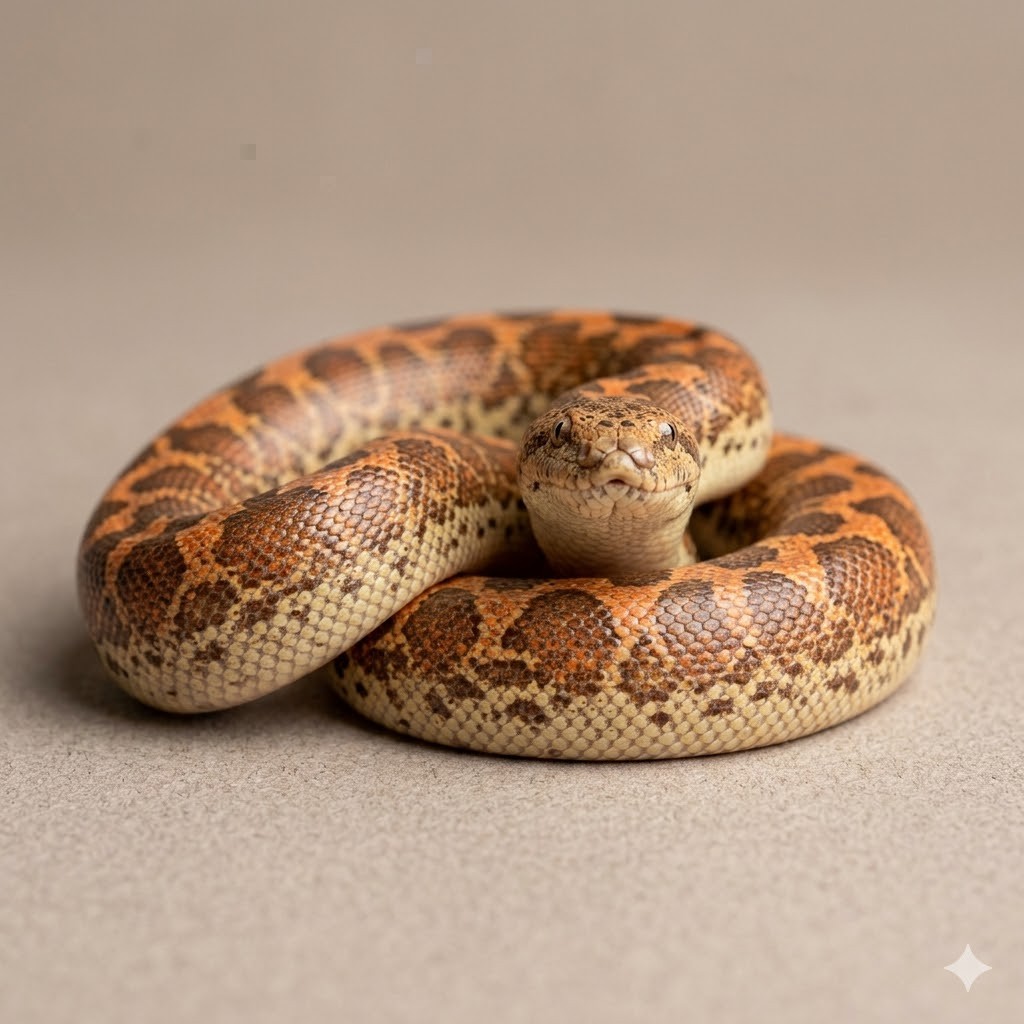
Colour and pattern: a warm orange to yellow-orange base broken by dark brown blotches running down the back, with a paler underside. The head is small and blunt with upward-set eyes and a wedge-shaped snout suited to burrowing, and the tail is short and tapered. Selective breeding has produced many colour and pattern morphs, but the classic orange-and-brown blotched look is the most familiar.
Temperament & Handling
Calm and docile, the Kenyan sand boa generally tolerates gentle, brief handling once settled. Bites are rare; this is a slow-moving, non-aggressive snake that is far more likely to try to burrow into your hands than to strike. Support the body fully and let the snake move between your hands rather than restraining it. Because it naturally stays buried, expect it to be shy and to wriggle to hide - this is normal. Avoid handling for a day or two after feeding to prevent regurgitation.
Enclosure
Minimum: a secure 60 × 30 cm (about 20-gallon) floor-space enclosure for one adult; floor area matters more than height for this ground-dwelling species. A low, horizontally oriented glass or PVC enclosure suits it well.
Provide:
- A deep layer of loose, dry substrate (at least 8-10 cm) such as aspen shavings or sand the snake can burrow into completely.
- A secure, tight-fitting and lockable lid - these are determined, surprisingly strong escape artists.
- A hide at both the warm and cool ends, though a deep substrate is the main security.
- A shallow, sturdy water dish that cannot be tipped or buried.
Heating & Lighting
- Warm end / basking zone: 32-35°C surface temperature, ideally from an under-tank heat mat on a thermostat at one end.
- Cool end: 24-27°C, giving a clear thermal gradient so the snake can self-regulate by moving through the substrate.
- Night: a mild drop is fine; do not let the warm end fall below the low twenties.
- UVB: not required for this nocturnal, buried species, though low-output UVB can be offered. Always use a thermostat to prevent overheating and burns.
Humidity
Low ambient humidity, roughly 30-50%, matching its arid origins. Keep the substrate dry; persistently damp or wet conditions cause scale rot and respiratory problems in this desert species. A slightly more humid hide or light misting can be offered during a shed if the snake struggles to shed cleanly, but the enclosure should dry out fully between.
Diet
Carnivorous. Fed simply on whole rodents:
- Staple: appropriately sized mice (or rat pups for large females) - prey roughly the width of the snake at its widest point.
- Frequency: every 7-14 days; younger snakes more often, adults less.
- Form: thawed, pre-killed (frozen-thawed) rodents are safest and readily accepted, often taken as the snake strikes from beneath the substrate.
Feeding is easy and one of the species' main appeals. Avoid overfeeding, which is a common cause of obesity in adults. Provide fresh water at all times.
Health & Lifespan
15-20+ years.
Common concerns:
- Obesity from overfeeding - one of the most frequent issues.
- Scale rot and respiratory infection from substrate kept too damp.
- Retained shed, especially around the eyes and tail, in overly dry conditions.
- Mites.
- Mouth rot.
- Thermal burns from unregulated heat sources without a thermostat.
For any signs of illness, consult a reptile or exotics vet rather than attempting to treat at home.
Pros & Cons
Pros:
- Docile and beginner-friendly.
- Small, with modest space needs.
- Simple, easy feeding on rodents every 1-2 weeks.
- Hardy and very long-lived.
Cons:
- Stays buried, so it is more for watching occasionally than constant interaction.
- A determined escape artist - the lid must be secure.
- Needs dry conditions and careful heat regulation.
- 15-20+ year commitment.
Best Suited For
- First-time snake owners.
- Keepers with limited space.
- Those wanting a low-maintenance, long-lived snake.
Not suited for owners wanting a large, visible, or frequently handled snake, or homes that cannot keep the enclosure dry and securely closed.
Kenyan Sand Boa (Eryx colubrinus) - frequently asked questions
Are they good for kids?
Yes, for older children with supervision. They are docile and slow-moving, though their habit of burrowing and wriggling calls for calm, gentle handling.
Do I need UVB?
No. As a nocturnal, buried species it does well without UVB, though low-output UVB can be offered if you wish.
How long do they live?
Often 15-20 years or more with good care. Plan for a long commitment.
Why is my snake always hidden?
That is completely normal. Kenyan sand boas are ambush predators that spend most of their time buried, surfacing mainly to feed or explore at night.
Do they bite?
Rarely, and bites are mild. They are far more likely to burrow into your hands than to bite.
🧠 Test yourself: guess the reptile
Three clues from our quiz bank, each about another of our reptiles. Can you name them?
Clue 1.This slender egg-laying snake earns farmers' favor by hunting mice in grain stores, and is closely related to the rat snakes.
It's the Corn Snake - read the full profile →
Clue 2.Often sold tiny but reaching over five feet, this tree-dwelling herbivore is a far bigger commitment than buyers expect.
It's the Green Iguana - read the full profile →
Clue 3.This nonvenomous constrictor earns its royal name by hunting and eating other snakes, even venomous ones.
It's the King Snake / Milk Snake - read the full profile →