Musk Turtle
The Musk Turtle (Sternotherus species) is one of the best small aquatic turtles for the home aquarium - tiny, tough, and endlessly entertaining as it patrols the bottom of its tank.
🗓️ Last reviewed: July 2026
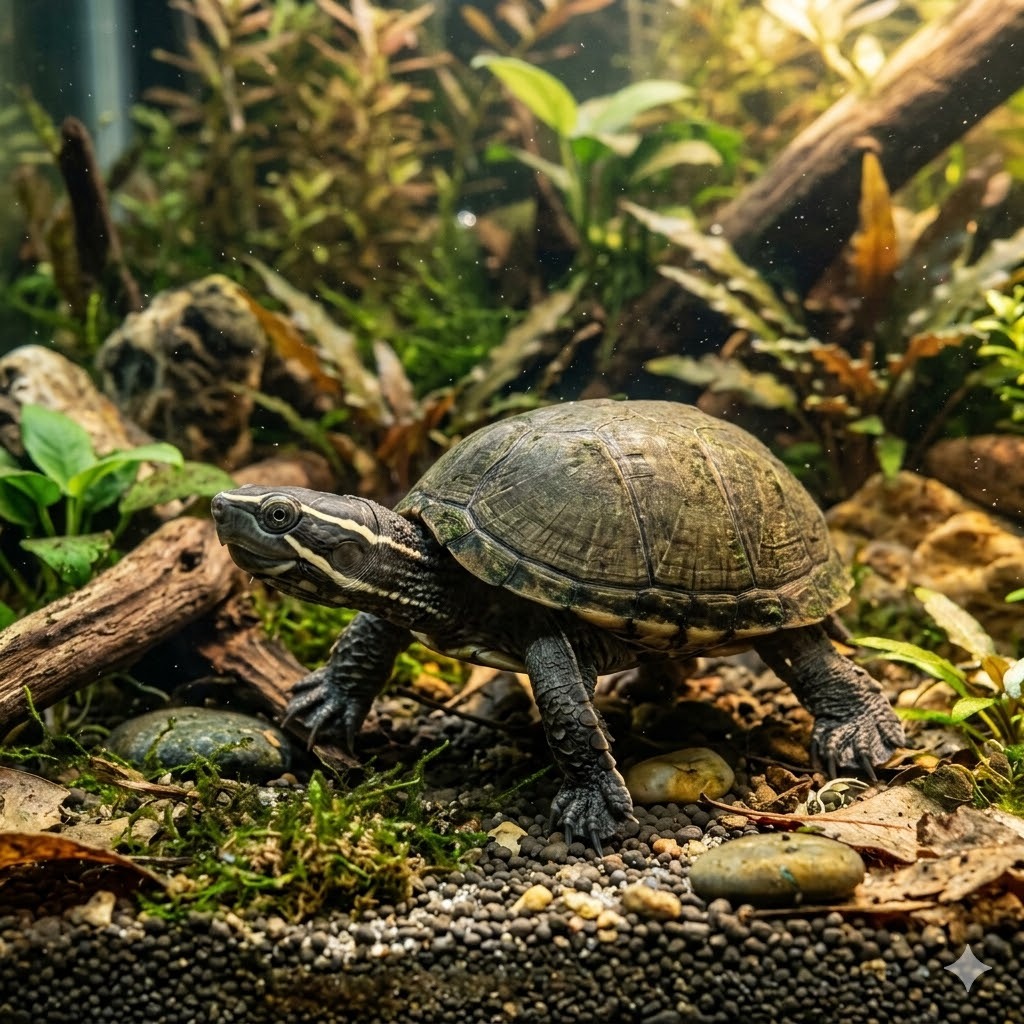
Overview
The Musk Turtle (Sternotherus species) is one of the best small aquatic turtles for the home aquarium - tiny, tough, and endlessly entertaining as it patrols the bottom of its tank. Nicknamed the "stinkpot" for the musky odour it releases when frightened, this little North American turtle stays palm-sized for life, tolerates a modest setup, and rewards patient keepers with quirky, curious behaviour. It is a genuinely aquatic species that spends most of its day walking along the substrate rather than swimming in open water, which shapes almost every decision about its care.
Natural History
Musk Turtles are native to the eastern and central United States and southern Canada, where they live in slow-moving rivers, ponds, swamps, and shallow lake margins. They favour soft-bottomed, densely vegetated water they can walk across rather than swim through. Largely nocturnal and crepuscular, they forage along the bottom at dusk and after dark. The common Musk Turtle (Sternotherus odoratus) is the species most often kept, though the razorback and loggerhead musk turtles appear in the hobby too. When threatened, they discharge a foul musk from glands near the shell - a defence that gives them their less flattering name. In the wild they spend long stretches submerged, walking the bottom in search of food, and only occasionally haul out to bask, which is exactly the pattern a good captive setup should allow.
Appearance
Adults reach only 7-13 cm shell length, with the common musk turtle at the smaller end. Weight is modest, generally under 250 g. The carapace is domed, dark brown to black, often coated in algae in older animals. Two pale yellow stripes typically run along each side of the head, and small fleshy barbels dangle from the chin and throat. The plastron (belly shell) is small and reduced, leaving the legs comparatively exposed. Males have longer, thicker tails and rougher scale patches on the hind legs. This is a species that stays small for its entire life, which is a large part of its appeal.
Temperament & Handling
Musk Turtles are bold, active, and personable in the water, but they are not cuddly. They do not enjoy being picked up and will readily extend that surprisingly long neck to deliver a firm bite - the mouth can reach nearly back to the hind legs, so there is no truly safe place to grip. Handle only when necessary, support the body from below and behind, and keep fingers clear of the head. They are best treated as a display animal to observe rather than a pet to hold. With time they learn to associate their keeper with food and will beg at the glass, which is where most of the personality shows.
Enclosure
Minimum: 75-90 cm long aquarium (roughly 75-115 litres) for one adult. Larger is always better.
Provide:
- Shallow water. Because they are bottom-walkers and weak swimmers, water depth should let the turtle reach the surface for air easily - a common guideline is depth no more than one and a half to two times the shell length for youngsters, increasing gradually as they gain confidence.
- Easy exits and resting spots. Driftwood, rock stacks, and sloping decor let the turtle climb toward the surface without exhausting itself.
- A basking platform or cork raft that lets the whole turtle leave the water and dry off.
- Sturdy filtration. Turtles are messy; a canister or strong internal filter rated well above the tank volume keeps the water clean.
- Live or silk plants and hides for security.
- A fine sand or bare-bottom base; avoid gravel small enough to swallow.
Heating & Lighting
- Water temperature: 22-26°C for adults, kept stable with a guarded aquarium heater.
- Basking surface: 30-32°C under an overhead basking bulb.
- Ambient air above the water: warm and draught-free.
- UVB: required. A UVB tube or bulb over the basking area supports shell and bone health; replace it on schedule as output fades.
Keep a clear temperature gradient between the warm basking spot and the cooler water so the turtle can regulate itself.
Humidity
As an aquatic species, ambient humidity is a non-issue - the concern is water quality and depth rather than air moisture. Keep water clean, well filtered, and partially changed on a regular schedule, and make sure the turtle can always reach the surface and a dry basking spot.
Diet
Carnivorous-leaning omnivore. Musk Turtles are enthusiastic bottom foragers:
- Staple: quality aquatic turtle pellets.
- Protein: earthworms, bloodworms, snails, crickets, small pieces of fish, and shrimp.
- Occasional: leafy greens and aquatic plants, which some individuals nibble.
- Avoid: fatty meats, processed human food, and constant feeder fish.
Snails and other shelled prey help wear down the beak and provide calcium. Offer a cuttlebone in the tank for extra calcium. Juveniles eat daily; adults every other day or a few times weekly, in portions they finish in a few minutes. Vary the menu rather than relying on one food, since a monotonous diet can lead to nutritional gaps over the turtle's long life. Uneaten food should be removed promptly, because leftovers foul the water quickly and undo the work of the filter.
Health & Lifespan
30-50 years, sometimes longer with excellent care - this is a decades-long commitment despite the turtle's small size.
Common concerns:
- Shell rot and fungal infections from poor water quality.
- Metabolic bone disease from inadequate UVB or calcium.
- Respiratory infections from cold or dirty water.
- Overgrown beak without hard-shelled prey.
- Retained shed on the shell scutes.
- Injury from drowning risk if water is too deep with no easy surface access.
Pros & Cons
Pros:
- Stays tiny for life.
- Hardy and forgiving of beginner mistakes.
- Fascinating, active bottom-walking behaviour.
- Modest tank footprint compared with other turtles.
- Long-lived companion.
Cons:
- Will bite and can release musk when stressed.
- Not a handling pet.
- Messy - demands strong filtration.
- Decades-long commitment.
- Weak swimmer, so water depth must be managed carefully.
Best Suited For
- Aquarium hobbyists who enjoy watching rather than handling.
- Keepers wanting a small, hardy turtle in limited space.
- Patient owners ready for a multi-decade commitment.
Not suited for anyone wanting a turtle to hold, or unwilling to maintain filtered aquatic setups.
Musk Turtle - frequently asked questions
Do they really smell?
Only when frightened. A settled, well-kept musk turtle rarely releases musk, and the odour fades quickly. The nickname is worse than the reality.
Can they swim?
They are weak swimmers and prefer to walk the bottom. Keep water shallow enough that they can reach the surface easily, with plenty of climbable decor.
How long do they live?
30-50 years or more. Plan for a very long-term pet despite the small size.
Do they bite?
Yes. That long neck reaches surprisingly far, and bites are firm. Handle sparingly and keep fingers away from the head.
How big a tank do they need?
A 75-90 cm aquarium suits one adult, with strong filtration and a basking spot. Bigger is always better.
🧠 Test yourself: guess the reptile
Three clues from our quiz bank, each about another of our reptiles. Can you name them?
Clue 1.This spotted desert lizard is a top beginner reptile and, unusually for geckos, has movable eyelids.
It's the Leopard Gecko - read the full profile →
Clue 2.This stocky Australian lizard gapes its mouth to flash a startling cobalt-colored mouth-organ at predators when threatened.
It's the Blue-Tongue Skink - read the full profile →
Clue 3.This small Central Asian tortoise is the only one of its genus with four toes, not five, on each front foot.
It's the Russian Tortoise - read the full profile →